By [Riley/DANSKER Team], Senior Marketing & Engineering Specialist
One of the most significant shifts in our Industrial Design (ID) recently has been the adoption of 2.5D curved glass.
While standard flat displays have been the industry baseline for years, the demand for a more “smartphone-like” experience in the cabin is driving change. Here is a deep dive into the engineering, market dynamics, and future of 2.5D displays in the automotive electronics sector.
1. What is a 2.5D Curved Screen?
In the world of automotive optics, “2.5D” refers to the cover glass, not the underlying display panel. The LCD or OLED panel remains perfectly flat to prevent image distortion. However, the protective glass on top undergoes an additional precision-grinding process.
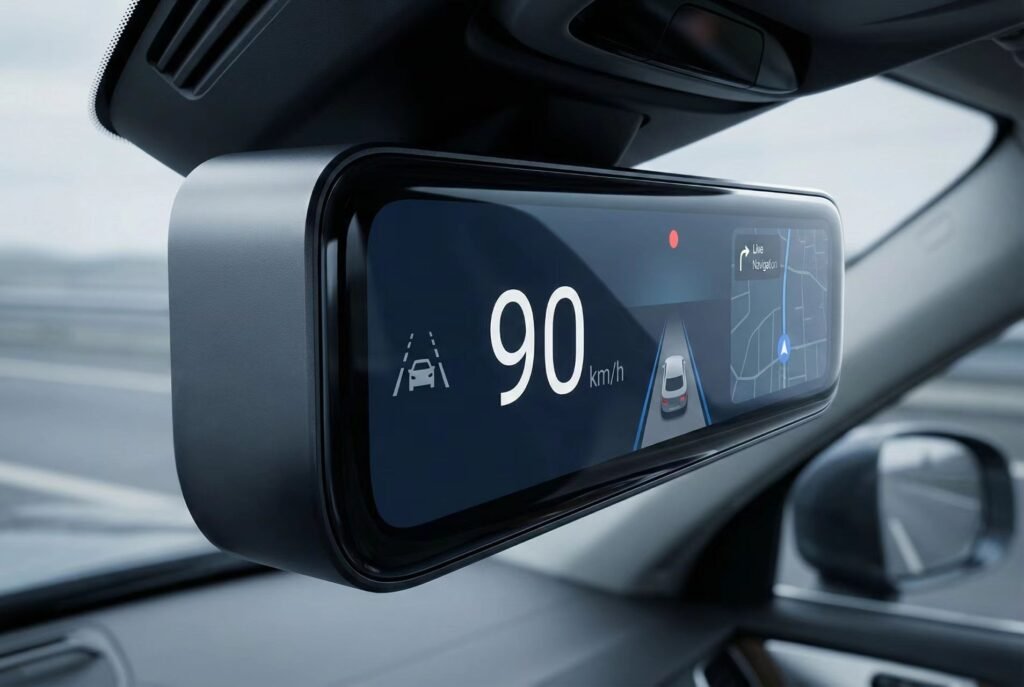
Unlike 2D glass (which is flat with 90-degree edges) or 3D glass (which is contoured across the entire surface), 2.5D glass features a flat central viewing area with slightly rounded, polished edges. This creates a seamless “waterfall” transition into the device’s frame.
2. Market Penetration: US & EU (2022–2025)
In the Western markets (US/EU), where DANSKER primarily operates, the adoption of 2.5D screens has seen a steady climb, particularly in the premium segment.
- 2022: ~5–8%. Primarily found in ultra-high-end “Boutique” dash cams.
- 2023–2024: ~12–18%. A surge driven by the popularity of Streaming Rearview Mirrors.
- 2025 (Projected): ~22–25%. As manufacturing costs for contoured glass stabilize, we are seeing it trickle down from flagship mirrors to high-end 4K compact units.
3. Why Flat Screens (2D) Still Rule the Mainstream
Despite the beauty of 2.5D glass, the “Traditional Flat” display remains the volume leader for several engineering and practical reasons:
- Optical Integrity & Glare: In a vehicle, light enters from 360 degrees. Curved edges can catch sunlight and create “edge glare,” which is distracting for drivers. Flat glass is easier to treat with AG (Anti-Glare) and AR (Anti-Reflection) coatings.
- Interior Consistency: Most dashboards and windshields are designed with utilitarian, flat geometries. A flat dash cam often “disappears” better into the OEM (Original Equipment Manufacturer) look.
- BOM Costs: 2.5D glass requires CNC edge-grinding and longer polishing cycles, increasing the Bill of Materials (BOM) cost by roughly 15–30% compared to standard tempered glass.
- Durability & Screen Protectors: Flat glass is inherently more resistant to corner impacts and is much easier for consumers to fit with aftermarket screen protectors.
4. The Value Proposition of 2.5D Curved Glass
So, why do we use it? At DANSKER, we prioritize 2.5D for specific product lines because:
- Haptic UX: For touch-screen units, 2.5D glass provides a superior “swipe-in” feel. Your finger doesn’t catch on a sharp edge when navigating menus.
- Aesthetic Integration: It mimics the design language of modern smartphones (iPhone/Samsung) and high-end infotainment systems, making the dash cam feel like a premium tech gadget rather than a cheap plastic accessory.
- Visual Depth: The slight curvature creates an “Infinity Screen” effect, making the bezels appear thinner than they actually are.
5. Why the “Streaming Mirror” loves 2.5D
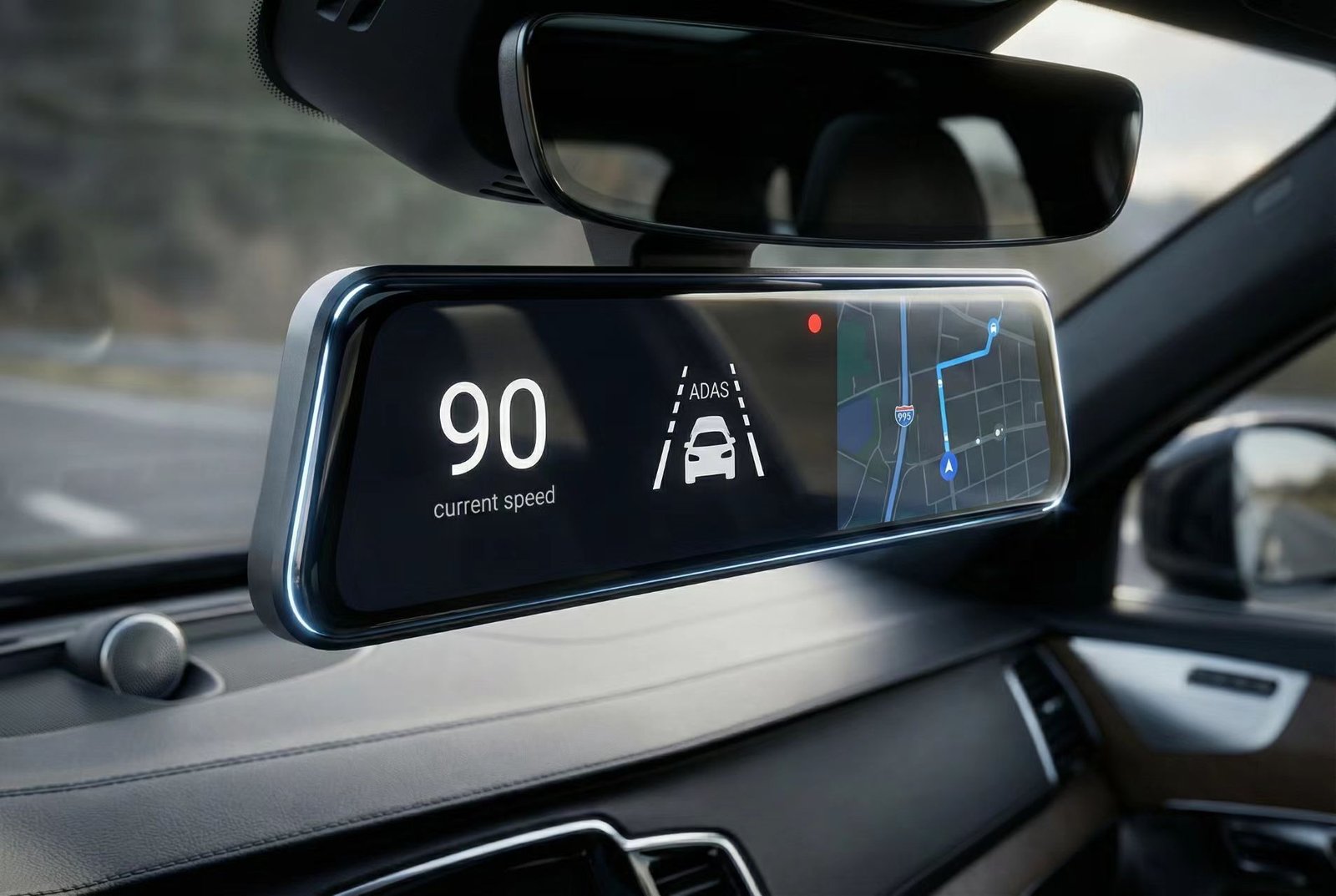
You’ve likely noticed that 2.5D is most common in Streaming Rearview Mirror Dash Cams. This is intentional. Since these devices replace the physical mirror, they occupy a central focal point in the car.
- Edge-to-Edge Aesthetics: A mirror needs to look like a mirror. 2.5D glass allows the display to blend into the housing, providing a “full-screen” look that flat glass cannot achieve without looking “boxy.”
- Safety: The rounded edges are safer in the event of an interior impact, as there are no sharp 90-degree glass perimeters near the driver’s head level.
6. The Future Trend: Is 2.5D Here to Stay?
Yes, but only for specific categories. The future of 2.5D glass lies in Smart Mirror systems and Large-format 4K touch units. For professional, “screenless” recorders (hidden behind the mirror), flat glass or no glass will remain the standard. However, as cars move toward the “Digital Cockpit” era, consumers expect their dash cams to match the sleek, curved aesthetic of their Tesla or Mercedes-Benz MBUX displays.
Engineer’s Summary: The Intersection of Form and Function
From a pure R&D perspective, the shift toward 2.5D curved glass isn’t just an aesthetic whim—it’s a response to the “Smartphone-ification” of the automotive cockpit. As we design the next generation of DANSKER hardware, we recognize that the HMI (Human-Machine Interface) experience starts before the screen even turns on.
While 2.5D glass presents challenges in thermal expansion management and optical refraction at the edges, the payoff in User Experience (UX) and structural “hand-feel” is undeniable. It transforms a dash cam from a mere utility tool into a seamless component of the modern vehicle’s interior. For the US and European markets, where build quality is often the deciding factor in brand loyalty, 2.5D glass is no longer a luxury—it is becoming the baseline for excellence.
Drive the Future: Experience the DANSKER Difference
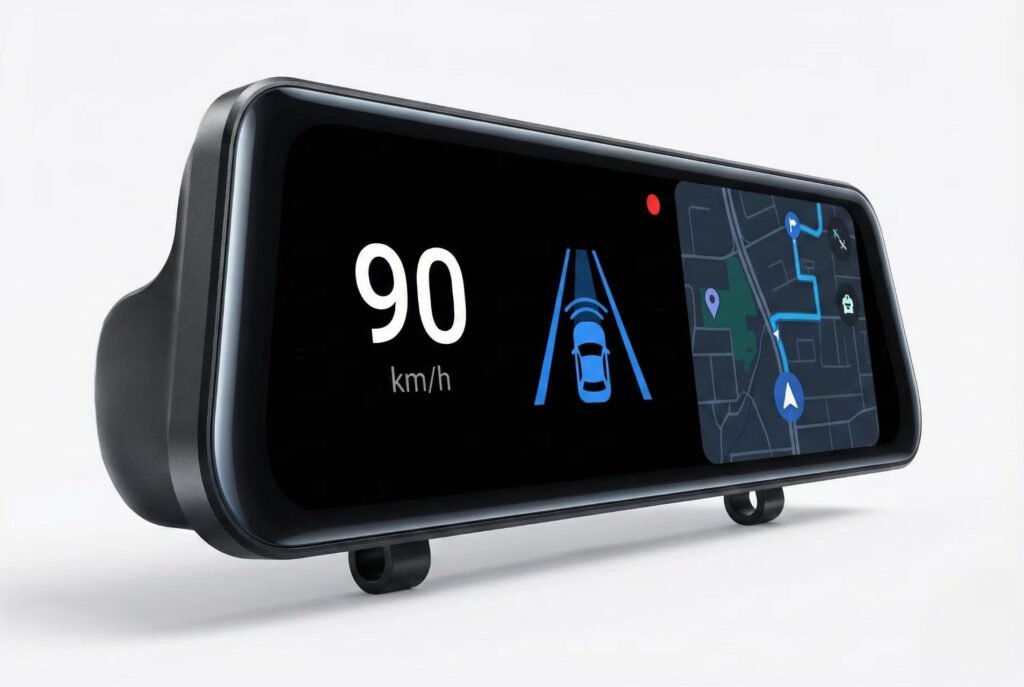
Precision in every pixel, elegance in every curve. Elevate your driving vision with our latest 2.5D streaming solutions.