Unpacking the engineering behind Front Car Moving Detection and BCW—and why your next dash cam needs them.
In the world of automotive electronics, there is a massive difference between a device that simply records video and a system that actively understands the road. As engineers with a decade of experience in vehicle telematics and safety systems, we at DANSKER know that the future of driving isn’t just about pixel resolution—it’s about Computational Perception.
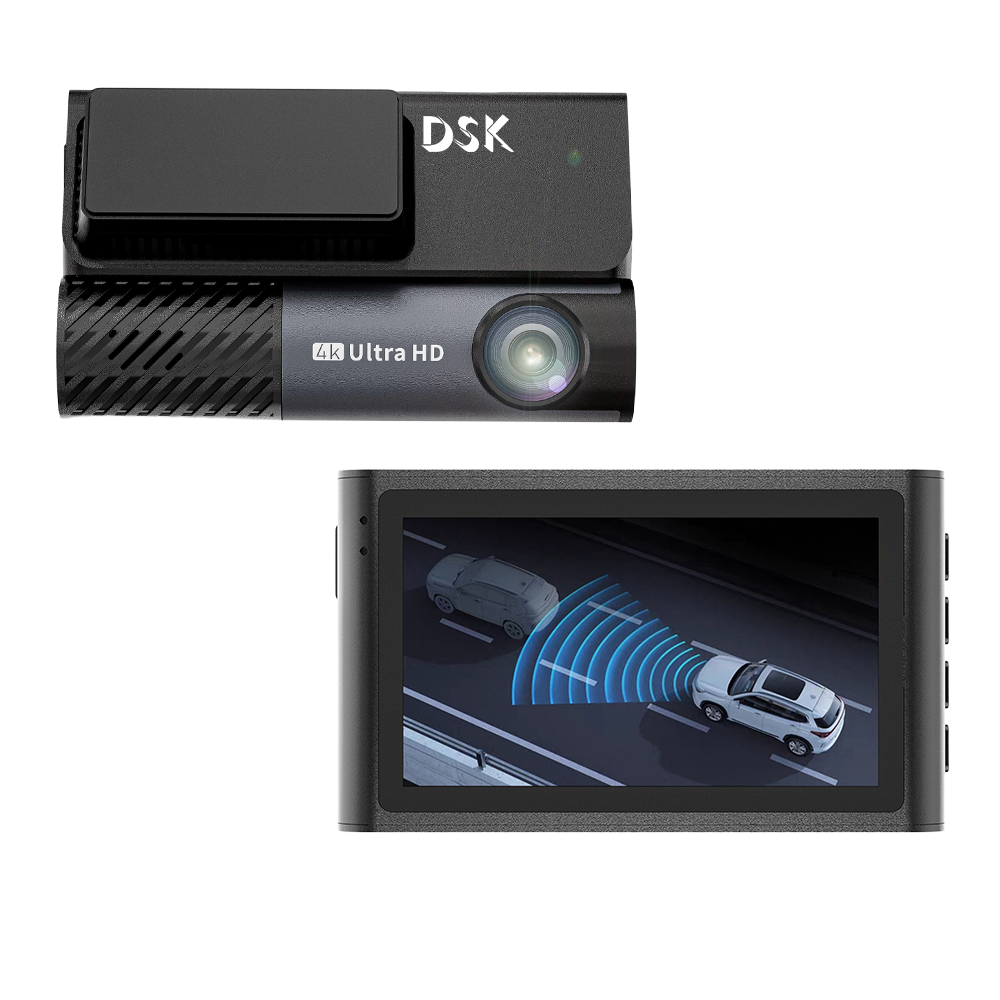
Our latest AI-powered Dash Cam doesn’t just watch the road; it analyzes it. By integrating Advanced Driver Assistance Systems (ADAS) directly into the device, we bring premium vehicle safety features to any car, regardless of its make or model year.
Today, we are diving deep into two specific features: Front Car Moving Detection (FCMD) and Blind-Spot Collision Warning (BCW). Here is how they work, and why they add critical value to your daily commute.
1. Front Car Moving Detection (FCMD)
The “Stop-and-Go” Specialist
In heavy city traffic, driver attention often drifts during red lights or gridlock. FCMD acts as your digital “tap on the shoulder.”
The Engineering Logic: Unlike standard motion detection which reacts to any pixel change, our AI algorithm is trained to recognize the specific visual signature of a vehicle’s rear profile.
- Perception: Using the high-definition front optical sensor (camera), the system calculates the “Optical Flow.” It monitors the distance and relative velocity of the vehicle directly ahead.
- Trigger Conditions: The system activates when the “Ego-Vehicle” (your car) is static (0 km/h) or creeping (<5 km/h).
- The Algorithm: When the lead vehicle initiates acceleration and creates a displacement gap (typically verified within 0.5–2 seconds), and your vehicle remains stationary, the ECU triggers a Human-Machine Interface (HMI) alert—a soft chime or visual cue.
How is this different from Forward Collision Warning (FCW)? This is a common point of confusion.
- FCW is about high-speed safety; it warns you if you are about to crash into someone.
- FCMD is about traffic efficiency and convenience. It does not assess collision risk; it assesses traffic flow.
The User Value:
- Eliminate “Green Light Anxiety”: Never be the driver getting honked at because you didn’t notice the light turned green.
- Reduce Distraction: If you glance at your navigation or check a mirror while stopped, FCMD ensures you snap back to attention the moment traffic moves.
- Seamless Integration: It is purely an advisory system. It respects your control and does not intervene with braking or throttle, ensuring a natural driving experience.
2.The Engineering Core: How BCW Works


Unlike standard motion detection, the Bumper Collision Warning system is a complex interplay of Perception, Computation, and Feedback. It is designed specifically to cover the “blind zone” immediately in front of your vehicle (1–3 meters)—a blind spot that costs drivers millions in repairs every year.
Here is the technical breakdown of the workflow inside the DANSKER system:
1. The Perception Layer: Precision Data Acquisition
The system utilizes a sensor fusion approach to map the immediate environment:
- Ultrasonic Sensing: The core relies on high-frequency acoustic echolocation. By continuously emitting sound waves, the sensor measures the “Time-of-Flight” (ToF) for the wave to bounce back from obstacles like curbs, stone pillars, or bumpers. This provides granular distance data.
- AI Vision (Short-Range Optical): While radar measures distance, our AI-enhanced optics identify what the object is. The short-range camera feed is processed to distinguish between a solid hazard (like a concrete bollard) and a soft, non-threat (like a drifting plastic bag), drastically reducing false alarms.
2. The Computing Layer: Real-Time Risk Analysis
Data is nothing without interpretation. The sensor inputs are fed into the system’s dedicated Neural Processing Unit (NPU).
- Data Fusion: The processor pulls vehicle speed data (via GPS or CAN Bus integration) and combines it with the obstacle distance.
- TTC Calculation: The system calculates the Time-to-Collision (TTC).
- Logic: If your speed is ≤15km/h (Low-Speed/Parking Mode) and the TTC drops below 1.5 seconds, the system flags a “Critical Risk.”
- Static vs. Dynamic: It detects both static threats (a wall <30cm away) and dynamic threats (a car backing toward you).
3. The Feedback Layer: The Human-Machine Interface (HMI)
Since this system focuses on warning rather than active braking (differentiating it from AEB), the alert mechanism is crucial.
- Auditory: A graded frequency buzzer. The closer the danger, the faster the beep, mimicking the intuitive response of factory-installed parking sensors.
- Visual: The DANSKER dash cam screen overlays a “Red Alert” icon with precise distance metrics, allowing you to gauge the gap down to the centimeter.
The User Value:
You might ask, “I’m a good driver; why do I need this feature in my dash cam?”
From a professional standpoint, integrating BCW into a dash cam with AI algorithms transforms the device from a passive recorder into an active co-pilot. Here is the tangible value this brings to your daily drive:
1. Eliminate the “Cost of Convenience”
The majority of insurance claims are for low-speed impacts—scraped bumpers, cracked headlights, and parking lot fender benders. These incidents usually fall below the deductible or aren’t worth the insurance hike, meaning you pay out of pocket.
- The Benefit: DANSKER’s BCW acts as a financial firewall. By alerting you to that low-profile bollard or the trailer hitch of the truck in front of you, it prevents the damage before it happens. It pays for itself by preventing just one scratch.
2. Navigate “Urban Canyons” with Confidence
Modern car designs prioritize aerodynamics and crash safety, which often results in higher hood lines and reduced near-field visibility. You literally cannot see the first meter in front of your bumper.
- The Benefit: Our system acts as your digital eyes. Whether you are inching through a narrow European alleyway or navigating a tight underground parking spiral, the BCW gives you spatial awareness that human vision simply cannot provide.
3. Smarter Alerts, Less Noise
Generic ADAS systems are notorious for beeping at everything. Because DANSKER utilizes AI-driven object classification, our BCW is tuned to ignore “soft” targets.
The DANSKER Philosophy: Why Retrofit ADAS?
You might ask, “Why do I need this in a dash cam?”
From an engineering perspective, modernizing a vehicle’s electronic architecture is difficult and expensive. DANSKER solves this by putting the “brains” of a luxury car into a portable, easy-to-install device.
By combining FCMD and BCW, we are not just selling you a camera; we are providing a predictive safety layer.
- FCMD saves you time and embarrassment in the city.
- BCW saves you from danger on the road.
This is the power of AI-driven automotive electronics. It is not just about recording the aftermath of an incident; it is about using technology to prevent the incident from happening in the first place.
Drive Smarter. Drive Safer. Choose DANSKER.