By: [William/Senior Engineering Lead at DANSKER]
In the realm of automotive consumer electronics, we often hear “4K” or “High Definition” as primary marketing buzzwords. However, from an Electronic Engineering (EE) perspective, resolution is rarely the bottleneck in critical moments. The real challenge lies in Dynamic Range.
As vehicles navigate the unpredictable “edge cases” of real-world environments—from the blinding glare of a sunset to the light-starved corridors of a midnight highway—the ability of a Dash Cam to resolve detail is determined by its High Dynamic Range (HDR) capabilities.
The Engineering Reality: Why 60dB is Not Enough
The human eye is a biological marvel, capable of perceiving a dynamic range of roughly 120dB. In contrast, a standard CMOS Image Sensor (CIS) without HDR typically caps out at 60-70dB.
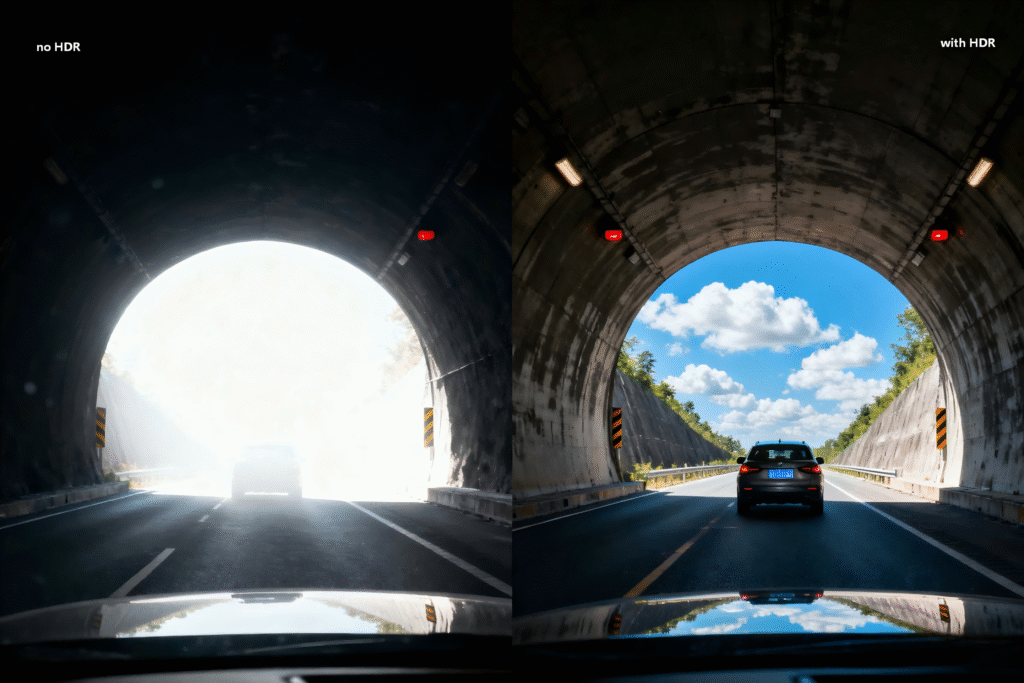
In automotive applications, we encounter extreme contrast ratios. For instance, exiting a dark tunnel into high-noon sunlight creates a delta exceeding 100dB. Without HDR, the ISP (Image Signal Processor) is forced to choose: expose for the tunnel (blowing out the exit into a white void) or expose for the sunlight (rendering the tunnel pitch black). In either scenario, critical forensic evidence—like a license plate or a pedestrian—is lost to “clipping.”
Hardware HDR vs. Software Simulation
As engineers, we distinguish between Software WDR (Wide Dynamic Range) and True Hardware HDR (such as DOL-HDR or Staggered HDR):
- Staggered/DOL-HDR: The sensor captures multiple exposures (short, medium, and long) on a line-by-line basis. These are fused by the ISP at the pixel level with minimal latency.
- The Advantage: This hardware-level integration significantly reduces motion artifacts (ghosting). For a vehicle traveling at 70 mph, a standard multi-frame HDR might blur a license plate; hardware-level HDR maintains edge sharpness even at high velocities.
Navigating Critical Scenarios: A Multi-Vehicle Analysis
1. The “Golden Hour” & Tunnel Transitions
For passenger cars, the most dangerous moments occur during rapid illumination changes. HDR prevents “white-out” during tunnel exits and “black-out” when driving directly against a low-hanging sun. By utilizing Local Tone Mapping, the HDR algorithm preserves the texture of the road and the legibility of signage simultaneously.
2. Nighttime Glare & High-Beam Suppression
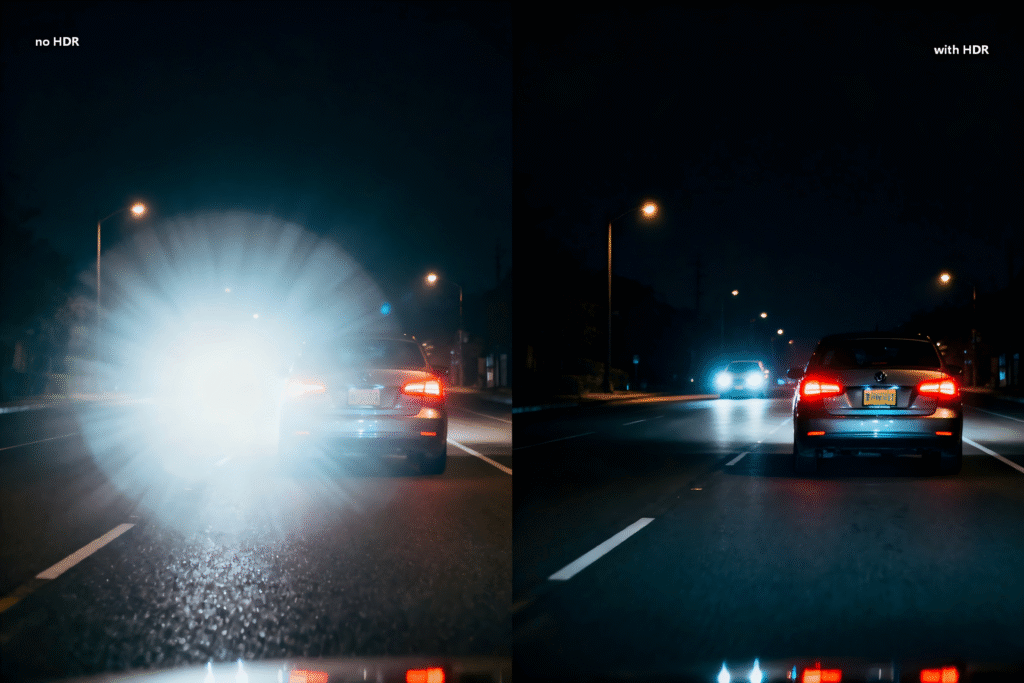
Night driving introduces the “High-Beam Challenge.” When a trailing vehicle or oncoming traffic uses high-intensity discharge (HID) or LED lamps, the light overwhelms the sensor’s photodiode capacity. HDR suppresses these highlights, preventing light blooming and ensuring that the perpetrator’s plate remains visible amidst the glare.
3. Adverse Weather: Rain, Fog, and Particulates
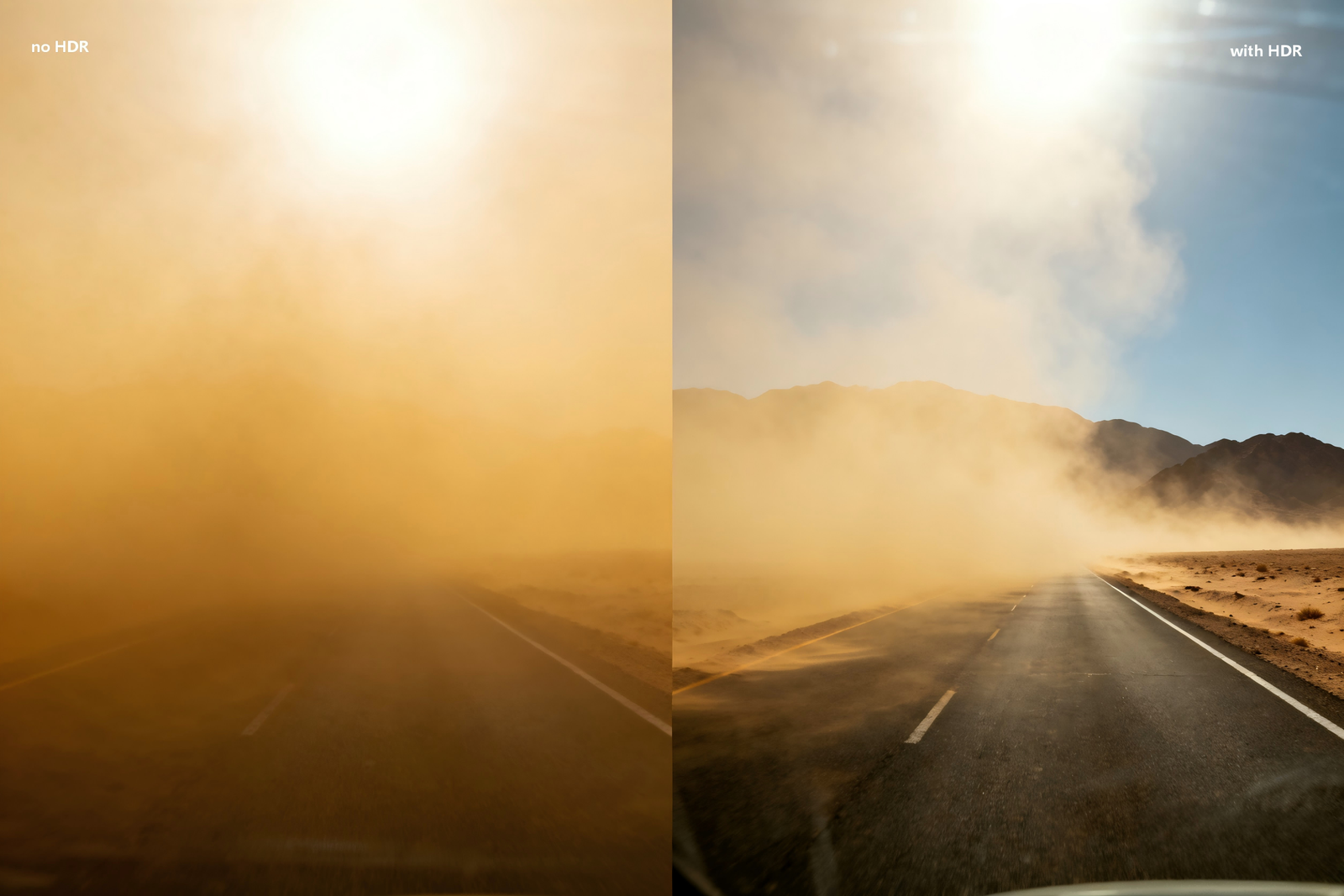
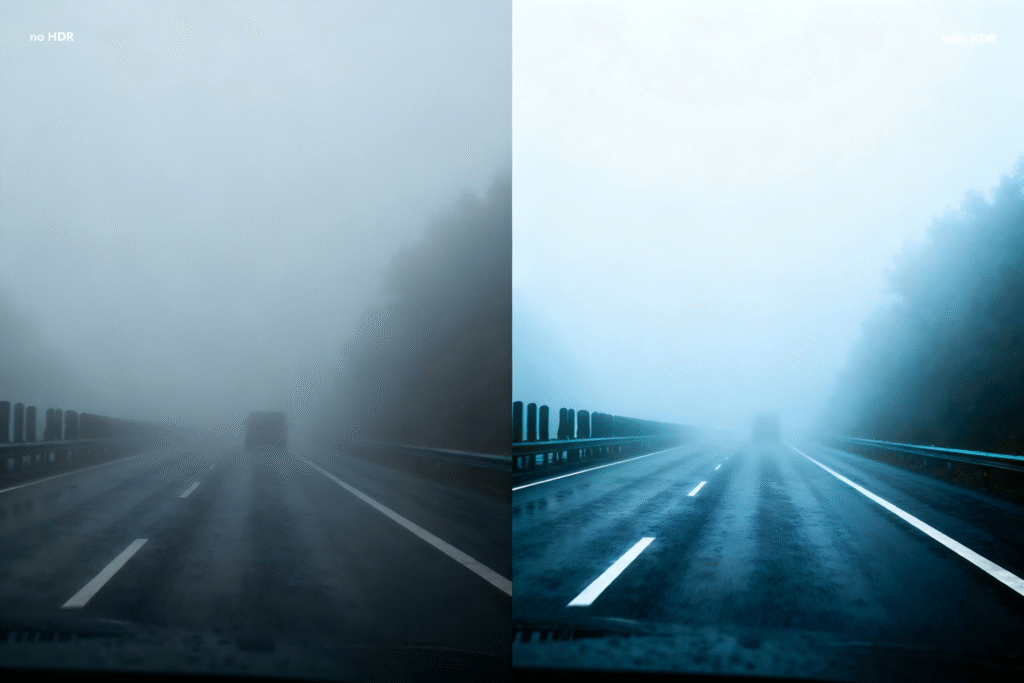
In heavy rain or sandstorms, light scatters across the medium, creating a low-contrast “gray” image. HDR enhances the Signal-to-Noise Ratio (SNR) and boosts local contrast, effectively “cutting through” the haze to identify hazards that would be invisible to standard optics.
4. Commercial & Special Purpose Vehicles
For logistics (Heavy Goods Vehicles) and emergency services (Fire/Ambulance), HDR is not a luxury—it’s a liability shield.
- Fleet Management: Clearer footage in all lighting reduces insurance disputes and improves driver coaching.
- ADAS Integration: Advanced Driver Assistance Systems rely on clean image data. An HDR-enabled camera provides the “clean” input necessary for AI algorithms to accurately detect lane departures and collision risks in suboptimal lighting.
The Engineering Verdict
If you are specifying a vision system for a vehicle, the priority must shift from “more pixels” to “better pixels.” A 1440p sensor with 120dB of hardware-level HDR will provide more actionable intelligence than an 8K sensor with a limited dynamic range.
In the automotive world, we don’t record for the easy miles; we record for the difficult seconds. HDR is the technical bridge that ensures those seconds are captured with forensic precision.