By: [William/Senior Engineering Lead at DANSKER]
4G Real-Time Monitoring vs. SD Card Recording: An Engineering Perspective
1. Real-Time Telematics vs. Forensic Evidence
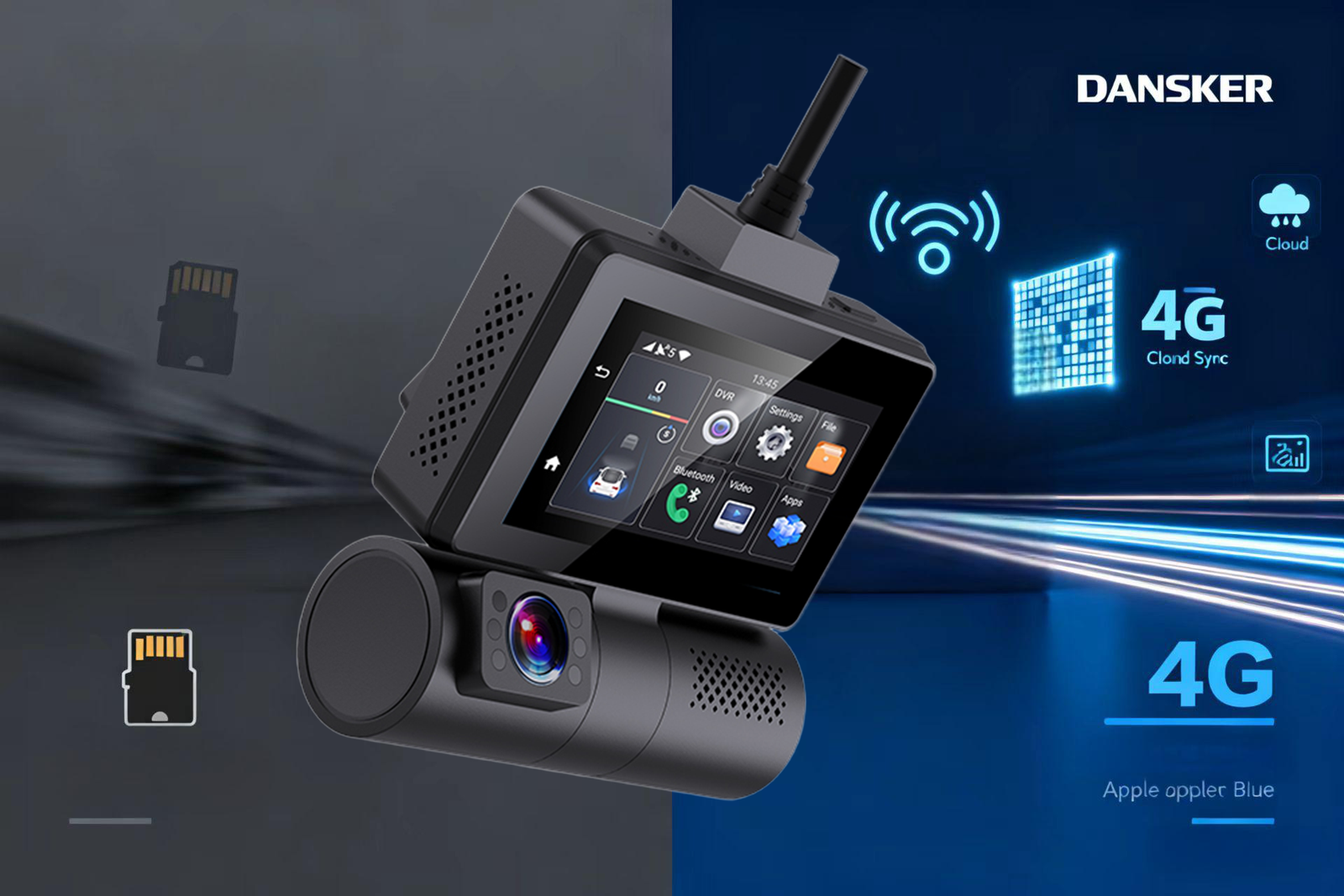
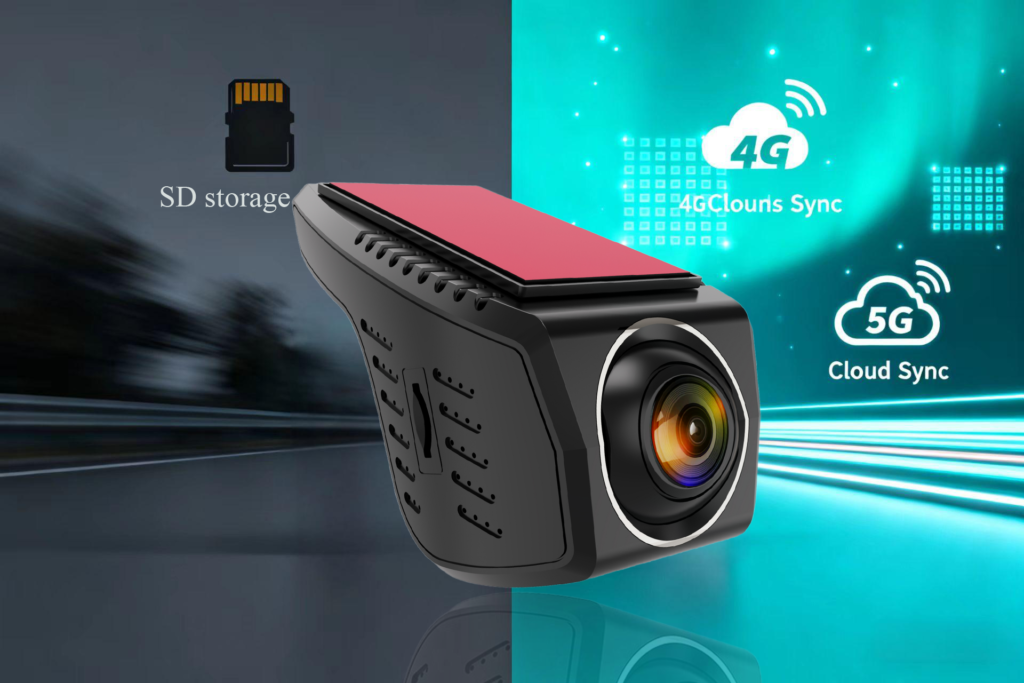
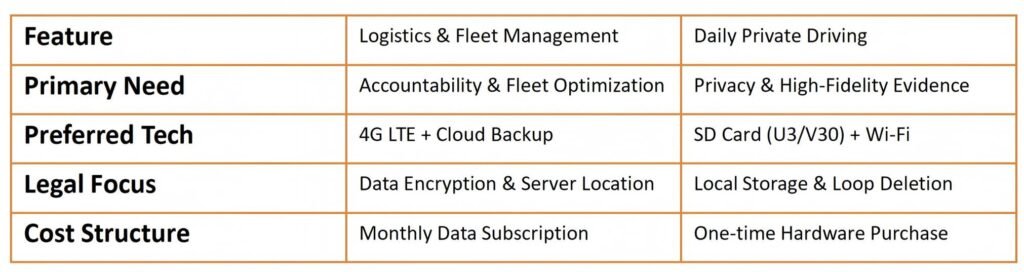
For Logistics/Fleet Management, 4G connectivity is non-negotiable. It transforms a dash cam from a passive recorder into an active IoT sensor. 4G allows fleet managers to receive real-time impact alerts, track GPS locations, and perform “Live View” for remote coaching. Conversely, Daily Drivers primarily need “set-and-forget” forensic evidence. For them, a high-end SD card recording at 4K resolution provides the granular detail (like license plates) that 4G sub-streams often compress for transmission.
2. GDPR and Privacy Compliance
In the EU, GDPR (General Data Protection Regulation) imposes strict rules on data processing. 4G dash cams that upload continuous footage to the cloud may face legal hurdles regarding “justified interest.” For Private Users, SD card recording with a Loop Recording strategy (where the oldest footage is overwritten) is the safest legal bet, as the data stays physically with the driver. For Logistics, data must be encrypted and stored on secure EU/US-based servers to ensure compliance.
3. Storage Protocol & Reliability (V30/U3 Standards)
From an engineering standpoint, SD cards are the primary point of failure. At DANSKER, we optimize the SDA (SD Association) file system protocols to prevent “fragmentation” during high-bitrate 4K recording. While 4G provides a cloud backup for “Event” clips (accidents), the SD card remains the “Black Box” for continuous high-fidelity data. Logistics companies must use “High Endurance” MLC/pSLC cards to withstand the 24/7 write cycles common in long-haul trucking.
4. Remote Retrieval vs. Manual Playback
The “Efficiency Gap” is where 4G shines for businesses. If a logistics driver is involved in an incident in a remote state, the manager can remotely fetch the footage via LTE without waiting for the vehicle to return. For Daily Driving, the occasional need to review footage via a Wi-Fi App or by removing the SD card is usually sufficient and avoids the recurring monthly cost of a 4G data plan.
5. Advanced Driver Assistance Systems (ADAS) Integration
4G connectivity allows for OTA (Over-The-Air) updates, ensuring that ADAS algorithms (lane departure, forward collision warnings) are always calibrated. For Logistics, this means a proactive reduction in insurance premiums. For Personal Use, while ADAS is helpful, the priority is often Parking Mode—using the G-sensor to trigger local SD recording without draining the car battery or consuming cellular data unnecessarily.
6. Bandwidth Management and Recording Redundancy
A professional dash cam architecture utilizes Dual-Stream Recording. The SD card records the “Main Stream” (Full 4K/2K), while the 4G module transmits a “Sub-Stream” (720p/360p) for real-time monitoring. This ensures that even in areas with poor 4G coverage (common in rural US or Alpine Europe), the evidence is never lost. Logistics requires this redundancy for liability protection, whereas Daily Drivers might find the hardware cost of 4G-enabled devices overkill for a simple commute.
The Engineering Verdict: Mission-Critical Connectivity vs. Local Integrity
“From an R&D perspective, the choice between 4G cloud integration and local SD storage isn’t about which technology is superior, but which operational mission it serves.
For Logistics and Fleet Operations, 4G connectivity is the backbone of modern telematics. It transitions a dash cam from a passive recorder to a proactive management tool, offering real-time visibility, remote evidence retrieval, and GDPR-compliant cloud backups that are essential for liability protection and fleet efficiency.
For the Daily Driver, the priority shifts toward data sovereignty and high-fidelity forensic evidence. A high-endural SD card architecture ensures maximum bitrates for 4K clarity without the recurring costs or privacy complexities of constant cellular transmission.
At DANSKER, we bridge this gap with a Dual-Stream Architecture: prioritizing local data integrity for ultra-high-definition evidence while leveraging 4G LTE for mission-critical remote access. Whether you are managing a hundred-vehicle fleet across the EU or commuting through US suburbs, your safety is powered by engineering that understands your specific environment.”