By: [William/Senior Engineering Lead at DANSKER]
As a senior software engineer at DANSKER, I’ve spent years under the hood of automotive vision systems, optimizing how pixels turn into evidence. In the high-stakes world of dash cam development for the North American and European markets, “Dual Encoding” (H.264 and H.265) has moved from a luxury buzzword to a technical necessity for high-performance units.
But why does this feature command a premium, and does it actually change your driving experience? Let’s break down the silicon and the software.
The Engineering Deep Dive
1. Why is Dual Encoding Reserved for the “Elite” Tier?
From a software engineering perspective, dual encoding isn’t just a “software toggle”—it’s a heavy-duty hardware requirement.
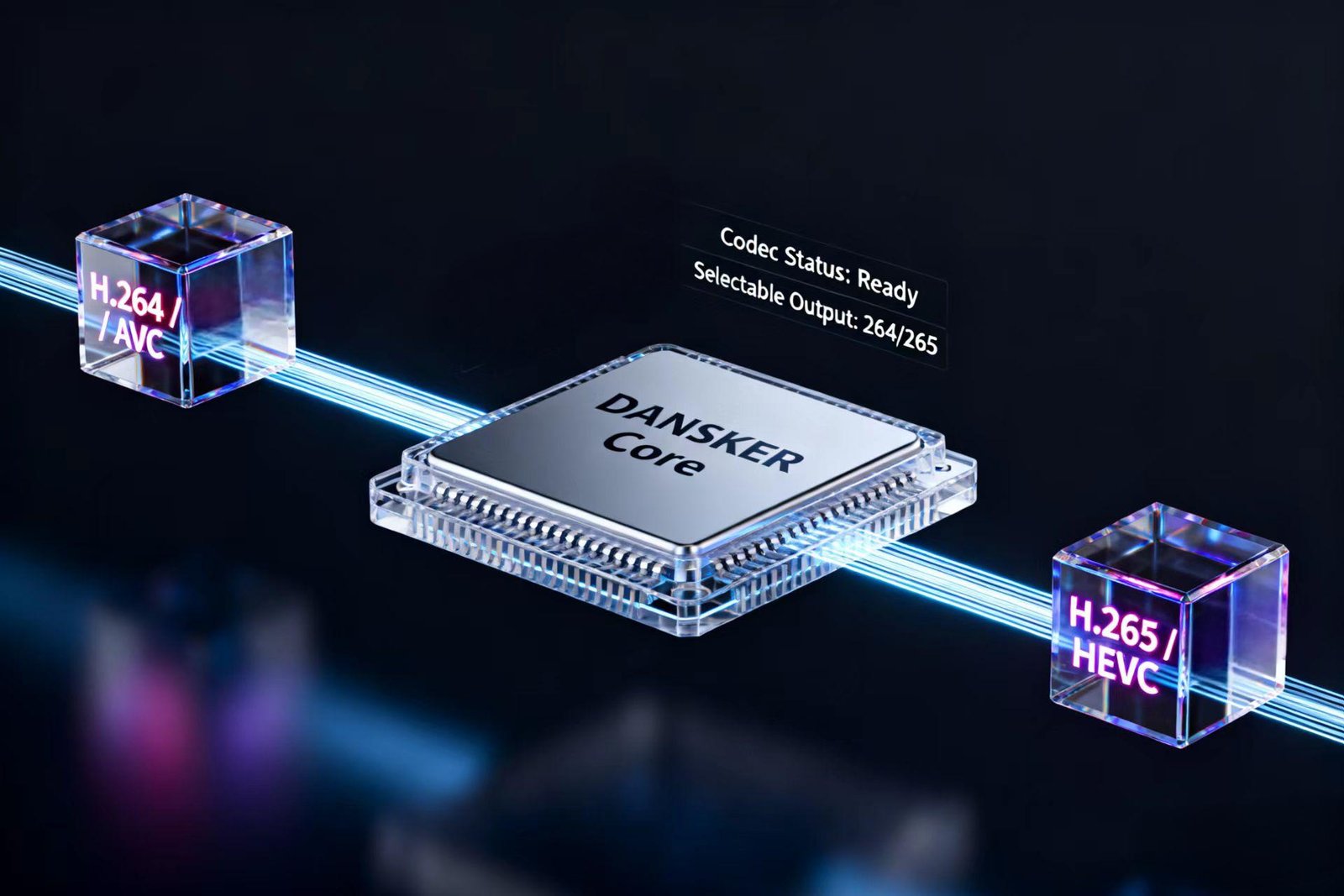
- SoC Architecture: Low-end dash cams use budget processors that barely handle a single 1080p H.264 stream. To run dual H.264 and H.265 simultaneously, you need a high-end SoC (like the top-tier Ambarella or Novatek series) that features multi-core hardware encoders.
- Memory Bandwidth: Writing two high-definition streams to an SD card at once creates a bottleneck. High-end units utilize LPDDR4/5 RAM and sophisticated buffer management to prevent frame drops—components that are too costly for “budget” models.
- Thermal Throttling: Encoding H.265 at 4K is computationally “expensive.” Doing it alongside a secondary H.264 stream generates significant heat. High-end dash cams use automotive-grade thermal pads and structural cooling that cheap plastic units simply don’t have.
2. The Strategic Edge: Dual vs. Single Encoding
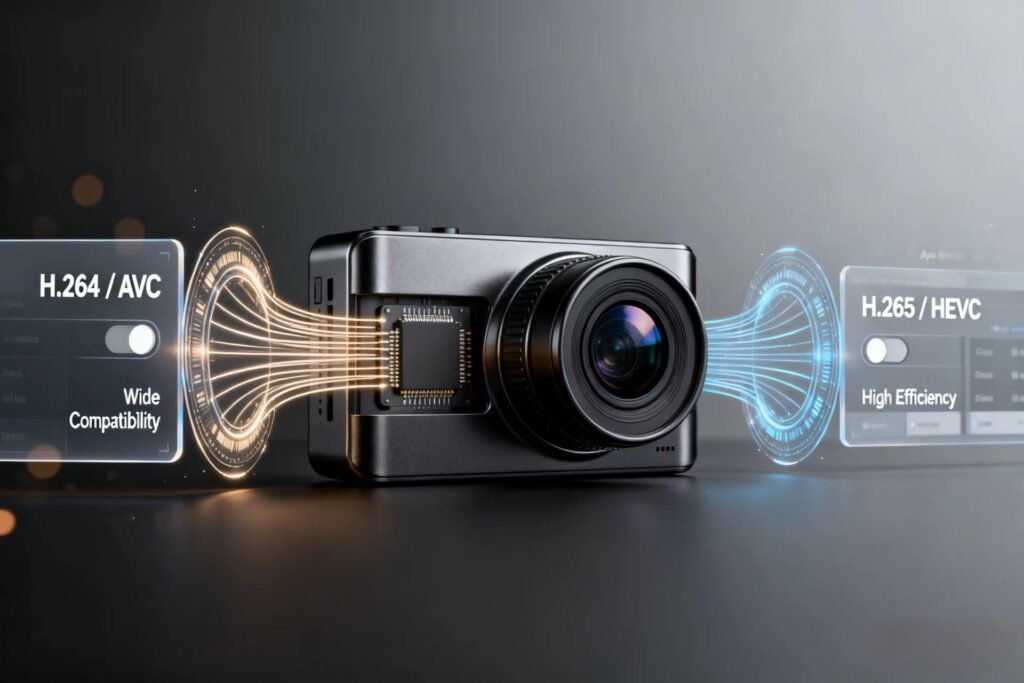
A single-encoder dash cam forces a compromise: you either choose Efficiency (H.265) and risk compatibility issues on older PCs, or Compatibility (H.264) and sacrifice storage space and 4K clarity. Dual encoding eliminates the “Either/Or.” It allows the ISP (Image Signal Processor) to fork the video feed into two distinct pipelines. You get a Master File in HEVC for maximum detail and a Preview Stream in AVC for seamless app integration.
3. Real-World Value: Beyond the Spec Sheet
The biggest benefit for the user is Speed and Convenience.
- Instant Wi-Fi Previews: High-resolution H.265 files can be massive. If you try to stream a 4K H.265 file to your phone over Wi-Fi, it will likely buffer. A dual-encoding system sends the smaller H.264 “sub-stream” to your phone for an instant, lag-free preview.
- SD Card Endurance: By using H.265 for the main recording, we reduce the data written per second. This extends the lifespan of your high-end microSD card—a critical factor for European drivers who endure long commutes.
4. Does the Western Market Truly Need It?
In the US and Europe, we see two major trends: Cloud Integration and Legal Evidence Standards.
- Cloud & LTE: For DANSKER users in regions with high LTE/5G coverage, dual encoding is vital. The camera can upload a lightweight H.264 clip to the cloud immediately after an impact, while keeping the 4K H.265 “Blackbox” version on the local SD card for insurance adjusters.
- GDPR & Privacy: In Germany and the UK, quick access to specific, shareable clips (H.264) is essential for compliance and reporting without needing specialized playback software.
5. When to Choose H.264 vs. H.265?
In modern DANSKER products, we automate this, but the logic is clear:
- Switch to H.264 when: You need to share a clip immediately to social media, or you are viewing the footage on an older laptop or a smart TV that lacks HEVC hardware decoding.
- Switch to H.265 when: You are recording in 4K or 2K, you want to maximize the “loop recording” time on your SD card, or you are capturing high-speed highway footage where license plate clarity (minimizing blocky artifacts) is non-negotiable.
Engineer’s Conclusion
“As a software engineer, I view dual encoding not as a redundant feature, but as a sophisticated solution to the Codec Dilemma. It is the bridge between future-proof 4K quality and current-day device interoperability. By allocating dedicated hardware resources to both H.264 and H.265, we ensure that the user never has to choose between a file they can open and a file that clearly shows a license plate. In the premium automotive sector, dual-stream architecture is the hallmark of a product that prioritizes user experience as much as raw technical specs.”
Final Thoughts
Dual encoding isn’t just about having “two of everything.” It’s about Efficiency and Accessibility. It’s the difference between a dash cam that just “records” and a professional-grade automotive safety tool that works seamlessly with your modern digital life.