By: [William/Senior Engineering Lead at DANSKER]
As a software engineer here at DANSKER, I’ve spent a significant amount of time under the hood of our dash cam firmware. I’ve seen firsthand how the transition from “functional” to “frictionless” defines the premium market.
When we talk about the Western markets—from the tech-savvy hubs of California to the Autobahns of Germany—users don’t just want a camera; they want an appliance that “just works.”
Here is a technical deep dive into the dual-connectivity architecture that is currently reshaping our industry.
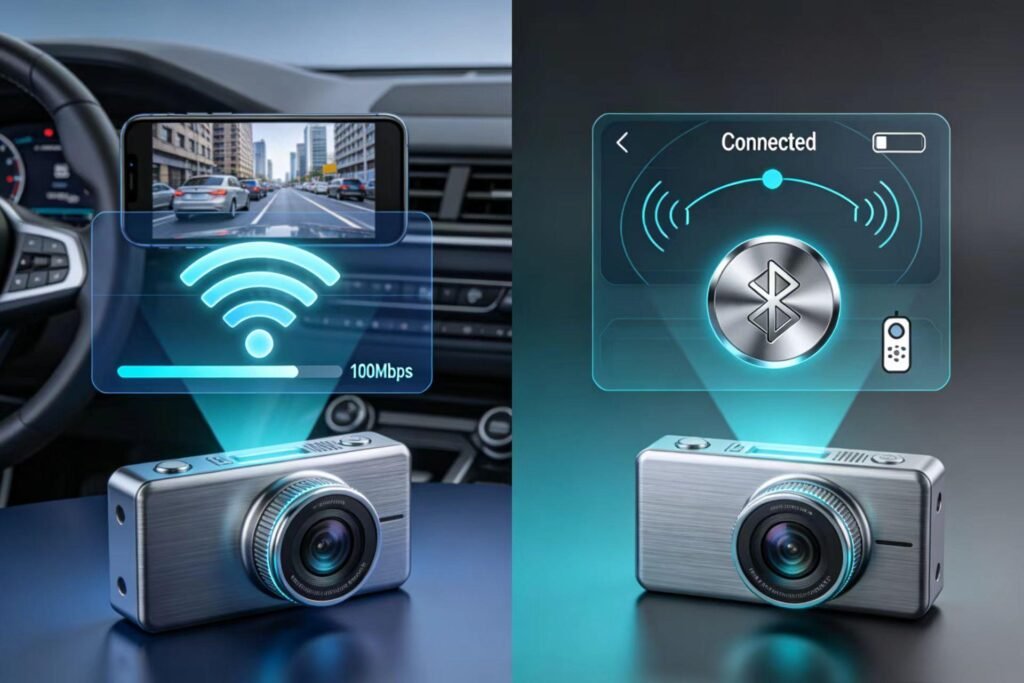
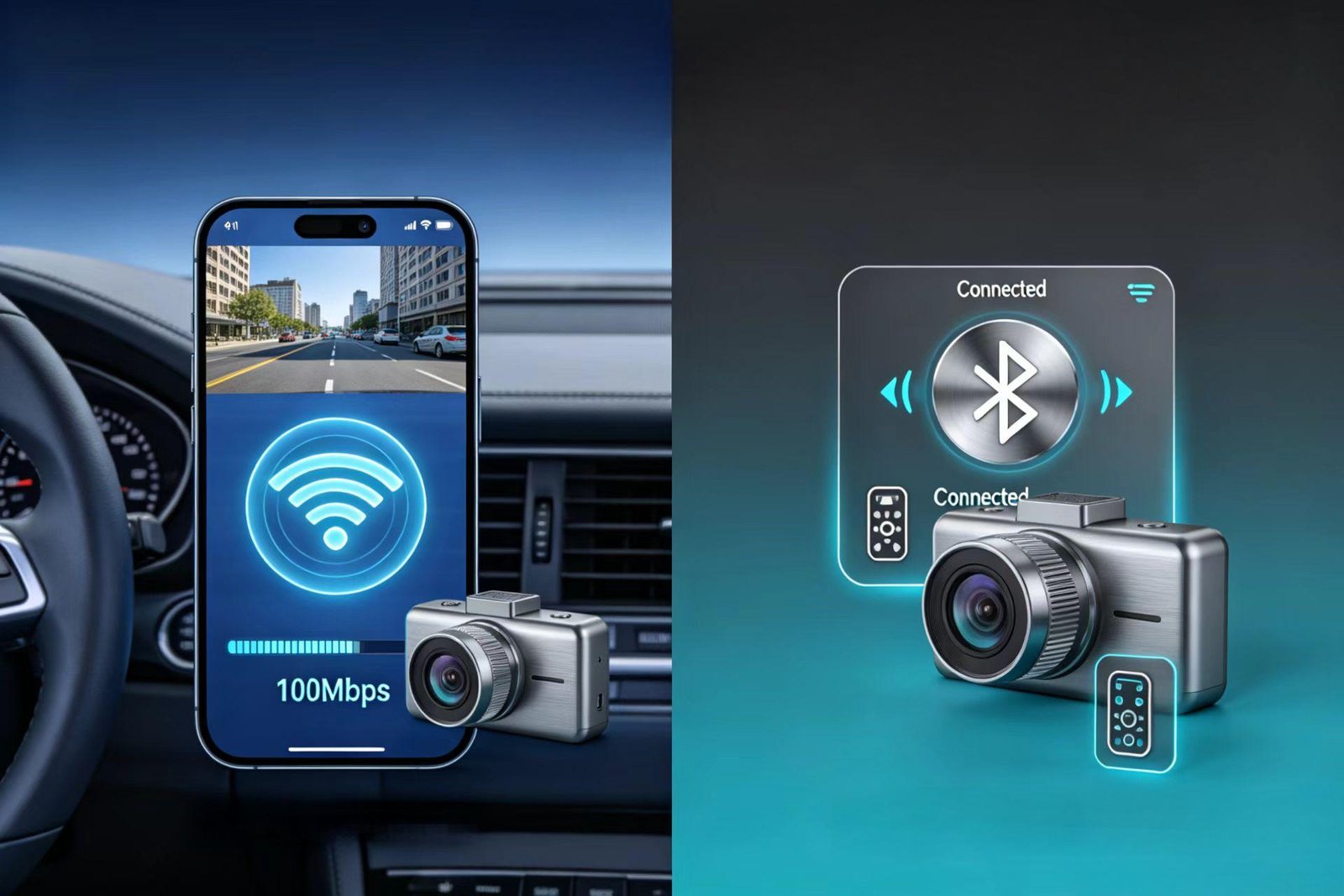
In the world of automotive electronics, connectivity is often the “make or break” factor for user satisfaction. While entry-level devices rely on manual setups, the high-end segment has moved toward a sophisticated dual-band choreography.
1. The Premium Barrier: Why It’s Reserved for High-End Models
The integration of Bluetooth (specifically BLE – Bluetooth Low Energy) alongside high-speed WiFi isn’t just about the cost of a combo chip. It involves a significantly higher BOM (Bill of Materials) due to:
- Advanced SOCs: Only mid-to-high-tier System-on-Chips have the bus bandwidth to handle simultaneous Bluetooth and WiFi stacks without latency.
- Licensing & Certification: Incorporating Bluetooth requires SIG certification, and dual-band WiFi requires stricter FCC/CE regulatory testing for EMI (Electromagnetic Interference).
- Complex Firmware: Developing the “handshake” logic that allows these two protocols to talk to each other requires thousands of hours of senior-level software engineering.
2. Hardware Architecture: Beyond the Surface
To implement this successfully, the motherboard must meet rigorous standards:
- Combo Modules: We typically use high-performance modules (like those from Broadcom or Realtek) that integrate both radios on a single die to minimize the footprint.
- Antenna Isolation: Designing the PCB layout is a nightmare for RF engineers. You need specialized shielding to prevent the 2.4GHz Bluetooth signal from interfering with the WiFi signal, especially if using 2.4GHz WiFi.
- Thermal Management: WiFi chips generate significant heat during 4K video streaming. Premium motherboards use specialized thermal pads and copper heat sinks to ensure the Bluetooth connection doesn’t drop due to thermal throttling.
3. The “Handshake” Value: What Dual Connectivity Actually Does
The primary value is UX Friction Reduction. In a single-WiFi setup, a user must manually go to phone settings, find the SSID, and enter a password. In a dual-link system:
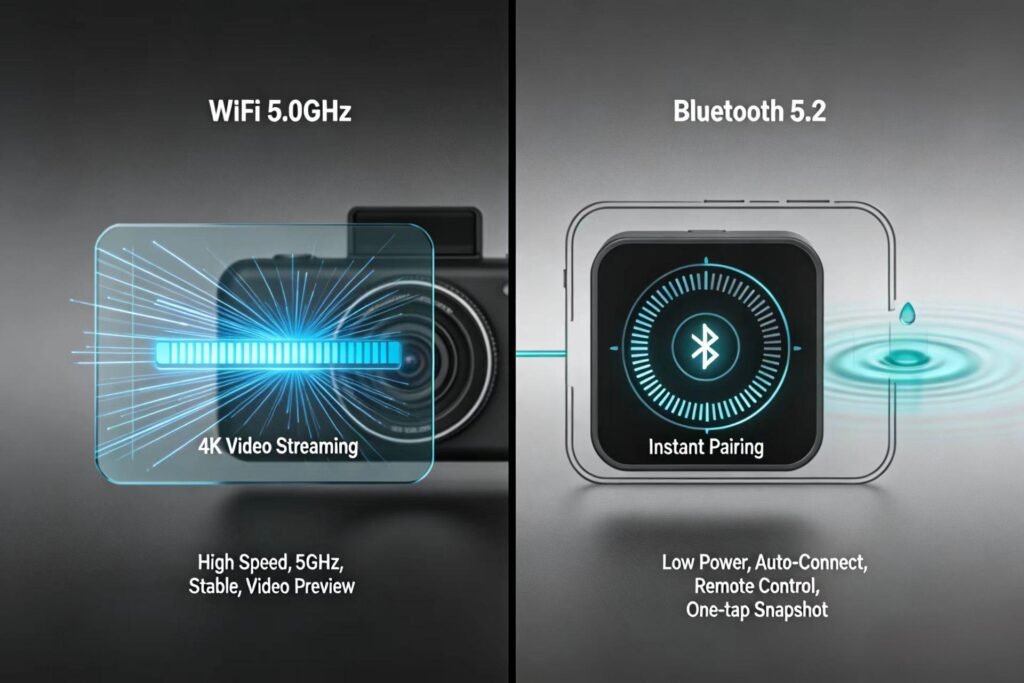
- BLE is the “Always-On” Sentinel: It stays on with minimal power draw. When you open the app, the phone “finds” the camera via Bluetooth instantly.
- The OOB (Out-of-Band) Trigger: Bluetooth sends the WiFi credentials and “wakes up” the camera’s high-power WiFi module only when needed.
- Result: The user sees a “Join Network?” popup and hits “Yes.” No passwords, no manual searching.
4. The Western Market: A “Set-and-Forget” Requirement
In the US and European markets, user patience for clunky UI is near zero. Drivers in these regions view the dash cam as a safety tool, not a hobbyist gadget.
- CarPlay/Android Auto Conflict: Most modern cars in the West use Wireless CarPlay (which uses WiFi). A dash cam that forces you to manually disconnect your CarPlay to view a video is considered a failure. Dual connectivity allows for smarter switching and background synchronization.
5. Market Penetration (2022–2025)
Looking at the data from the past few years:
- 2022: Only about 10-15% of the market (mostly flagship models like BlackVue or high-end DANSKER units) featured dual connectivity.
- 2023-2024: We saw a “trickle-down” effect. The share rose to 25-30% as combo chips became more accessible.
- 2025: It has become a standard requirement for anything priced above $150 USD/€140, capturing roughly 45% of the total new-product volume in the Western premium segment.
6. The Persistence of “WiFi-Only” Designs
Why do budget models still shun Bluetooth? It’s not because Bluetooth lacks value—it’s because WiFi is mandatory for data, whereas Bluetooth is a “luxury” for control.
- Bluetooth bandwidth (even 5.0+) is insufficient for streaming 4K video bitrates (25-50 Mbps).
- Budget manufacturers prioritize the lowest possible BOM. If they can save $3 per unit by skipping the Bluetooth-ready SOC and the extra antenna, they will.
7. The Future: A Ubiquitous Standard
Is it a trend? No, it’s the new baseline. As we move toward V2X (Vehicle-to-Everything) and deeper integration with smart home ecosystems (e.g., your dash cam uploading footage to your home server as you pull into the driveway), the low-power “always-aware” nature of Bluetooth is essential. We are moving toward a future where the dash cam is an invisible, intelligent node in your digital life.
The Engineer’s Summary
From a purely architectural standpoint, the transition to Bluetooth-WiFi dual-connectivity represents a paradigm shift in automotive HMI (Human-Machine Interaction). It is no longer enough for a dash cam to simply record high-quality footage; the modern standard is defined by how that data is accessed. By leveraging BLE 5.0 as a low-power control plane and 802.11ac WiFi as a high-speed data plane, we have effectively eliminated the “connection friction” that plagued previous generations.
For us at DANSKER, this isn’t just adding a chip to a board—it’s about system-level optimization. We are moving toward an era where the hardware disappears, and only the utility remains. If you are operating in the premium Western markets, this architecture is no longer an “extra”—it is the baseline for user retention and brand trust.