By: [William/Senior Engineering Lead at DANSKER]
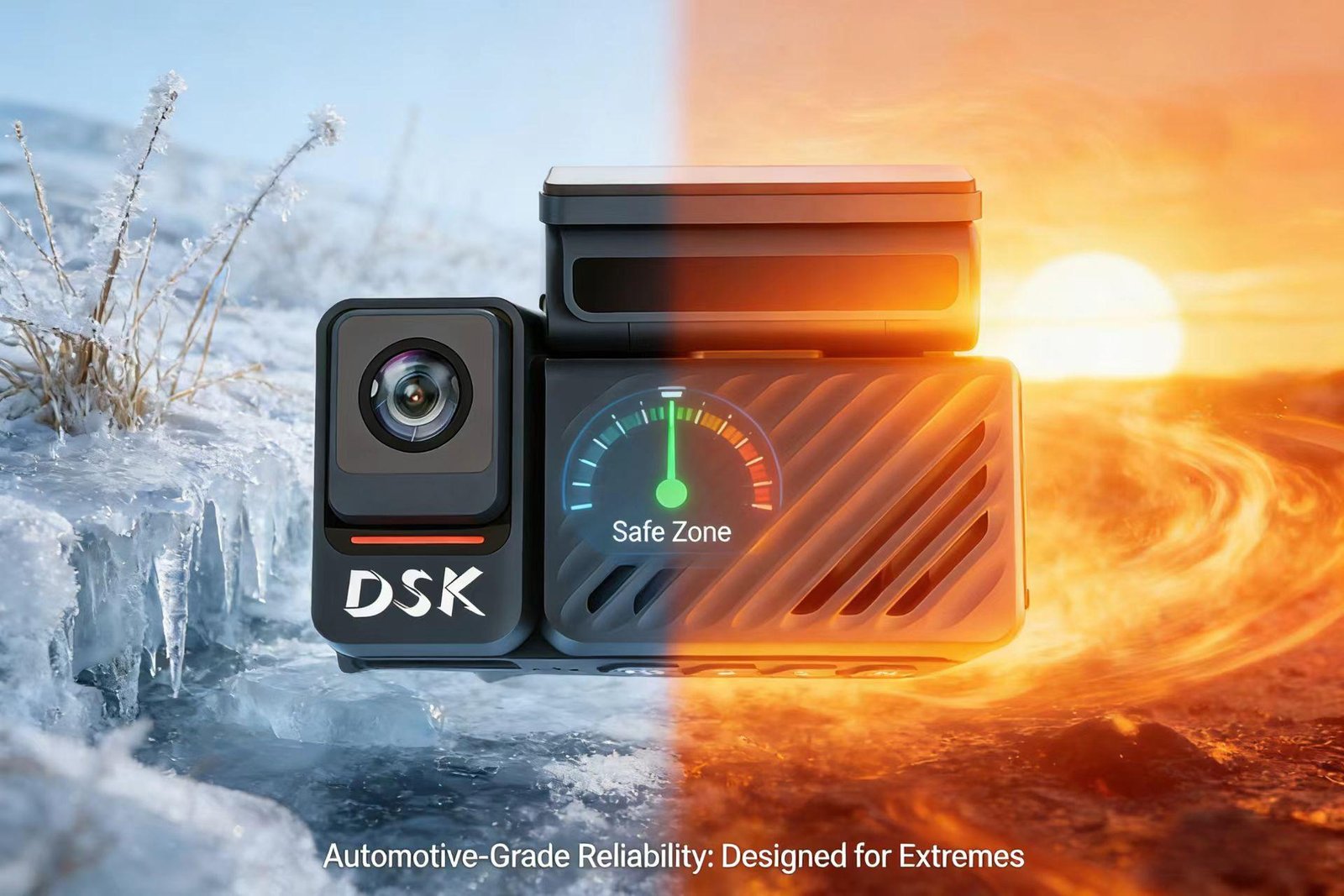
As an engineer at DANSKER, my daily focus isn’t just on lens clarity or GPS accuracy—it is on survival. A dashcam is the only consumer electronic device expected to perform high-bitrate 4K encoding while mounted directly to a glass pane under a scorching summer sun. In markets like the Southern United States or Southern Europe, cabin temperatures can easily exceed 70°C (158°F). Without a robust thermal architecture, even the most expensive camera becomes a brick. At DANSKER, we treat heat not as an inconvenience, but as a critical engineering boundary.
In the industry, we often say that heat is the “silent killer” of precision electronics. For a device like a dashcam, which sits in the harshest thermal environment of a vehicle (the windshield), managing heat is an art form.
Here is a professional breakdown of the thermal architecture for our DANSKER products.
1. What is Dashcam Thermal Management?
At its core, thermal management is the synergistic optimization of energy conversion and heat transfer to ensure the SoC (System on Chip) and Image Sensor operate within their Recommended Operating Conditions (ROC). It isn’t just “staying cool”; it’s about active equilibrium.
- Power Consumption Control: Using high-efficiency PMICs (Power Management ICs) to minimize switching losses.
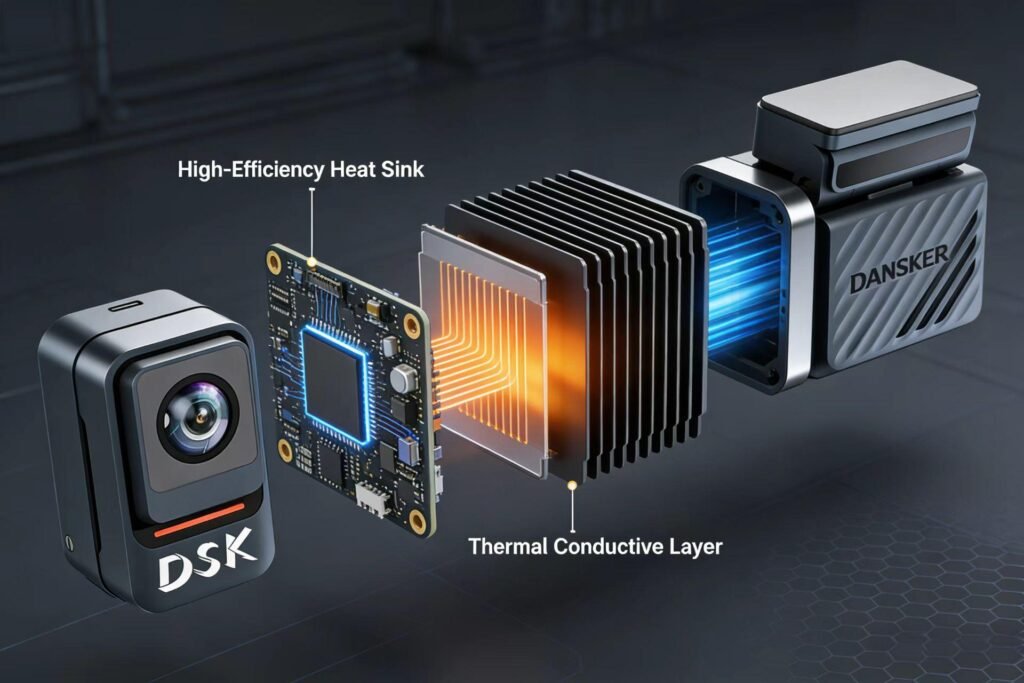
- Thermal Conductivity: Utilizing high-K materials (Thermal Pads/Gaps) to bridge the “air gap” between the PCBA and the casing.
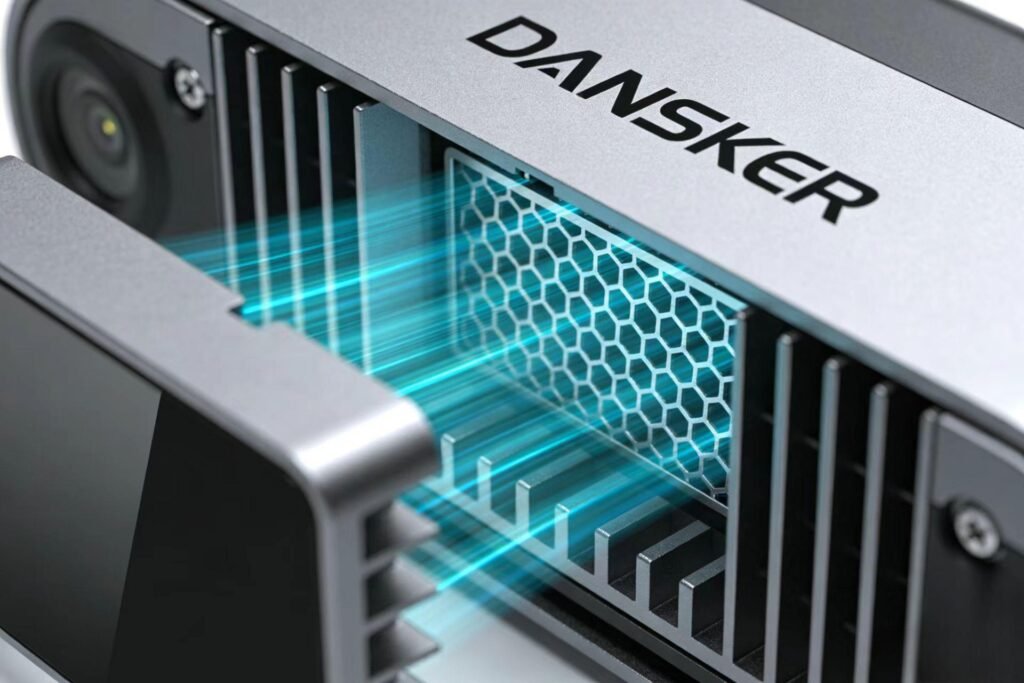
- Heat Dissipation: Designing the mechanical housing with convection airflow or high-emissivity materials to shed heat to the cabin.
- Intelligent Dynamic Voltage and Frequency Scaling (DVFS): A software-level coordination that throttles performance based on real-time NTC (Negative Temperature Coefficient) thermistor feedback.
2. The High-Risk Reality of “Unmanaged” Devices
In the US Sunbelt or a heatwave in Southern Europe, a dashcam without thermal logic is a liability.
- Frame Dropping & Latency: High temperatures increase the “Dark Current” in CMOS sensors, leading to thermal noise and encoder lag, resulting in stuttering footage.
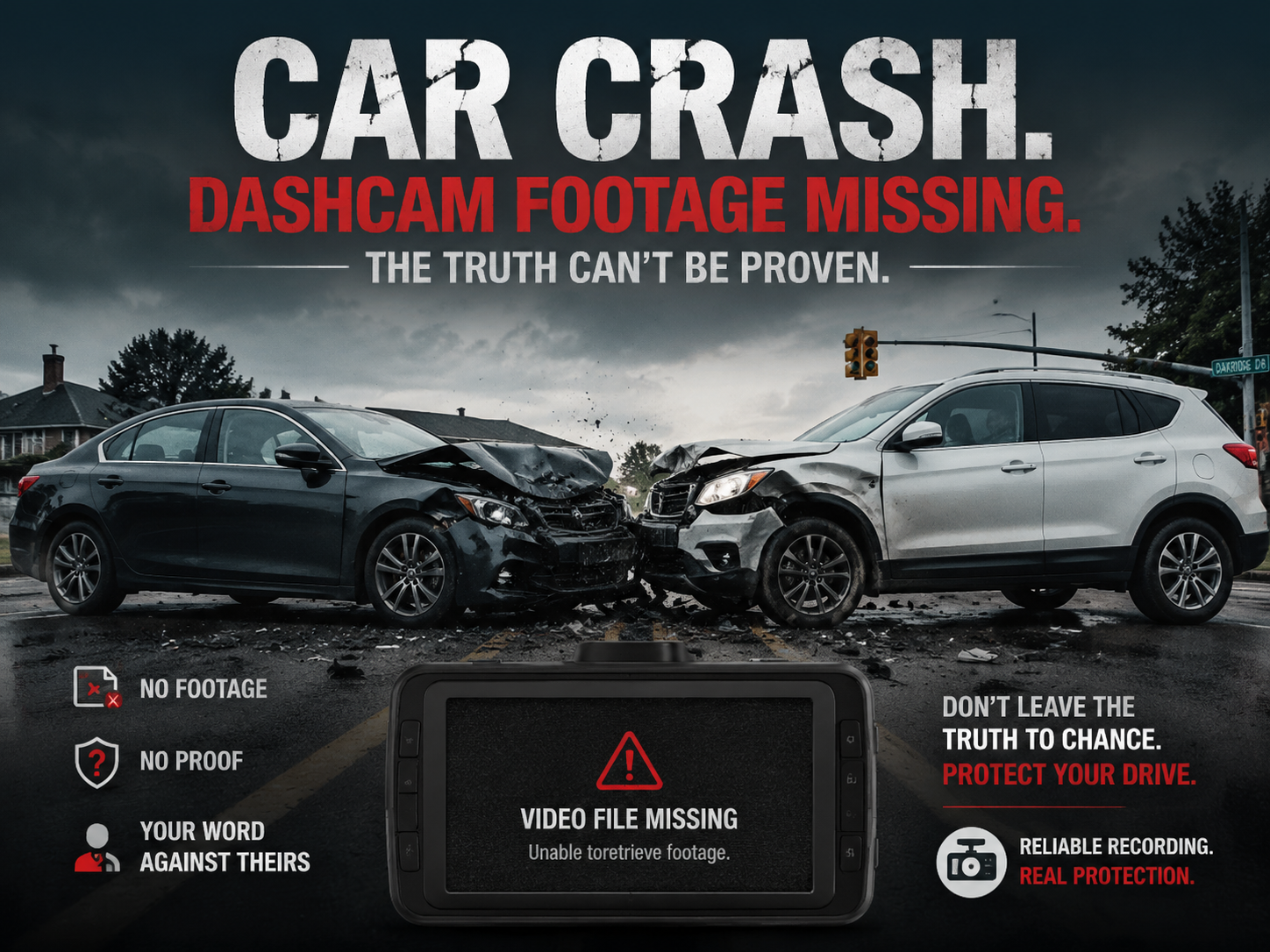
- Critical Shutdowns: Without a “Graceful Shutdown” protocol, a device may hard-crash, causing the final (and most important) video file to be corrupted.
- Storage Failure: High heat accelerates the “Electromigration” in NAND Flash (TF cards), leading to write errors or permanent “Read-Only” locking.
- Physical Deformation: Inferior batteries or capacitors may suffer from gas buildup (bloating), while LCD crystals can undergo “Liquid Crystal Phase Transition,” causing permanent black spots or “bruising” on the screen.
3. The Value Proposition: Why It Matters to the User
Thermal management isn’t just an engineering spec; it’s a “peace of mind” feature.
- Daily Commute: Ensures “Instant-On” capability even after the car has been baking in a parking lot at 70°C (158°F).
- Parking Mode: Allows for extended 24/7 surveillance without the device entering a thermal protection loop, which is vital for hit-and-run protection.
- Accident Integrity: During a collision, the internal temperature of a device can spike due to high-bitrate writing. Thermal management ensures the “Event File” is locked and saved safely without the hardware seizing up.
4. Hardware-Level Thermal Architecture
We focus on the “Path of Least Resistance” for heat:
- AEC-Q100 Qualified Components: Using automotive-grade chips that have higher thermal tolerances than consumer-grade electronics.
- Thermal Vias and Copper Pouring: Multi-layer PCB designs (6-8 layers) that act as a giant heat sink to spread localized “hot spots” from the processor.
- Anodized Aluminum Housings: Often used in DANSKER’s high-end lines to maximize the surface-area-to-volume ratio for passive cooling.
5. Software-Level Thermal Logic
This is where the “intelligence” happens. Professional software stacks include:
- Thermal Throttling Logic: Instead of turning off, the software intelligently reduces the frame rate (e.g., 60fps to 30fps) or disables non-essential features (like Wi-Fi) to lower the TDP (Thermal Design Power).
- Smart Parking Mode: If the internal NTC detects a dangerous threshold, the device switches from “Motion Detection” to “Low Power Time Lapse” to reduce the CPU load.
- File System Robustness: Implementing “Failure-Resilient” file systems (like TS stream or FAT-Safe) that ensure data is written in a way that remains readable even if an emergency thermal shutdown occurs.
6. Is it Necessary for the Western Market?
Absolutely. In North America (from the humidity of Florida to the desert heat of Arizona) and Europe (from the fluctuating summers in Germany to the intense sun in Italy/Spain), dashcams are subjected to extreme “Thermal Cycling.”
The windshield acts as a magnifying glass. Without professional-grade thermal management, a dashcam is not a safety device—it is a “fair-weather” accessory. For the DANSKER brand, we treat thermal management as a core safety pillar, ensuring our devices are “Automotive Grade,” not just “Consumer Grade.”
Engineer’s Perspective: The Bottom Line
“In automotive electronics, reliability is non-negotiable. Many brands focus solely on 4K resolution or AI features, but as engineers, we know that these features are useless if the hardware cannot withstand the thermal load. At DANSKER, our thermal management strategy is built on the ‘Fail-Safe’ principle: every line of code and every thermal pad is there to ensure that when an accident happens, your camera is running, not overheating. High resolution captures the moment; thermal management preserves it.”
DANSKER: Engineered for the Extremes. Reliability That Never Cools Down.