By: [William/Senior Engineering Lead at DANSKER]
The Invisible Lens Behind Every Frame
In the world of high-end automotive electronics, the difference between a “video recording” and “legal-grade evidence” lies in the mastery of light. At DANSKER, we understand that our users in the rainy streets of London, the sun-drenched highways of California, and the snow-covered roads of Scandinavia face a common enemy: optical volatility.
For a dashcam to be a true “silent witness,” it must possess more than just a high-resolution sensor; it requires an intelligent brain capable of reacting to blinding glare and pitch-black tunnels in milliseconds. As a senior software and hardware R&D engineer, I’ve seen how Exposure Compensation (EC) has evolved from a simple photography setting into a cornerstone of automotive safety architecture. Today, we peel back the layers of ISP logic and silicon-level processing to explore why this feature is the non-negotiable standard for the modern, professional driver.
1. Defining Exposure Compensation: The Intelligence of Light Control
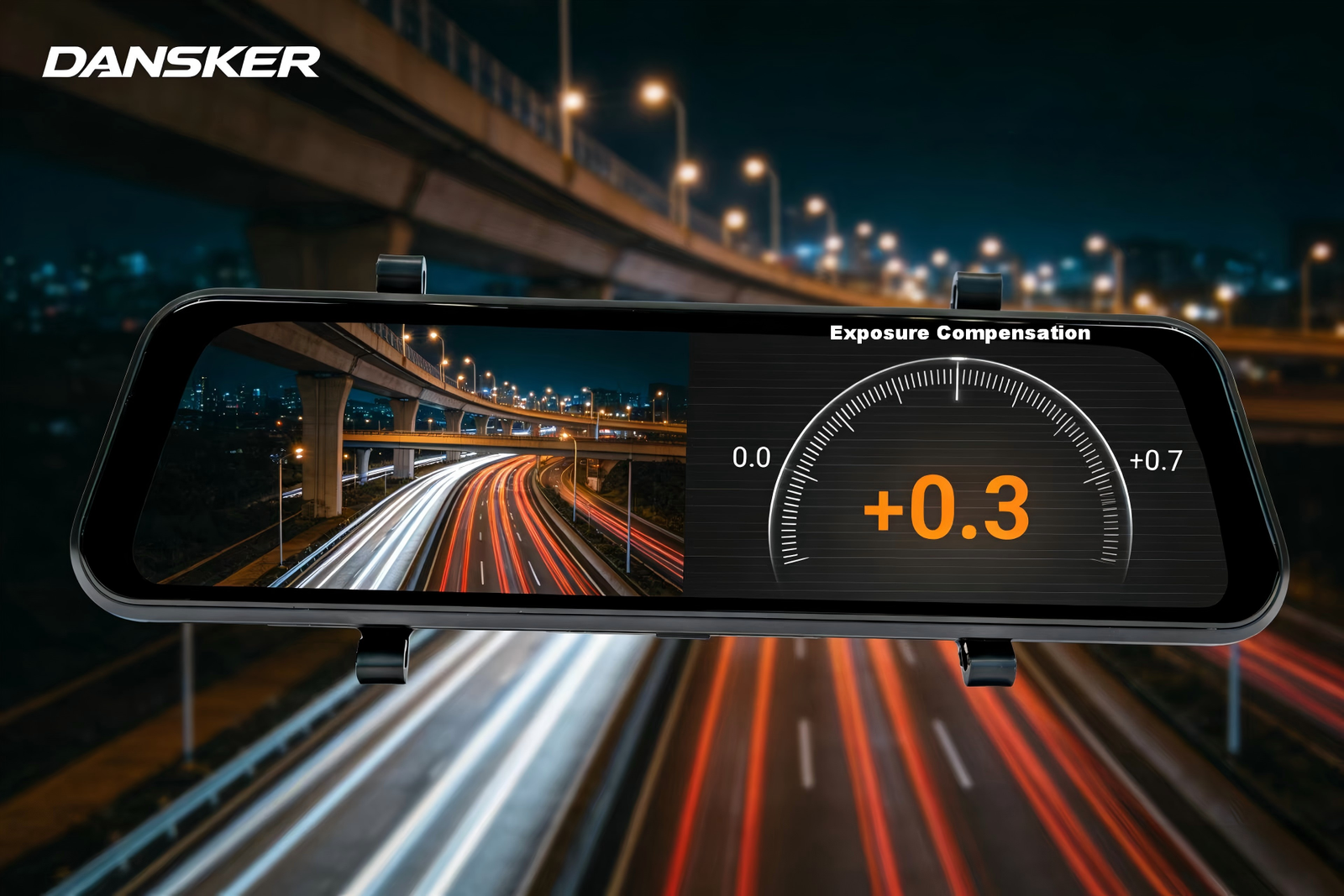
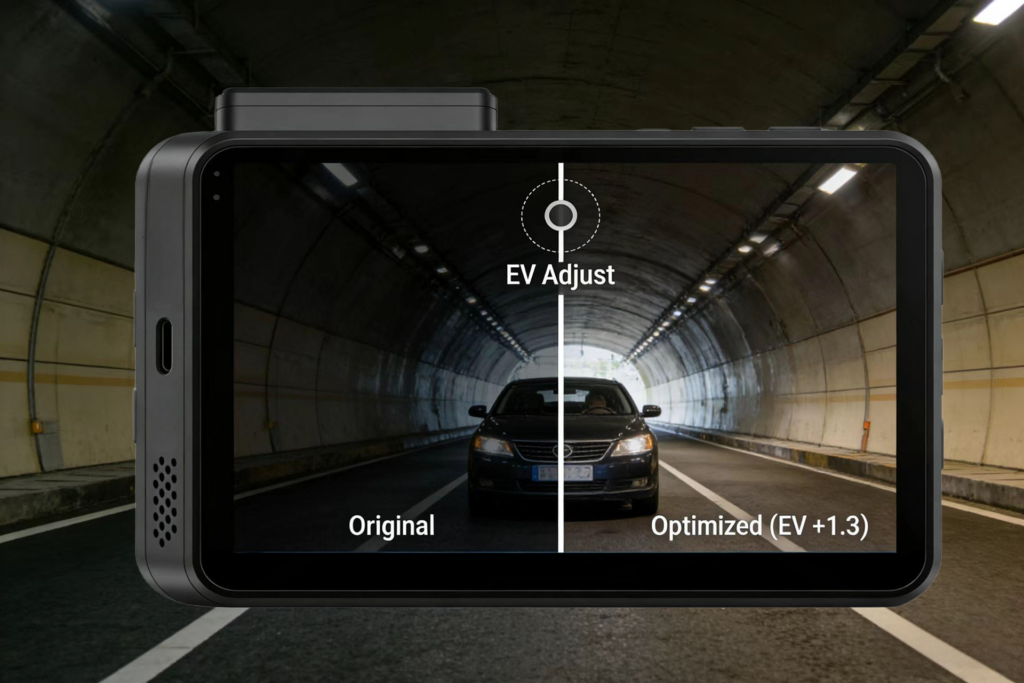
In automotive imaging, Exposure Compensation is not just a slider; it is a dynamic closed-loop control algorithm. Unlike static photography, a dashcam operates in a high-velocity environment where the “luminous flux” changes millisecond by millisecond.
- Automation & Real-time: We utilize Auto Exposure (AE) logic that calculates the Mean Sample Value (MSV) of a frame. EC allows the software to offset the AE target, ensuring the ISP (Image Signal Processor) prioritizes detail in specific zones (like license plates) rather than averaging out a bright sky.
- Adaptability: It functions as the “brain” that bridges the gap between the sensor’s limited native dynamic range and the chaotic reality of Western European weather or the harsh glare of the American Southwest.
2. Hardware and Software Prerequisites: The Engineering Backbone
Implementing effective EC places significant stress on the system architecture:
- ISP & SoC Requirements: The chipset must support Multi-Exposure HDR (High Dynamic Range) or DOL-HDR (Digital Overlap HDR). This requires a high-bandwidth pipeline to process two or more frames (short and long exposure) simultaneously.
- Stability & Real-time Constraints: From a software engineering perspective, the EC adjustment must be synchronized with the V-Sync of the sensor. If the exposure changes mid-frame, it causes “flicker” or “banding,” which can corrupt the H.264/H.265 encoding process, leading to frame drops during critical incident recording.
- Power & Heat Dissipation: Constant AI-driven exposure calculation increases the DMIPS (Dhrystone MIPS) load on the CPU. For DANSKER products, we optimize the thermal envelope to ensure that intense image processing doesn’t trigger a thermal shutdown during a heatwave in Southern Italy or California.
3. Practical Value Across Scenarios
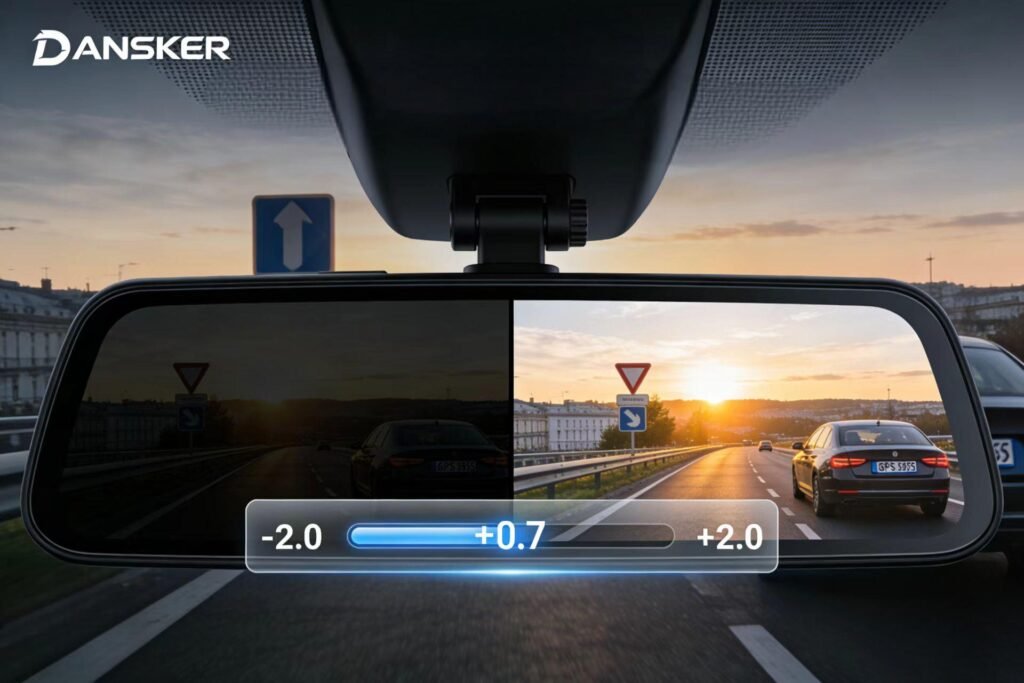
- Daily & Fleet Management: For Uber or long-haul trucking, EC ensures that the “visual evidence” is admissible. It prevents the “silhouette effect” when driving toward a sunset, keeping the vehicle in front visible.
- Accident Reconstruction: In a collision, the exact moment of impact often involves sudden light changes (e.g., headlights flashing). EC preserves the bit-depth of the shadows, allowing investigators to see pre-impact maneuvers that would otherwise be lost in black crush.
- Parking Surveillance: Low-light performance in dimly lit parking garages relies on EC to boost gain without introducing “salt-and-pepper” noise that obscures faces.
4. The Engineering Logic Behind Over/Under Exposure Protection
We design “Guardrails” into the firmware to prevent Overexposure (highlights blowing out) and Underexposure (loss of shadow detail).
- Why we restrict manual tuning: In automotive safety, user error is a liability. If a driver manually sets a high exposure for a night drive but forgets to reset it the next morning, the daylight footage becomes a white void. Our firmware uses Luma Histograms to automatically clip the exposure peaks, ensuring that crucial data—like the red of a stoplight—is never lost to “sensor saturation.”
5. Market Necessity: The Anglo-European Context
Is it necessary? Absolutely. In the US and Europe, legal standards for digital evidence are stringent. “Washout” from LED headlights (which use PWM and can confuse cheaper sensors) or sun-glare on wet autobahns can render a recording useless. In the Nordic regions, where “Golden Hour” lasts for half the day, EC is the only thing standing between a clear video and a useless orange blur.
6. Why it’s the Industry Standard: An Engineer’s Perspective
From an R&D standpoint, Exposure Compensation has moved from a “feature” to a “standard” because of the Pixel-to-Intelligence shift. We no longer just record pixels; we record structured data. As we move toward ADAS (Advanced Driver Assistance Systems) integration, the “computer vision” needs a perfectly exposed image to identify lanes and pedestrians. EC is the foundational layer that ensures the machine “sees” as well as, or better than, the human eye.
Engineer’s Conclusion: Beyond Pixels, Towards Precision
From a firmware architecture perspective, Exposure Compensation is the bridge between raw silicon performance and real-world reliability. At DANSKER, we don’t just view a dashcam as a camera; we treat it as a high-precision optical sensor integrated into a complex automotive ecosystem. Our goal is to ensure that whether you are navigating a foggy morning in the Scottish Highlands or a blistering afternoon on the Texas I-10, the “digital truth” is never compromised by poor lighting. As engineers, we handle the complex algorithms—the MSV calculations, the Luma histograms, and the ISP tuning—so that all you have to do is drive with peace of mind.