By: [William/Senior Engineering Lead at DANSKER]
As a Senior Automotive Electronics Software Engineer at DANSKER, I’ve spent years navigating the intersection of imaging technology and vehicle-to-everything (V2X) connectivity. Our focus on the Euro-American markets has shown us a significant shift: the dash cam is no longer just a “silent witness” but is evolving into the primary Human-Machine Interface (HMI) for the cockpit.
Below is a professional deep dive into the integration of CarPlay within high-end dash cams.
1. What is the CarPlay Function in a Dash Cam?
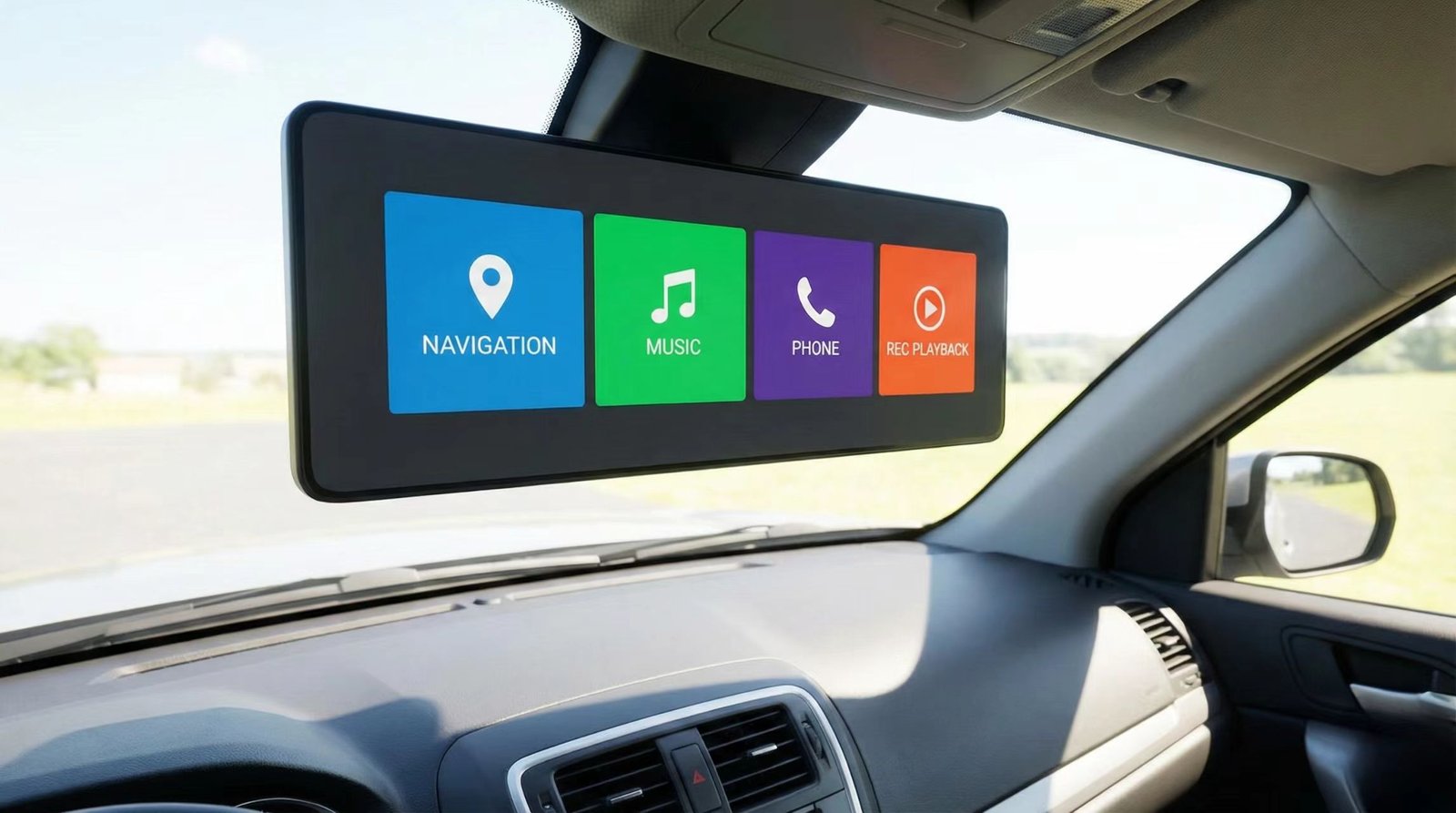
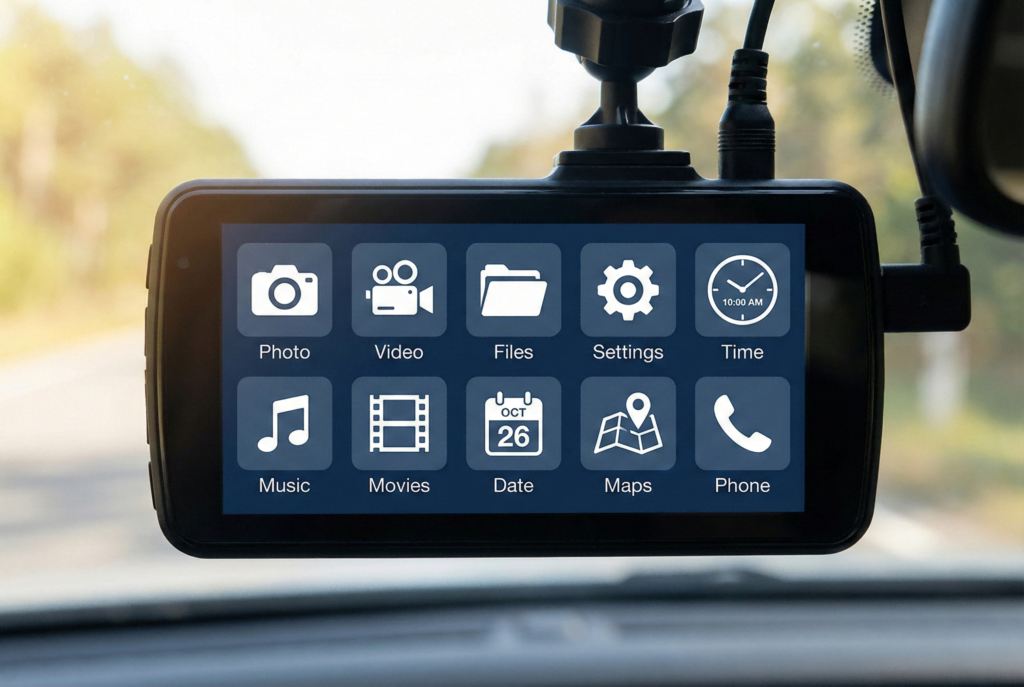
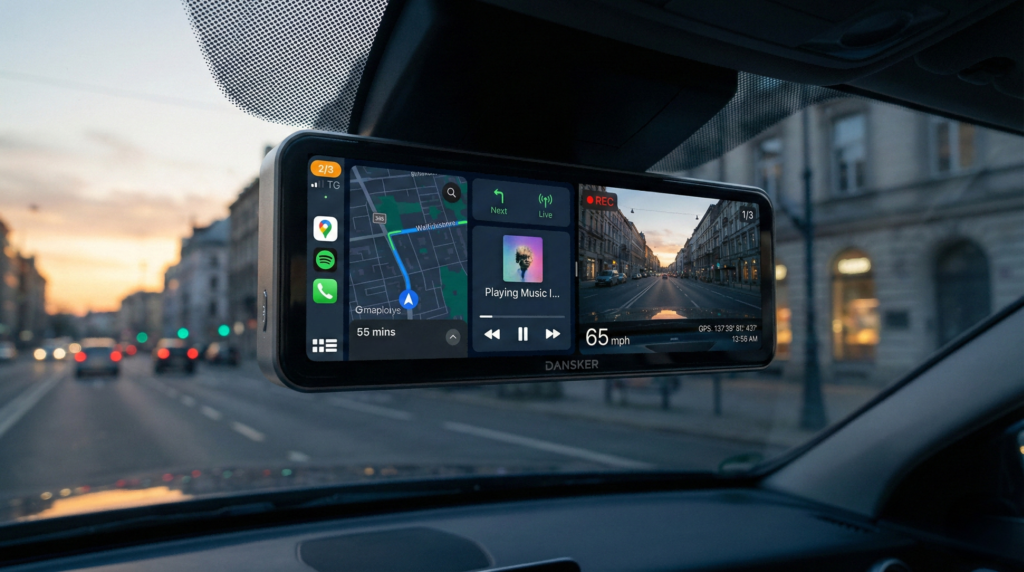
In the context of modern automotive electronics, the CarPlay function transforms a dash cam from a passive recording device into an active Infotainment Extension. It utilizes the dash cam’s high-resolution display (typically 9-inch to 12-inch IPS screens) to mirror an iPhone’s interface wirelessly.
Unlike basic “screen mirroring,” true CarPlay integration involves a dedicated software stack that handles navigation (Waze/Google Maps), communication, and media, while the dash cam simultaneously performs background 4K multi-channel video encoding. It essentially creates a “secondary head unit” for vehicles that lack native smart connectivity.
2. Technical Requirements: From Silicon to Signal
Implementing CarPlay is a rigorous engineering challenge that dictates the hardware architecture of the mainboard:
- SoC & Compute Power: The mainboard requires a high-performance System-on-Chip (SoC) . The SoC must have a multi-core architecture capable of handling H.265 video compression for recording while maintaining a 30-60fps UI rendering for CarPlay via a dedicated Graphic Processing Unit (GPU).
- Transmission & Connectivity: * Wi-Fi: A dual-band 802.11ac (5GHz) module is mandatory. 2.4GHz is too congested and lacks the bandwidth to stream low-latency video data for CarPlay.
- Bluetooth 5.0: Used for the initial “handshake” and authentication before handing off the data stream to Wi-Fi.
- Audio & Voice Control: The PCBA must integrate a high-sensitivity MEMS microphone and a dedicated DSP (Digital Signal Processor) for Acoustic Echo Cancellation (AEC). This ensures that “Hey Siri” commands are accurately captured even against high road noise levels (common in trucks/older sedans).
- Signal Integrity (SI): High-end boards require multi-layer PCB designs (6-8 layers) with specialized RF shielding to prevent Wi-Fi/BT signals from interfering with the CMOS sensor’s high-speed differential pairs (MIPI CSI-2), which could otherwise cause “snow” or artifacts in the recorded footage.
3. Value Proposition: Civil, Commercial, and HMI
- Civilian Use: For the millions of pre-2018 vehicles in Europe and North America, a CarPlay dash cam is the most cost-effective way to “digitize” an old cockpit without invasive dashboard surgery.
- Commercial & Fleet Management: In commercial scenarios, it provides drivers with a standardized navigation interface. This reduces the urge to look at a handheld phone, directly lowering Distracted Driving Risks. For fleet managers, it ensures that the “driver’s cockpit” is optimized for safety and efficiency.
- HMI Design Philosophy: We follow a “Glance-able UI” principle. By moving navigation from a low-mounted factory head unit to a dash cam mounted near the driver’s eye line, we reduce Mean Time Off Road (MTOR), significantly enhancing active safety.
4. Market Reality: Is it a Necessity in the West?
Yes, absolutely. In the US and Germany, where average vehicle ages are roughly 12.5 and 10 years respectively, there is a massive “retrofit” market. Western consumers prioritize hands-free compliance due to strict distracted driving laws. A dash cam that provides both legal protection (recording) and hands-free utility (CarPlay) solves two problems with one device.
5. Market Share Trends & The High-End Logic
The cost of MFi (Made for iPhone) certification, high-spec SoCs, and premium IPS panels keeps this feature in the $150+ segment.
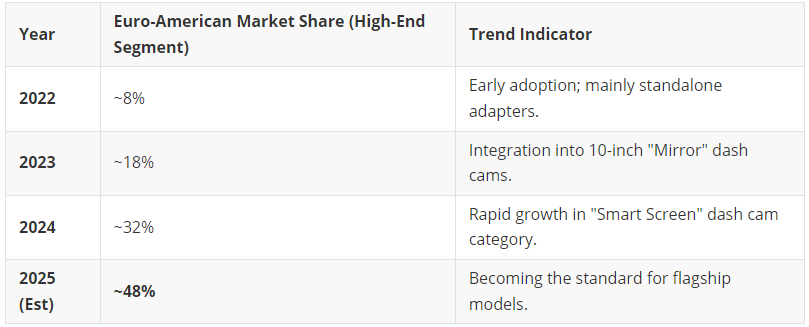
Future Prediction: By 2027, we expect CarPlay/Android Auto to be a standard feature in over 70% of the mid-to-high-end market, eventually merging with ADAS (Advanced Driver Assistance Systems) to provide real-time AR navigation overlays.
Engineer’s Postscript
Technical Summary: The Architecture of Trust
From a software engineering perspective, integrating CarPlay into a dash cam is a balancing act of resource allocation. We aren’t just building a media player; we are maintaining a “mission-critical” safety recording while hosting a complex, third-party communication stack. The “Gold Standard” for a high-end DANSKER device lies in thermal management and interrupt handling—ensuring that even if the CarPlay interface is streaming a high-bitrate navigation map, the 4K video buffer remains prioritized and lag-free. In the Euro-American market, reliability is our greatest feature; if the software fails, the evidence is lost. That is why we invest in multi-layer signal isolation and 5GHz architecture. We don’t just record the road; we intelligently connect you to it.