By: [William/Senior Engineering Lead at DANSKER]
In the world of automotive electronics, we are currently witnessing a fascinating “tug-of-war.” On one side, there is the siren call of ultra-minimalist, buttonless design—driven by the aesthetics of the smartphone revolution. On the other, there is the uncompromising reality of the driver’s cockpit, where Human-Machine Interface (HMI) design can quite literally be a matter of life and death.
As a Senior Software Engineer at DANSKER, my job isn’t just to ensure our dash cams record in 4K; it’s to ensure that the device remains a reliable, “fail-safe” partner for drivers navigating the high-speed Autobahns of Germany or the sprawling interstates of North America.
Lately, the industry has reached a tipping point. While “all-touch” interfaces were the trend of the early 2020s, 2026 has seen a powerful return to integrated physical buttons. Why? Because at 70 mph, “sleek” is secondary to “tactile.” In this deep dive, we’ll explore the engineering logic behind physical controls, the shifting market data of the Western hemisphere, and why the most advanced technology is sometimes the one you can actually feel with your fingertips.
1. Market Penetration of Physical Button Dash Cams (2022–2025)
Between 2022 and 2025, the Western market (US, Canada, UK, and EU) saw a fascinating divergence. While high-end “Smart” dash cams with AI features grew rapidly, the “Basic” and “Advanced” segments—which primarily utilize integrated physical buttons—remained the bedrock of the industry.
Statistically, models featuring integrated physical buttons accounted for approximately 55% to 65% of the total market volume during this period. While touchscreens offer a “smartphone-like” appeal, European consumers, in particular, have shown a strong preference for the durability and immediate feedback of physical switches. At DANSKER, we’ve observed that while tech-savvy users enjoy app-based control, the average driver values a device that “just works” without requiring a Wi-Fi handshake or a multi-level menu dive.
2. The Logic Behind the “Buttonless” Trend
You may wonder why some competitors have stripped away all controls except the power toggle. This design philosophy stems from three technical pillars:
- Minimalist Industrial Design (ID): A buttonless chassis allows for a sleeker, more aerodynamic profile, which is highly sought after in premium North American EV markets.
- Cost & PCB Layout: Mechanical switches require physical space on the Printed Circuit Board (PCB), specific molding in the plastic housing, and manual assembly steps. Removing them simplifies the bill of materials (BOM) and reduces ingress points for dust and moisture.
- Engineering UI Shift: By offloading controls to a smartphone app or a capacitive touchscreen, engineers can update the UI via firmware (OTA) without changing the physical hardware.
3. The Value of Integrated Multi-Function Buttons
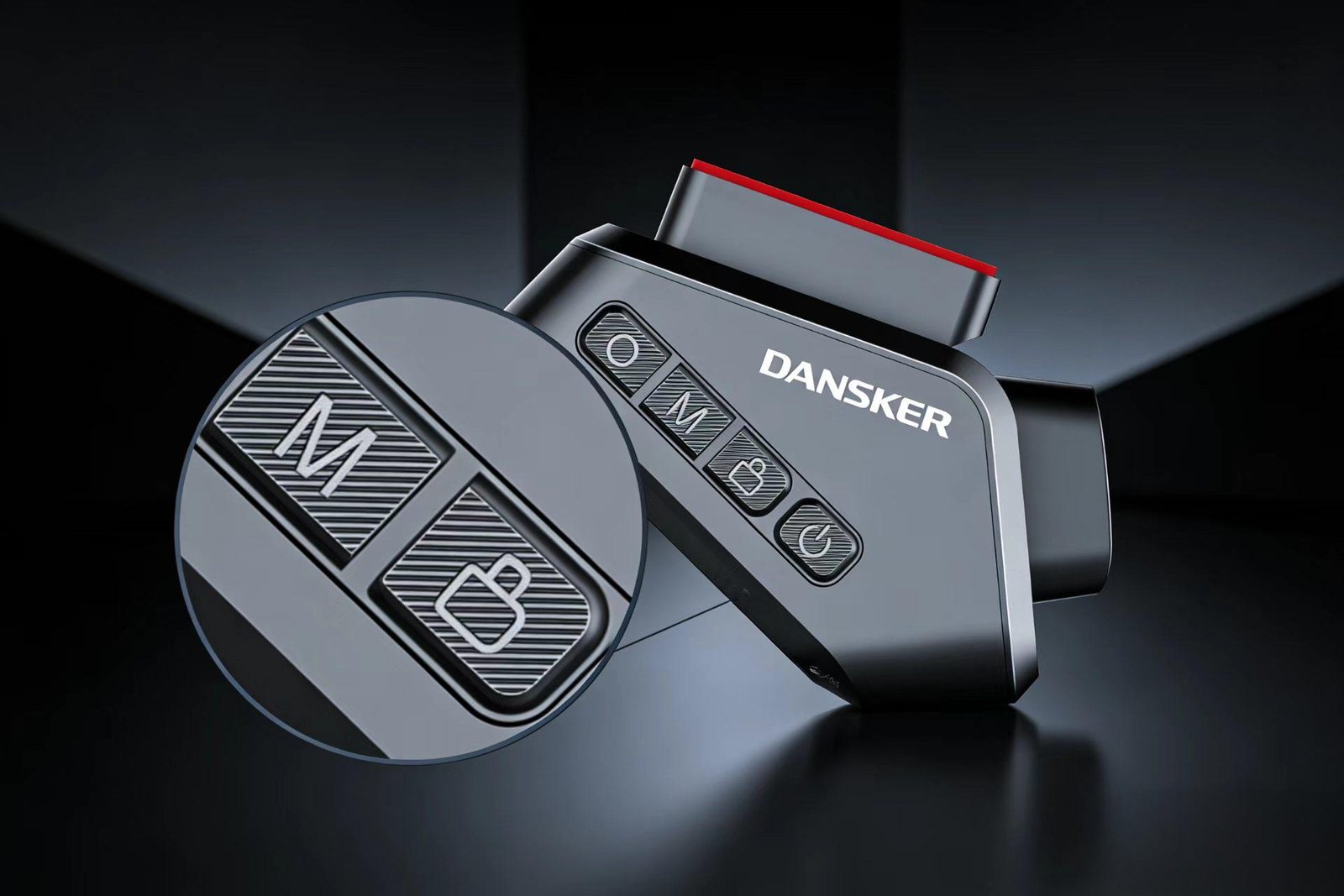
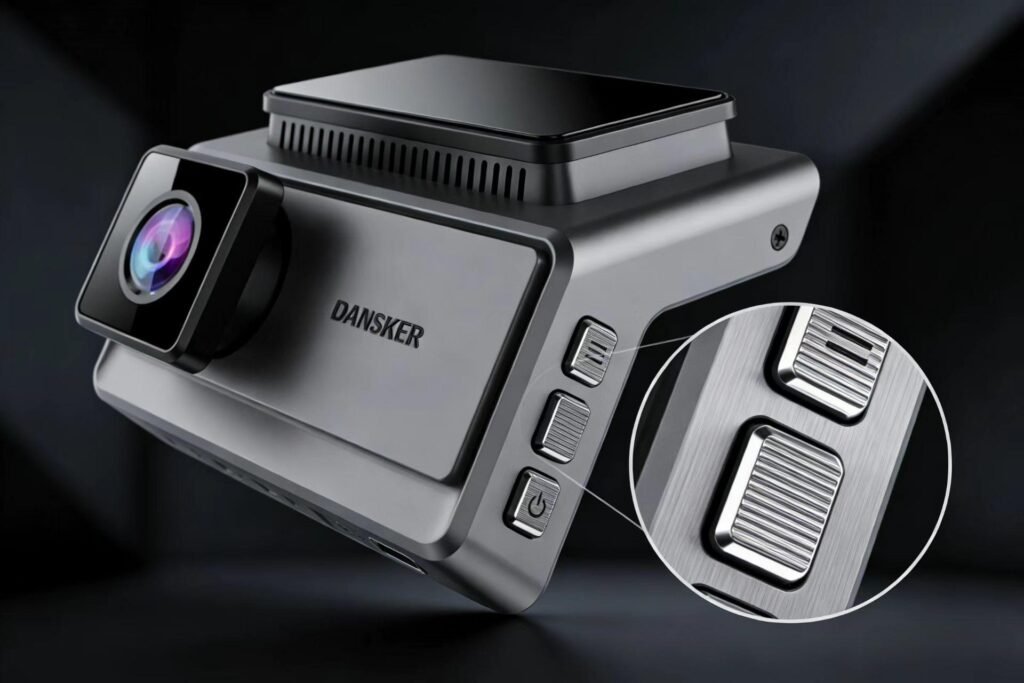
Integrated physical buttons—where a single button might handle “Return,” “Up,” and “Folder” via short/long presses—offer distinct advantages in automotive electronics:
- Blind Operation: Drivers can feel the button’s location and receive haptic confirmation without taking their eyes off the road.
- Thermal Resilience: In extreme climates (from the cold of Norway to the heat of Texas), capacitive touchscreens often suffer from “ghost touches” or lag. Physical switches operate on simple mechanical contact, ensuring 100% reliability in temperatures ranging from -20°C to 70°C.
- Emergency Response: In the event of a collision, a physical “Lock/SOS” button is far easier to trigger under stress than a software-based icon on a vibrating screen.
4. Is a Physical Button Truly Necessary?
From a software engineering perspective: Yes. While voice control and app-syncing are excellent supplements, they are not replacements. Voice recognition can fail due to cabin noise or accents, and apps can experience latency. A physical button provides an interrupt-driven hardware signal that the system can prioritize immediately at the kernel level, ensuring that an “Emergency Lock” command is executed with zero millisecond delay.
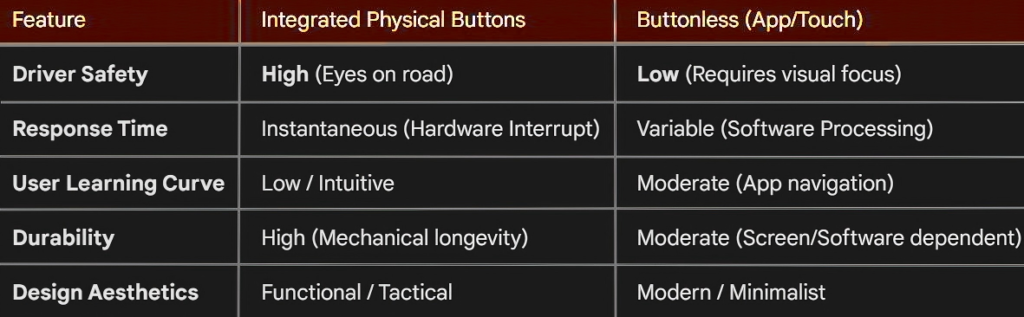
5. Competitive Edge: Integrated Buttons vs. Buttonless Designs
Final Engineering Perspective
At DANSKER, we view the dash cam as a silent guardian. Our commitment to integrated physical buttons isn’t about being “old school”—it’s about HMI Optimization. As we move into 2026, with safety authorities like Euro NCAP re-mandating physical controls for five-star safety ratings, it is clear that the industry is circling back to what we have always known: Tactile feedback is the gold standard for safety.
Whether you are navigating the motorways of the UK or the highways of the US, your dash cam should respond to your touch, even when you aren’t looking.