By: [William/Senior Engineering Lead at DANSKER]
In the high-stakes world of automotive electronics, “visibility” is the literal baseline for safety and liability. As DANSKER continues to penetrate the rigorous markets of North America and Europe, the demand for high-fidelity nocturnal imaging has transitioned from a “premium add-on” to a non-negotiable standard. However, a common technical conundrum persists among fleet operators and hardware distributors: Should we prioritize Low-Light (Starvis-class) sensors or Active Infrared (IR) illumination?
From an R&D perspective, this isn’t merely a choice of components—it is a strategic decision involving thermal management, ISP (Image Signal Processor) optimization, and the delicate balance between BOM (Bill of Materials) costs and evidentiary value. In this technical briefing, we will dissect the architectural differences between these two technologies and evaluate their performance in the grueling environments of long-haul logistics and urban commercial transit.
1. Technical Distinctions and Core Differences
The fundamental difference lies in the Photon Source and Spectral Sensitivity:
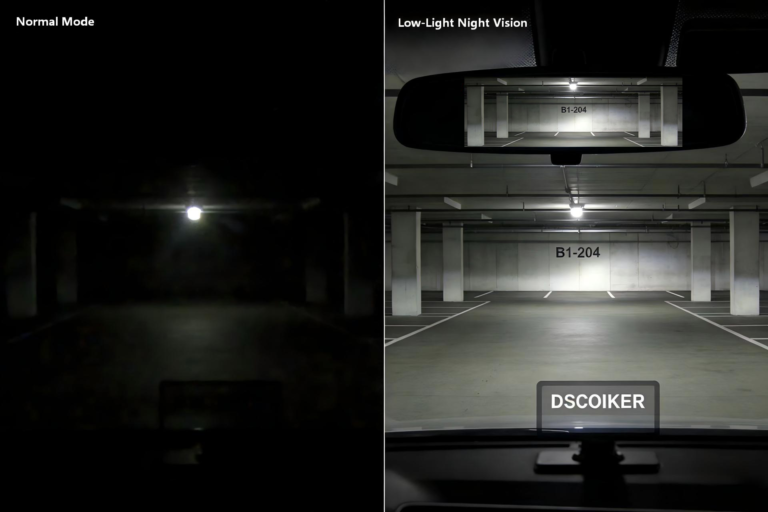
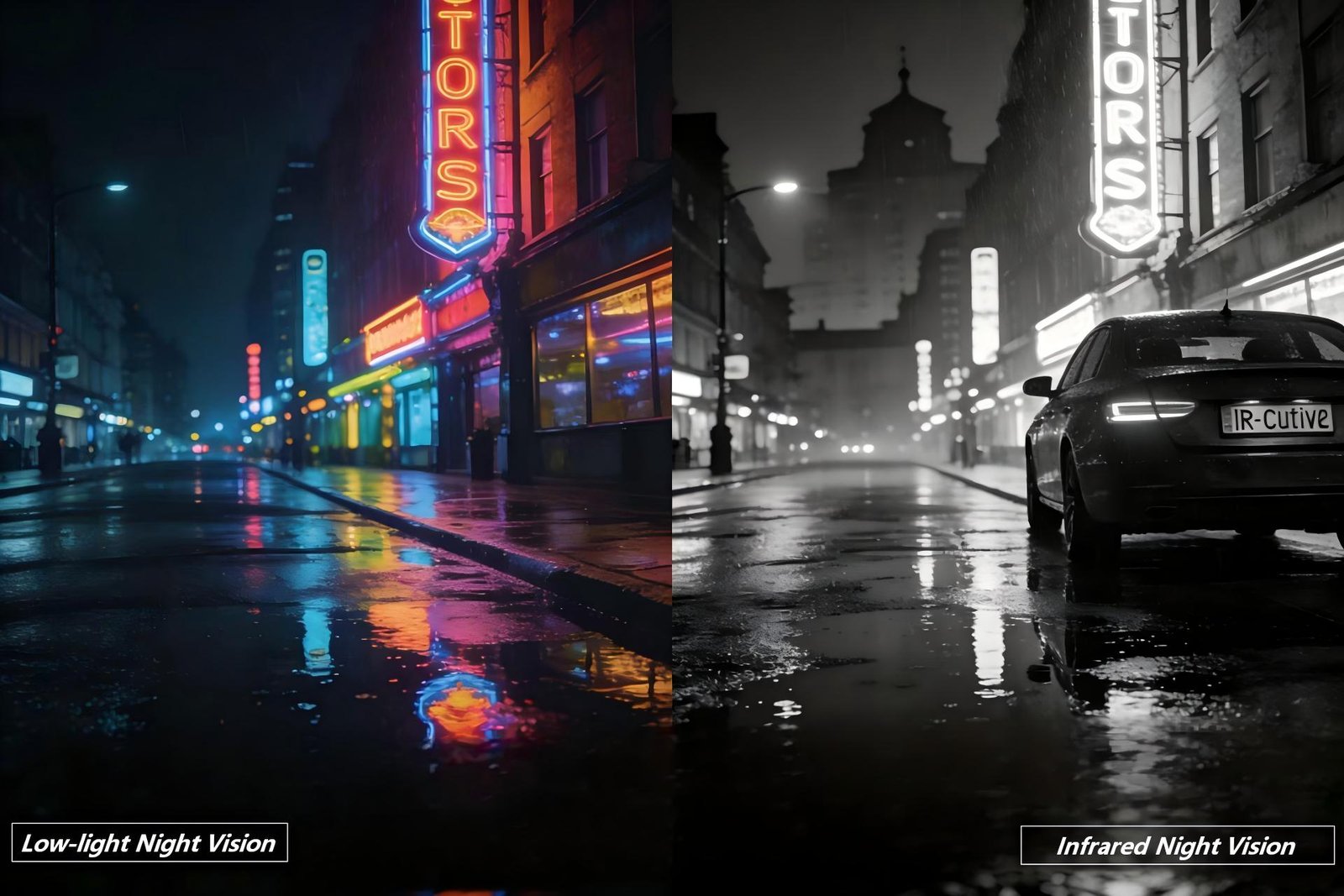
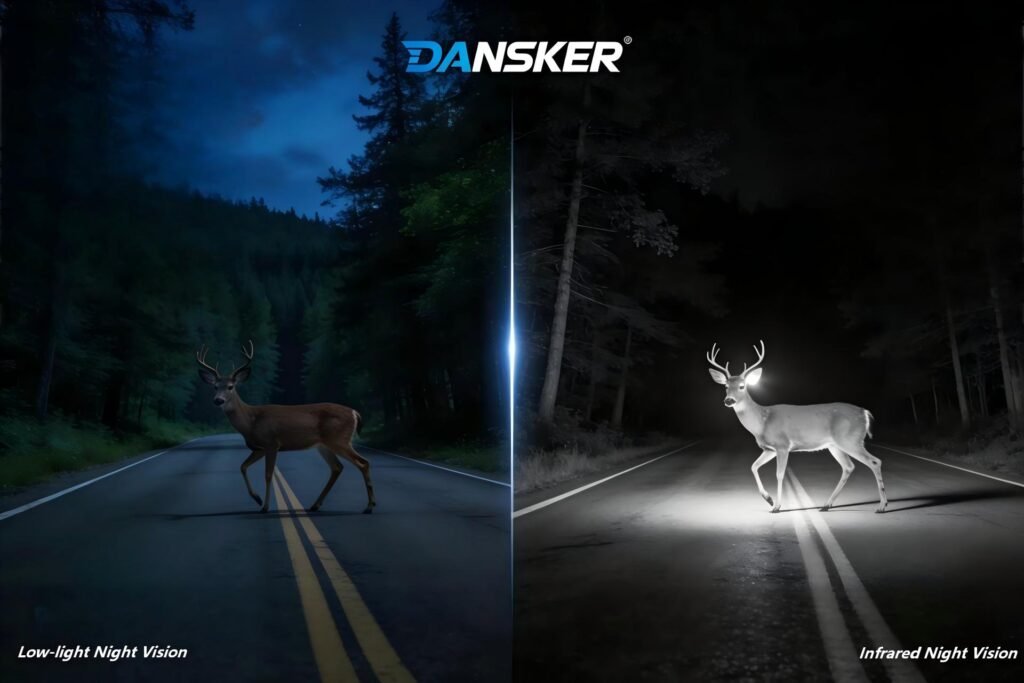
- Low-Light Night Vision (LLNV): Relies on high-sensitivity back-illuminated sensors (like the Sony STARVIS series). It amplifies ambient light (moonlight, streetlights) within the visible spectrum. It produces full-color or high-contrast monochrome images without external illumination.
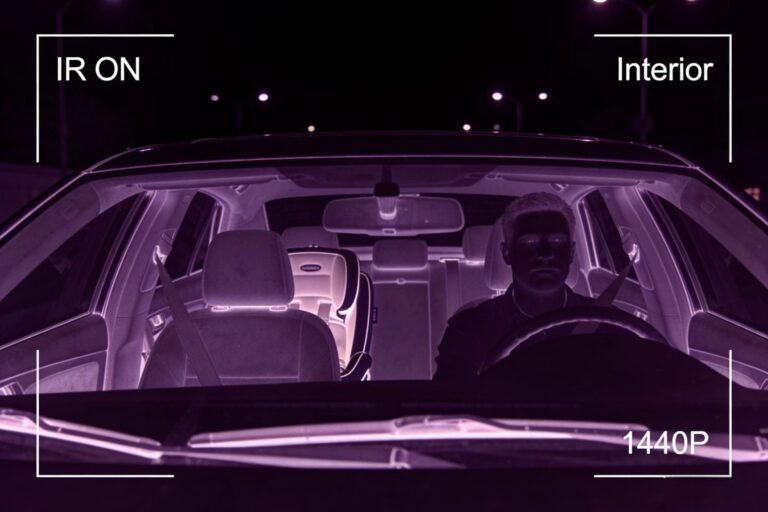
- Infrared Night Vision (IRNV): Uses an IR-Cut filter switcher and 850nm/940nm LED emitters. When ambient light drops below a certain Lux threshold, the filter slides away, and the sensor captures reflected IR light. The resulting image is always monochrome (black and white).
2. Hardware Considerations: BOM, Power, and Thermal Optics
From a hardware R&D standpoint, the comparison looks like this:
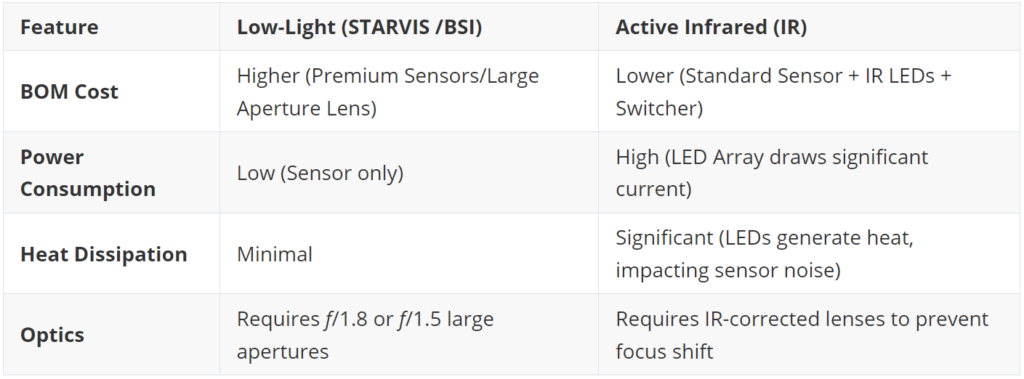
Verdict for Fleets: LLNV is superior for forward-facing cameras due to lower power and better heat management in enclosed dash-top housings.
3. Software Complexity: ISP and Scene Logic
- LLNV (Software Intensive): Requires sophisticated 3D Noise Reduction (3DNR) and dynamic range management to prevent “blooming” from oncoming headlights while brightening the shadows.
- IRNV (Logic Intensive): Requires a robust IRCUT switching logic to prevent “hunting” (flickering between color and IR mode in twilight). It also needs specific ISP tuning to handle the overexposure of reflective surfaces (like license plates) when hit by IR light.
4. Application Scenarios
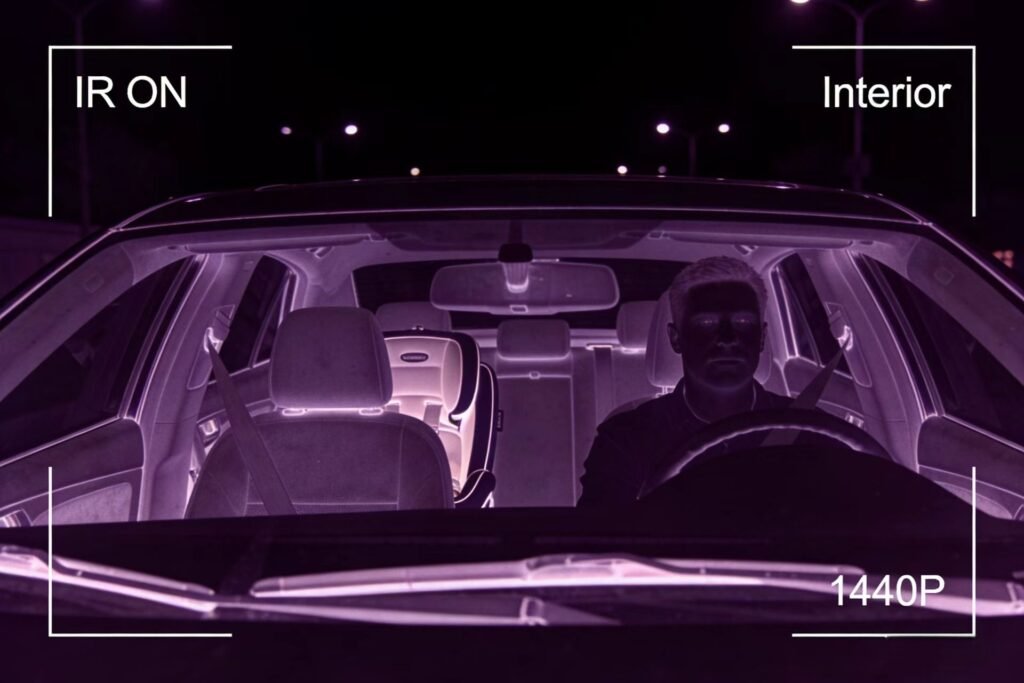
- IR Night Vision: Indispensable for In-Cabin monitoring. In taxis, ride-shares, and armored vehicles, the cabin is often pitch black. IR provides clear visibility of passengers without distracting the driver.
- Low-Light Night Vision: The gold standard for Long-haul trucking and Logistics. It allows drivers and fleet managers to see road hazards, debris, and lane markings in full color, providing better evidentiary value for insurance claims.
5. Market Trends: Why Low-Light Dominates the West
In the US and EU markets, Low-Light (Full Color) Night Vision is the preferred standard for exterior recording.
- Evidence Quality: Identifying the color of a vehicle involved in a “hit and run” is crucial for legal proceedings.
- Regulatory Compliance: High-intensity IR emitters can sometimes interfere with ADAS (Advanced Driver Assistance Systems) sensors in modern European trucks.
6. Hybrid Integration: The Future of Dash Cam R&D
Is a “Dual-Mode” system the future? Yes, but with a caveat. As an engineer, I foresee the “Hybrid Intelligent Vision” system. This uses an AI-driven ISP that can merge frames. We are moving toward sensors with higher Quantum Efficiency (QE) in the near-infrared spectrum.
The future isn’t necessarily adding more LEDs; it’s using Large-format 1/1.2″ sensors that make IR LEDs redundant for the exterior while maintaining discrete 940nm IR for driver fatigue monitoring. This “Dual-Spectral” approach minimizes hardware failure points (like mechanical IR-Cut filters) and maximizes data reliability.
Engineer’s Summary & Conclusion
Senior R&D Perspective: > When designing the DANSKER product roadmap, we don’t view Night Vision as a binary choice. For Exterior Road-Facing cameras, Low-Light (Full Color) is the superior choice for high-speed reliability and legal evidence. For Interior Driver/Cabin Monitoring, Active IR remains the industry benchmark for capturing detail in zero-lux environments. The ultimate fleet solution is a hybrid architecture: leveraging high-aperture optics for the road and discrete IR arrays for the cabin.