By: [William/Senior Engineering Lead at DANSKER]
Our team designs advanced products for the European market. Drivers in these regions face very tough road conditions. They deal with freezing winters and long summer hauls. These drivers need evidence they can trust. They demand high-definition video that never fails.
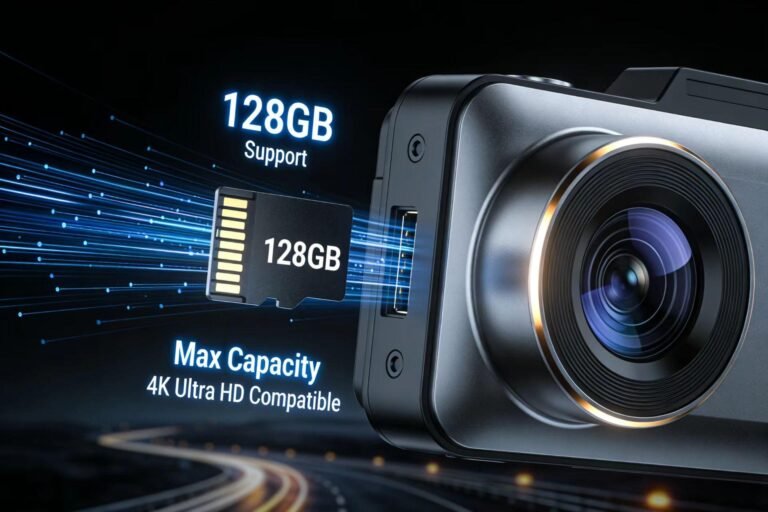
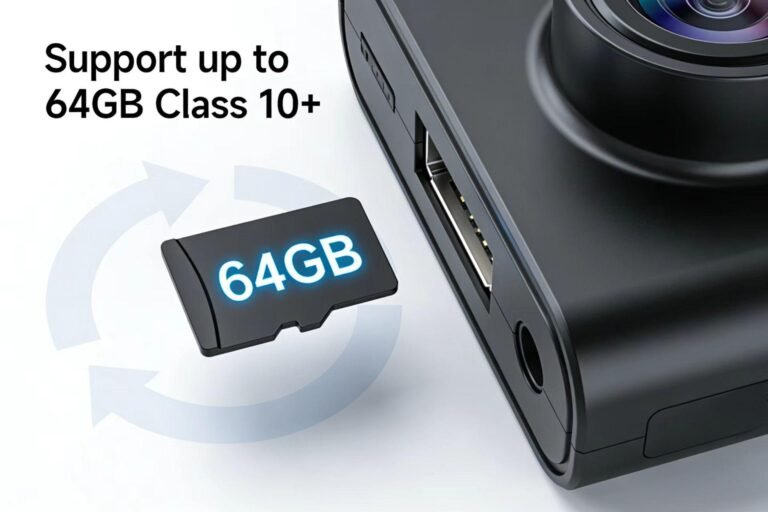
Many people ask about our storage limits. They want to know why our professional 4K models support 256GB. They often compare this to 64GB or 128GB cards. Many think it is just about recording more hours of video. This is not the full story. For an engineer, 256GB is a smart technical choice. We look at hardware endurance and signal integrity. We also focus on thermal management and stable data flow.
A 4K video stream is very heavy. It puts constant pressure on the storage chip. Think of storage as the heart of the system. Capacity is more than just a number. It is a key part of the system “health.” Larger storage reduces wear and tear on the memory cells. It also keeps the device cool during long trips. Our 256GB standard ensures your dash cam works perfectly during an emergency.
1. The Technical Logic of 256GB in 4K Systems
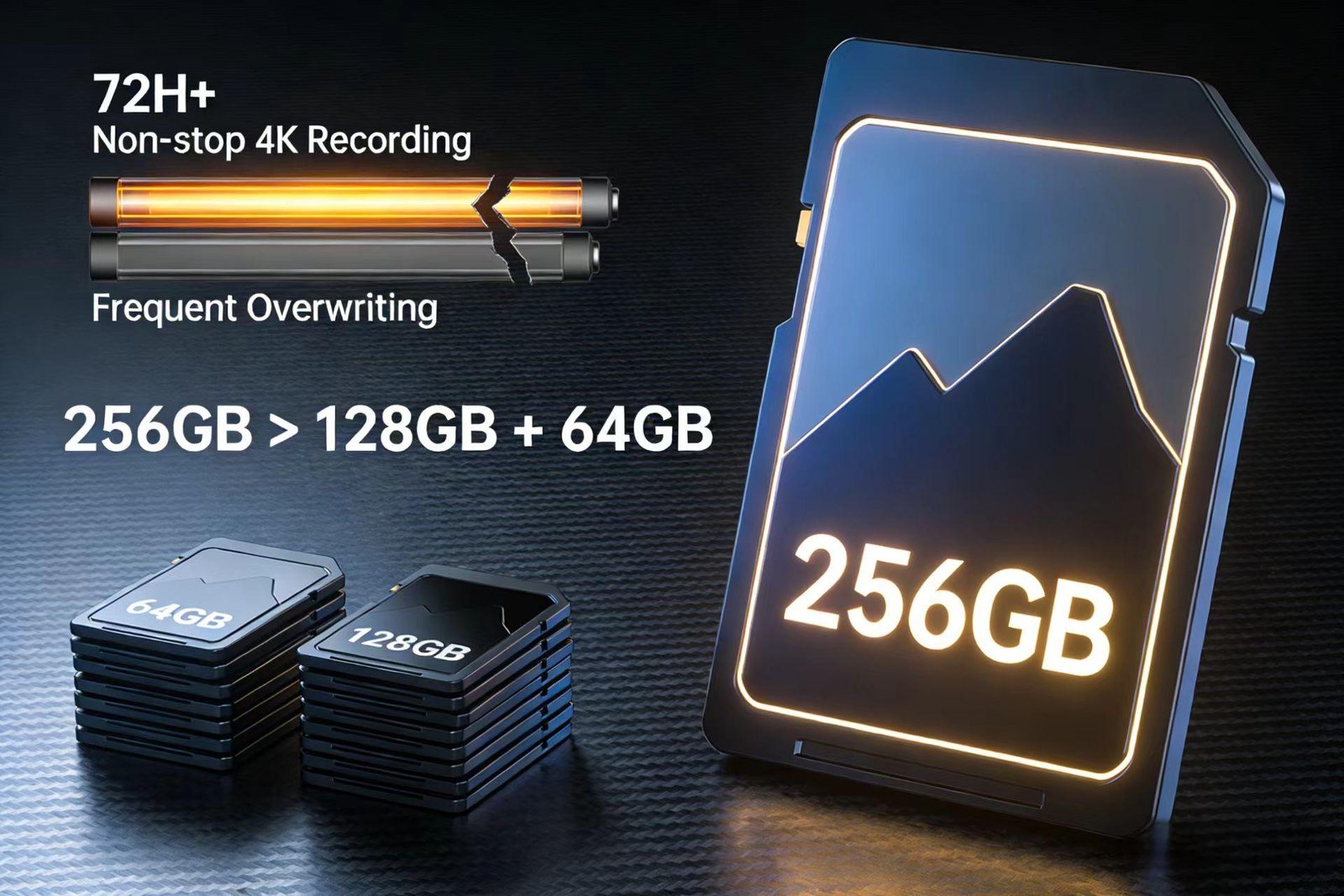
A true 4K dash cam records at a very high bitrate, often between 30 Mbps and 50 Mbps. If you use a 64GB card, the device will overwrite the oldest files every few hours. This frequent “Program/Erase” (P/E) cycle wears out the NAND flash memory very quickly.
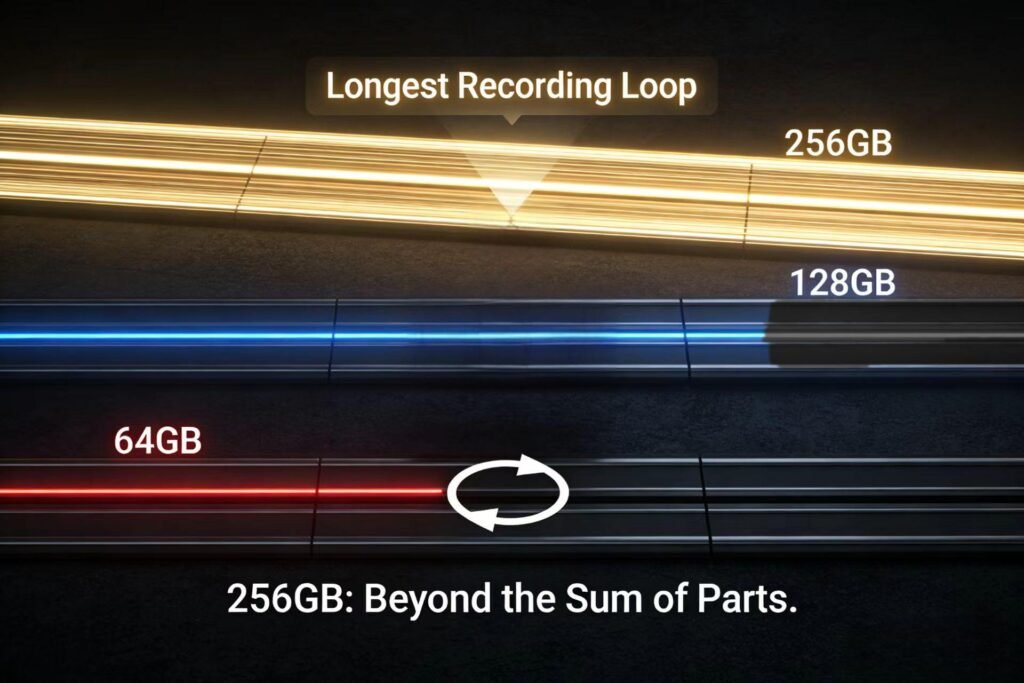
A 256GB card provides four times the “wear leveling” space compared to 64GB. This means the camera writes to the same physical memory cell much less often. It significantly extends the lifespan of the storage media. From a hardware signal perspective, high-capacity cards often use more advanced controllers. These controllers handle the high-speed data bursts of 4K video more efficiently.
Power stability is also a factor. 256GB cards require a stable current during peak write operations. High-end dash cams use dedicated power rails to ensure the voltage does not drop. If the voltage drops, the video file becomes corrupt. Furthermore, larger cards help with thermal distribution. They allow the system to maintain high-speed writes without triggering thermal throttling as quickly as smaller, older cards.
2. Hardware Design: Stability and Integrity
Supporting 256GB requires more than just a bigger slot. We must use SDIO 3.0 interfaces to achieve the necessary bandwidth. Our engineers focus heavily on Signal Integrity (SI). At high speeds, the copper traces on the PCB act like antennas. We must match the impedance of these traces to 50 ohms. This prevents signal reflection and data errors.
Heat is the enemy of automotive electronics. Constant 4K writing to a 256GB card generates significant heat. We design the internal housing with thermal pads to pull heat away from the microSD controller. The TF card slot itself must be “automotive grade.” It uses thicker gold plating on the pins. This prevents “fretting corrosion” caused by vehicle vibrations. Without these hardware optimizations, a 256GB card would fail in the harsh environment of a car dashboard.
3. Software Architecture: Files and Safety
On the software side, 256GB cards must use the exFAT file system. Our firmware includes custom “Bad Block Management” and “Wear Leveling” logic. We do not rely solely on the card’s internal controller. We use a Fragmented MP4 (fMP4) recording mechanism. This ensures that even if the power cuts out during an accident, the video is saved up to the last second.
We also implement a “Capacity Detection Strategy.” The software checks the card’s health and speed class every time the car starts. If the card is too slow or too old, the system warns the driver. This prevents the “fake recording” issue where the screen shows it is recording, but no data is actually saved.
4. Best Use Scenarios for 256GB Storage
While all drivers benefit from more storage, Long-haul Freight Trucks and Police Patrol Cars are the best fit for 256GB systems.
- Long-haul Trucks: These vehicles move for 10 to 12 hours a day. 256GB ensures a full day of 4K footage is stored before any overwriting happens.
- Police/Emergency Vehicles: These require “chain of custody” for evidence. High-resolution 4K video is useless if it was overwritten 30 minutes after an incident.
- Comparison: Civilian cars only drive about 1 hour a day. For them, 256GB is a luxury. For professional fleets, it is a legal and operational requirement.

5. Fleet Management Value: The 256GB BOM Strategy
For fleet managers in the UK or Germany, the Bill of Materials (BOM) is a financial tool. Choosing a dash cam that supports 256GB changes how a fleet operates. It is not just a hardware upgrade. It is a strategic investment in data safety.
Pros of the 256GB BOM:
- Pro 1: Lower Maintenance Costs. Fleet managers hate “downtime.” A 256GB card spreads the write load across more memory cells. This is called “wear leveling.” Because the card lasts twice as long as a 128GB card, you replace it less often. This reduces the labor cost of manual card swaps across hundreds of trucks.
- Pro 2: Extended Evidence Windows. Long-haul trucks often drive for 10 hours or more. A 256GB card can store an entire shift of high-bitrate 4K footage. If an incident happens early in the day, the video will not be overwritten by the time the truck reaches the depot. This protects the company from false insurance claims.
- Pro 3: Superior Hardware Stability. Our 256GB-ready BOM uses high-grade power regulators. These components handle the high current that large cards need during “peak write” cycles. This prevents the system from crashing during extreme summer heat in Southern Europe. High-quality hardware leads to fewer “black screen” errors.
The Main Drawback:
- The Con: Higher Initial Investment (CAPEX). The primary downside is the upfront price. A professional 256GB-supported dash cam and its specialized BOM cost more than basic 64GB models. For a fleet with 500 vehicles, this is a significant initial expense. However, most managers find that the long-term savings on card replacements and legal evidence far outweigh this cost.
6. Engineering Reliability and Life Cycles
To ensure 256GB stability, we perform rigorous testing. This includes High/Low Temperature Cycles from -20°C to +70°C. We conduct Long-term Write Aging Tests for 500+ hours. The device must pass ISO 16750 vibration standards.
We also focus on Automotive EMC/ESD. High-capacity cards can sometimes interfere with the vehicle’s GPS or FM radio. We use specialized shielding around the storage slot to block electromagnetic interference. Our goal is a 5-year service life in an automotive environment.
7. Why Multi-Channel 4K Demands 256GB
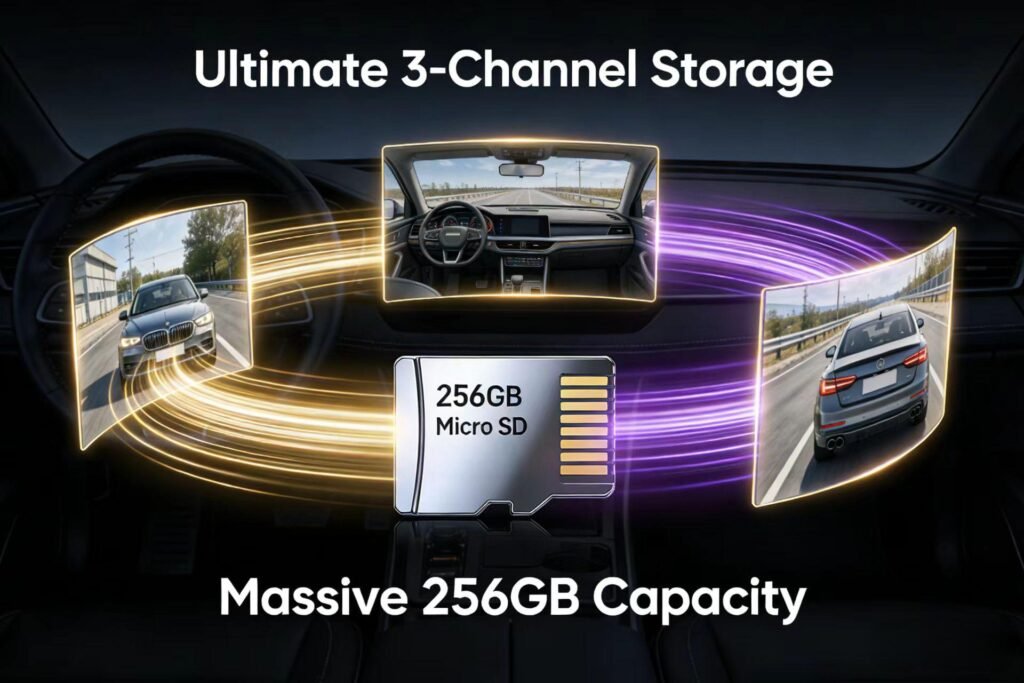
If you have a 3-channel (Front 4K + Cabin 1080P + Rear 1080P) or 4-channel system, the data throughput is massive. You are effectively writing three or four video files at the same time. A 128GB card would fill up in less than 3 hours in a multi-channel 4K setup. This makes it impossible to capture a full morning of driving. For professional 3/4-channel systems, 256GB is the standard configuration. It provides the necessary “buffer” to ensure high-bitrate data from all cameras is stored safely without constant, stressful overwriting.
6 Pillars of 256GB Storage:
| Core Point | Technical Dimension | Engineering Value & Description |
| Wear Leveling & Lifespan | NAND Flash Endurance | 256GB provides a much larger “pool” for wear leveling. By spreading data across more cells, it reduces the P/E (Program/Erase) cycle frequency. This doubles the lifespan of the media during 4K recording. |
| SDIO 3.0 & Signal Integrity | Interface Performance | Supporting 256GB requires the SDIO 3.0 protocol. Engineers must implement 50-ohm impedance matching on the PCB traces. This prevents signal reflection and ensures error-free 4K data transmission. |
| Thermal Management | Hardware Stability | Constant high-speed writing creates significant heat. Our hardware design uses dedicated thermal pads to move heat from the controller to the casing. This prevents thermal throttling in high-temperature environments. |
| Power-Loss Protection | Software Safety (fMP4) | We use the exFAT file system paired with fMP4 (Fragmented MP4) logic. Even if power is lost during a severe accident, the video remains safe. The system ensures the “last second” of evidence is never corrupted. |
| Multi-Channel Throughput | System Balancing | For 3-channel or 4-channel 4K systems, 256GB is a physical necessity. It provides the required write buffer and storage “history.” It ensures all camera feeds are saved without immediate overwriting. |
| Fleet TCO Optimization | Operational Value | While the BOM cost is higher, it reduces the Total Cost of Ownership (TCO). High-capacity systems result in fewer card failures and less vehicle downtime. This makes it the most cost-effective choice for professional fleets. |
Engineer’s Conclusion
In the automotive world, storage is not a passive component. It is an active participant in the system’s thermal and electrical environment. At DANSKER, we view 256GB support as a hallmark of professional engineering. By choosing 256GB for your 4K multi-channel systems, you are not just buying more space. You are investing in a system that manages heat better, lasts longer, and guarantees that your evidence is safe when it matters most. For 4K recording, 256GB isn’t an “option”—it’s the technical baseline.
Don’t let a small card be the weak link in your security. Explore our latest range of DANSKER 4K professional dash cams and ensure your fleet is protected by 256GB-ready engineering.