By [Olivia/DANSKER Team], Senior Marketing & Engineering Specialist
Why 128GB Defines the Modern Driving Experience
In the world of professional automotive electronics, data is more than just bits and bytes; it is your most reliable witness. At DANSKER, we design our dash cams to meet the rigorous demands of Western markets, from the high-speed Autobahns of Germany to the long-haul trucking routes across North America. As 4K resolution and multi-channel recording become the industry standard, the storage bottleneck has shifted. While 32GB or 64GB cards were once sufficient, they now fail under the pressure of high-bitrate video streams and constant rewrite cycles.
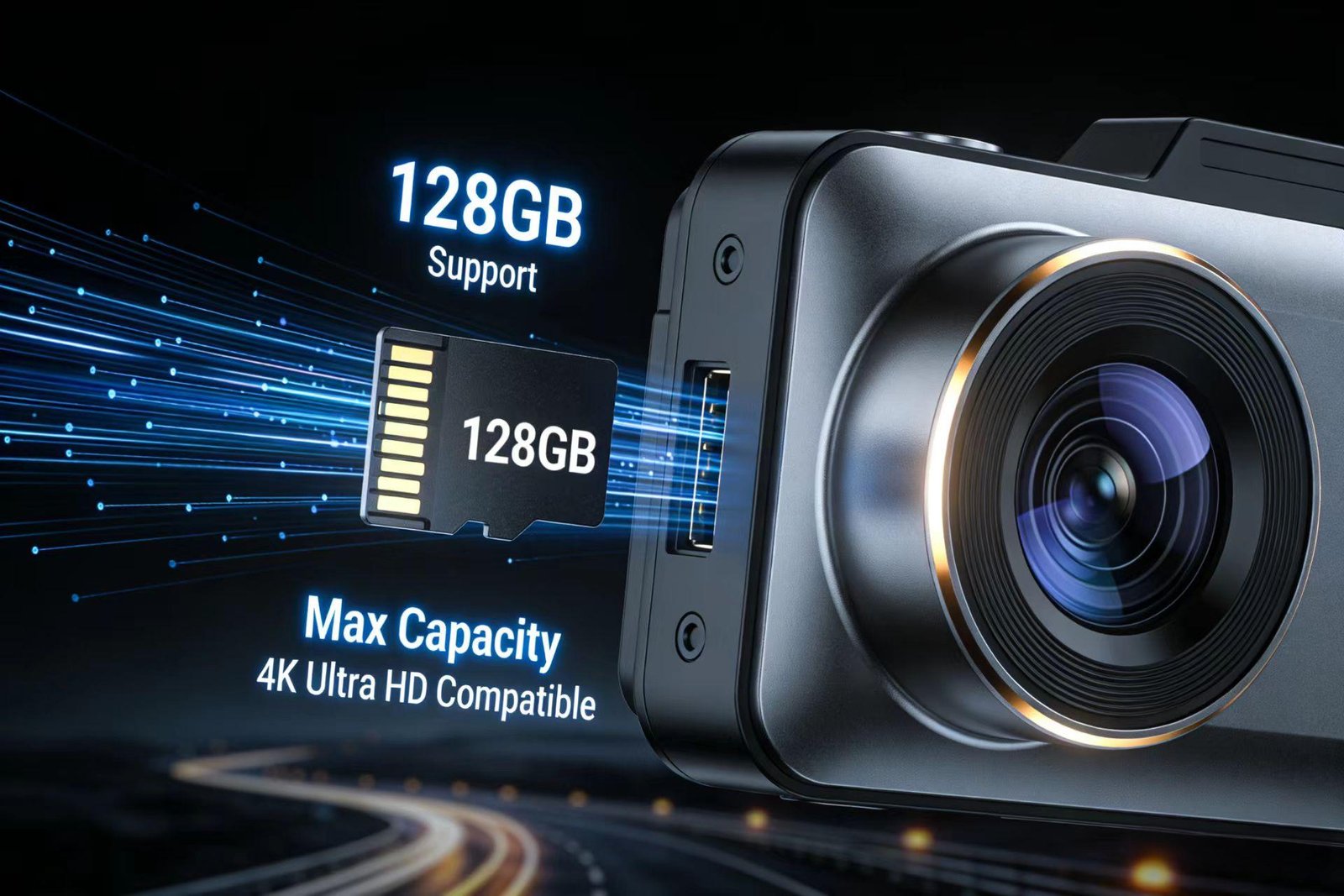
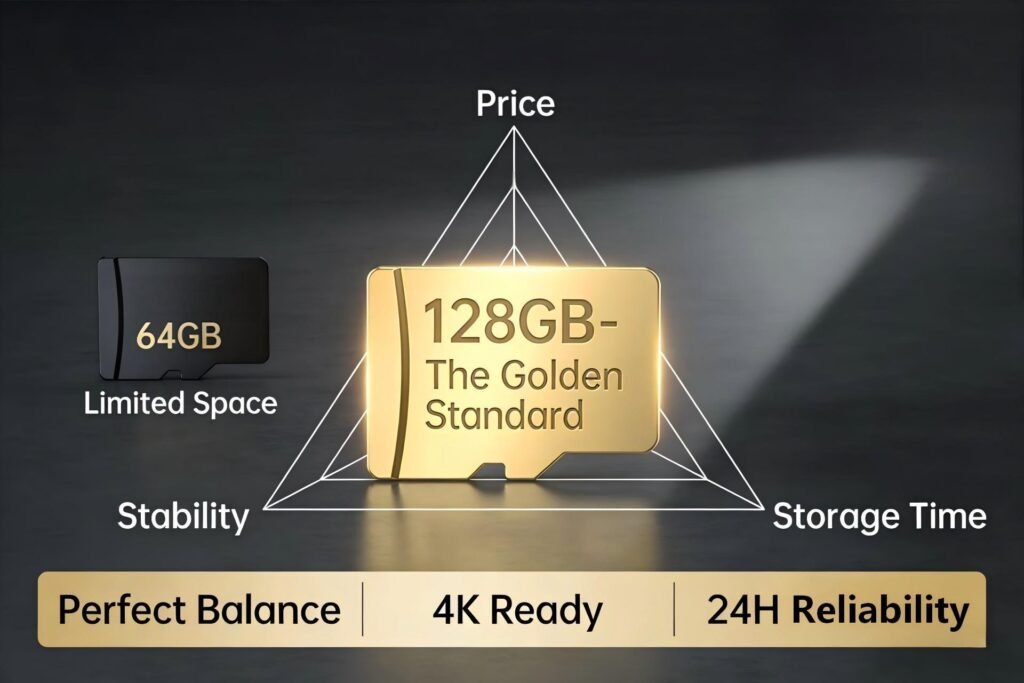
Today, 128GB storage has emerged as the “Golden Balance”—the perfect intersection of hardware cost, software stability, and user convenience. For a professional driver or a fleet manager, this capacity is not just a luxury; it is a technical necessity. It provides enough “buffer” to protect critical evidence while ensuring the physical memory chip survives the extreme temperatures of a vehicle cabin. In this post, we will go under the hood to explain why 128GB is the strategic choice for the next generation of professional-grade embedded dash cams.
1. The Golden Balance of Storage and Quality
Professional dash cams usually record in 2K or 4K resolution. These high-quality videos use a lot of data. A 128GB card provides the perfect “middle ground.” It stores about 8 to 12 hours of 4K footage or nearly 24 hours of 1080P video. This allows for a full day of driving without overwriting important files. It is the mainstream choice because it fits the budget of most consumers while meeting the technical needs of high-end lenses.
2. Hardware: Beyond Just a Memory Slot
Supporting 128GB requires high-level hardware design. We use advanced SDIO 3.0 interfaces to ensure high-speed data bus communication. The eMMC or SD controller must handle sustained write speeds (V30 class) without overheating. Since 128GB cards are often written to for hours, we design the PCB with optimized heat dissipation near the card slot. This prevents “thermal throttling” and ensures the electrical signals stay clean and reliable over years of use.

3. Software: Smart Data Management
On the software side, we use the exFAT file system for 128GB cards to handle large video files efficiently. Our firmware includes a Wear Leveling algorithm. This ensures the camera writes data evenly across the card to prevent “dead spots.” We also implement a Safe Shutdown Mechanism. If the car loses power suddenly, the software uses a “supercapacitor” to finish saving the last file. This prevents file corruption, which is common in low-end devices.
4. Ideal Use Cases for 128GB
The 128GB capacity is the “Best Fit” for several professional scenarios:
- Logistics & Long-Haul Trucking: Records the entire shift without gaps.
- Taxis & Rideshares: Provides enough space for both road-facing and cabin-facing cameras.
- Emergency & Police Vehicles: Ensures high-resolution evidence is kept for multiple shifts.
- Daily Commuters: Users only need to check or format the card once a month.
5. Fleet Management and BOM Value
For fleet managers, the BOM (Bill of Materials) for a 128GB system is highly cost-effective. While 256GB cards are expensive, 128GB offers a lower “Total Cost of Ownership.” It provides enough local buffer to delay expensive cloud uploads. Fleet owners save money on cellular data by only uploading “Event Clips” while keeping the full 128GB of history on the device. This creates a safety net for legal disputes and insurance claims, providing massive ROI for large vehicle fleets.
6. Reliability and Market Trends
In terms of lifespan, a 128GB High-Endurance card can last for years in a 4K system. In the European and American markets, 128GB support has grown significantly.
- 2022: 45% of mid-to-high-end sales.
- 2023: 60% as 4K became standard.
- 2024-2025: Projected to be 75%+ of the professional market. Consumers in these regions value “Set and Forget” reliability, making 128GB the most popular choice.
Core Technical Analysis: The 128GB Standard:
| Core Feature | Engineering Detail | Professional Value |
| The Golden Balance | Optimized for 4K @ 30fps or dual-channel 2K bitrates. | Provides 8–12 hours of ultra-HD footage before looping. |
| SDIO 3.0 Interface | Supports UHS-I / V30 high-speed bus communication. | Prevents frame dropping and “Write Speed Too Low” errors. |
| Thermal Stability | Advanced PCB layouts with dedicated heat sinks near the card slot. | Ensures 24/7 recording stability in 60°C+ cabin temperatures. |
| exFAT & FS Health | Specialized exFAT file system with high-speed indexing. | Faster file searching and reduced risk of file system “bloat.” |
| Wear Leveling | Firmware algorithms spread data across the entire 128GB NAND. | Extends the flash memory lifespan by 2–3 times vs. smaller cards. |
| Power-Loss Protection | Hardware Supercapacitors combined with metadata backup. | Guarantees the “Last Mile” of video is saved during a crash. |
Conclusion: The Future-Proof Standard for Professional Road Recording
In summary, the transition to 128GB support represents a calculated engineering decision for the modern automotive landscape. At DANSKER, we recognize that 128GB is not just a larger number; it is a critical technical threshold. It provides the necessary bandwidth for 4K UHD streams, ensures the thermal stability required for the European and American climates, and offers the “loop-cycle” longevity that professional fleets demand.
By balancing hardware costs with high-endurance software mechanisms like Wear Leveling and exFAT optimization, 128GB has become the definitive “Golden Point.” It offers enough storage for a full day of high-resolution evidence without the extreme price tag of larger capacities. As we look toward 2026, this capacity will remain the industry benchmark for reliability, protecting both drivers and businesses with every mile traveled.