By: [William/Senior Engineering Lead at DANSKER]
As the R&D Director at DANSKER, I’ve spent over a decade navigating the intricate hardware-software intersections of automotive electronics. One question frequently surfaces from our partners in the UK, Germany, and North America: “Why is Time-Lapse Recording a premium hallmark, and does it truly matter?”
Today, we’ll strip back the casing and look at the engineering logic that makes this feature a cornerstone of modern vehicle security.
1. The Engineering Barrier: Why It’s a Mid-to-High-End Exclusive
In the world of automotive Grade-A electronics, “recording” is easy; “intelligent persistence” is hard. Low-end dash cams utilize basic SoCs (System on Chips) that are designed for linear, high-frame-rate streaming. They lack the sophisticated ISP (Image Signal Processor) logic required to handle variable frame-rate encoding efficiently.
Mid-to-high-end models, like our DANSKER flagship series, employ advanced chipsets capable of I-frame manipulation. Implementing time-lapse requires a robust firmware architecture that can sustain a low-power state while keeping the CMOS sensor active. This necessitates higher R&D costs in thermal management and specialized power-efficient kernels, which budget models simply cannot afford without overheating or crashing.
2. Hardware Prerequisites: Beyond the Lens
True Time-Lapse functionality is not just a software toggle; it demands a synergy between several critical components:
- Advanced PMIC (Power Management Integrated Circuit): The mainboard must interface with a Hardwire Kit that supports ACC (Accessory) Logic. It needs to detect the moment the ignition kills and switch to a “low-duty cycle” state.
- Voltage Cut-off Protection: High-end boards integrate a precision voltage monitoring system to ensure the dash cam doesn’t drain the car battery below a critical threshold (e.g., 11.8V or 12V), a feature requires high-quality capacitors and resistors.
- High-Endurance Storage Controllers: Writing single frames at intervals (e.g., 1fps) creates a specific type of stress on the NAND flash. Professional-grade dash cams use controllers that optimize Write Amplification to prevent SD card burnout during 24/7 operation.
3. The Value Proposition: Efficiency and Evidence
The primary value of Time-Lapse is Storage and Review Optimization.
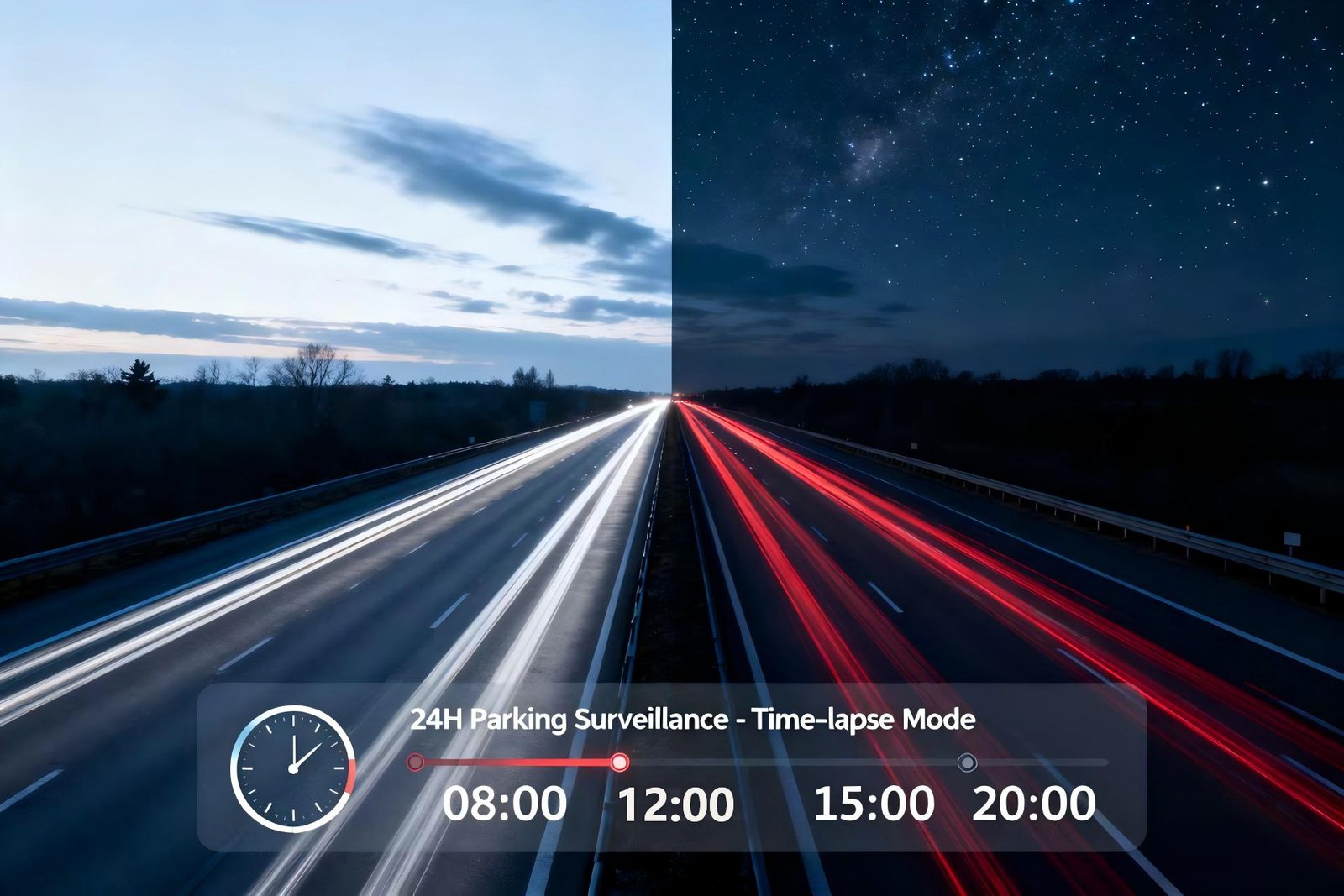
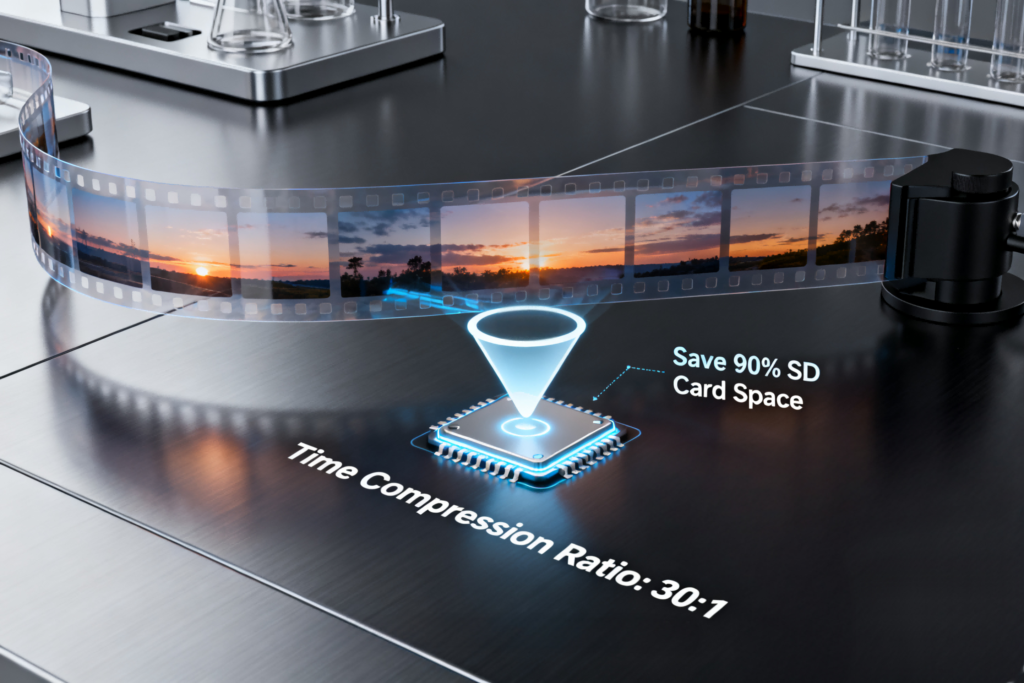
- Space Efficiency: Standard 30fps recording consumes massive amounts of data. Time-Lapse (1fps) can compress 24 hours of parking surveillance into just 30-40 minutes of footage.
- Lower Thermal Load: By reducing the encoding frequency, we reduce the heat generated by the processor. In the fluctuating climates of Western Europe or Scandinavia, this prevents the device from entering “Thermal Shutdown,” ensuring it’s actually recording when a hit-and-run occurs.
4. The EU/US Market: A Genuine Necessity?
In the European and North American markets, Time-Lapse isn’t just a “nice-to-have”—it’s an insurance essential.
- Street Parking Culture: In cities like London, Paris, or New York, street parking is the norm. The risk of “vandalism” or “unwitnessed scrapes” is high.
- Legal & Insurance Claims: Providing a 24-hour condensed video of a vehicle’s surroundings is far more persuasive to insurance adjusters than a fragmented “G-sensor triggered” clip that might have started too late to catch the culprit’s license plate.
- Regulatory Compliance: In regions like Germany (GDPR concerns), Time-Lapse is often seen as a more “passive” and acceptable form of surveillance compared to continuous loop recording, provided it’s used for incident protection.
Engineer’s Technical Summary: The DANSKER Engineering Philosophy
From a pure engineering standpoint, a dash cam is more than just a camera; it is a vehicle’s “Black Box” that must operate in one of the most hostile electronic environments—subject to extreme temperature fluctuations, power surges, and constant vibration.
Time-Lapse recording is the perfect embodiment of Hardware-Software Synergy. It isn’t just a “feature” we toggle on; it is a sophisticated ballet between the PMIC’s low-quiescent current management, the ISP’s frame-dropping logic, and NAND flash longevity algorithms. When we design for the European and American markets, we prioritize Data Integrity and Power Resilience.
My philosophy is simple: The best safety technology is the one that works silently and reliably when you aren’t there. By choosing a high-end device with a dedicated time-lapse architecture, you aren’t just buying a gadget; you are investing in a robust, 24/7 forensic tool that ensures “Zero Blind Spots” in your vehicle’s security lifecycle.