By: [William/Senior Engineering Lead at DANSKER]
As the Product R&D at DANSKER, with years of experience in automotive software architecture and hardware integration, I have seen the dash cam market evolve from a niche enthusiast accessory into a standard safety requirement across North America and Europe. While multi-channel systems (front, rear, and cabin) are gaining traction, the Single-Channel (1-CH) Dash Cam remains a dominant force.
From a software engineering perspective, “less is often more.”
1. Market Dynamics: The Persistent Dominance of Single-Channel (2022-2025)
Despite the aggressive marketing of dual-channel systems, our internal data and broader market research indicate that single-channel dash cams accounted for approximately 45% to 52% of the market share in the US, Canada, and Europe between 2022 and 2025. While multi-channel units are the “fastest-growing” segment, the 1-CH category maintains its lead due to its status as the primary entry point for first-time buyers and its widespread adoption in commercial fleets. In regions like Germany and the UK, where privacy regulations (such as GDPR) are stringent, many users prefer a single forward-facing lens to avoid the legal complexities associated with recording rear passengers or interior cabin space.
2. The User Rationale: Minimalism and High-Fidelity Evidence
Why do a significant portion of Western consumers still opt for a single lens?
- Aesthetic & Stealth: European drivers, particularly in the premium segment (BMW, Audi, Mercedes), prioritize a clean cockpit. A 1-CH device is easier to hide behind the rearview mirror, maintaining the vehicle’s OEM aesthetic.
- DIY Practicality: Routing cables through the headliner to the rear window is a significant barrier. Western consumers value “Plug-and-Play” solutions that don’t require professional hardwiring or invasive trim removal.
- The “Front-First” Logic: Statistically, the most critical evidence required for insurance—fault in intersections, “cut-offs,” and signal violations—occurs in the forward field of view (FOV).
3. Engineering Advantages: ISP Efficiency and Thermal Stability
From a software and hardware design standpoint, a single-channel system offers technical superiorities that multi-channel units often struggle to match:
- Optimized Bitrate & Encoding: In a 1-CH setup, the Image Signal Processor (ISP) can dedicate its entire clock cycle to a single stream. This allows for higher bitrates and the use of H.265 (HEVC) encoding at 60fps without dropped frames, ensuring license plates are legible even at high speeds.
- Superior Thermal Management: Multi-channel encoding generates significant heat. By processing only one stream, 1-CH devices experience much lower thermal throttling, leading to higher reliability during hot North American summers or long drives through Southern Europe.
- Storage Longevity: Writing a single high-quality stream reduces the NAND flash wear-and-tear on the microSD card. It simplifies the file system’s loop-recording logic, reducing the risk of “write errors” or corrupted segments during critical G-sensor events.
4. Practical Drawbacks: The “Context Gap”
As engineers, we must also acknowledge the limitations. The primary disadvantage of a 1-CH system is the lack of rear-end context.
- Blind Spots: Approximately 30% of collisions in the US are rear-end impacts. While a front camera proves you didn’t hit the person ahead, it provides no visual evidence of a “hit-and-run” from behind.
- Insurance Limitations: Without rear footage, it is harder to prove “aggressive tailgating” or specific types of insurance fraud where a vehicle intentionally strikes you from the rear or side.
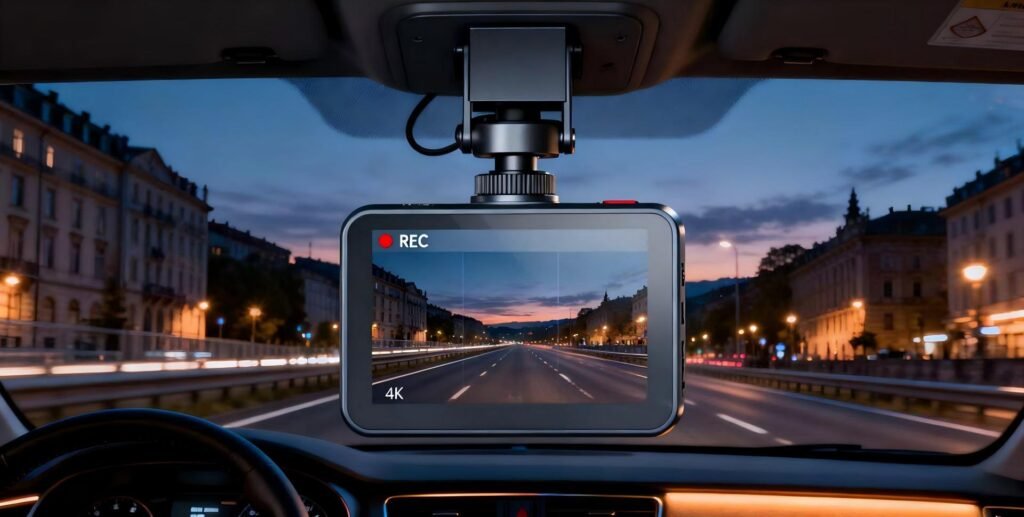
Engineer’s Summary: The Philosophy of Reliability
“In the world of automotive software, every additional hardware interface is a potential failure point. A single-channel system is, by definition, more stable. It requires less bus bandwidth, generates fewer write-cycles on the NAND flash, and simplifies the loop-recording logic within the firmware. For the driver who prioritizes bulletproof reliability and ultra-high image clarity over total perimeter coverage, the 1-CH dash cam is not a ‘basic’ choice—it is a specialized, high-performance tool.”
DANSKER Guidance: Precision Where It Matters Most.
Whether you are navigating the Autobahn or the I-95, DANSKER provides the engineering clarity you need to protect your journey. Focus on the road ahead—we’ll handle the rest.