By: [William/Senior Engineering Lead at DANSKER]
When we design for the European and North American markets, the choice of a display isn’t just an aesthetic decision—it’s a critical engineering requirement for safety, reliability, and user trust.
In the dash cam industry, the shift toward IPS (In-Plane Switching) technology has been transformative.Below is a deep dive into the technical and market-driven reasons why IPS has become the gold standard for DANSKER’s premium lineup.
1. Market Penetration: The Rise of IPS (2022–2025)
In the Western markets (US, UK, Germany, and the Nordic regions), consumer demand has pivoted toward “Evidence-Grade” recording. Between 2022 and 2025, the market share for dash cams equipped with IPS screens has seen a significant upward trajectory. In 2022, IPS was largely reserved for flagship models, representing roughly 40% of the market. By 2025, as 4K resolution and dual-channel (front/rear) systems became the baseline, IPS adoption has surged to approximately 70-75% of new releases in the mid-to-high-end segments. Users in these regions prioritize high-fidelity playback and user-friendly interfaces, pushing legacy display technologies out of the mainstream.
2. The Alternatives: What Happens Without IPS?
Before IPS became the standard, and still in many “budget” or “entry-level” models, manufacturers utilized TN (Twisted Nematic) TFT-LCD panels.
- TN Panels: These are cheaper to produce but suffer from “gray-scale inversion” and severe color shifting when viewed from an angle.
- Non-Screen Units: Some models omit the screen entirely (screenless), relying solely on Wi-Fi/App connectivity. While compact, they lack the “at-a-glance” status and immediate playback capability that professional drivers in Europe and North America often require.
3. The Functional Value of IPS in Automotive Environments
From a software and systems engineering perspective, the value of an IPS screen in a dash cam is three-fold:
- Extreme Viewing Angles: IPS provides a consistent 178° viewing angle. Whether the camera is mounted near the rearview mirror or on a vertical truck windshield, the driver or passenger can see the status and framing without the “washed-out” effect typical of TN screens.
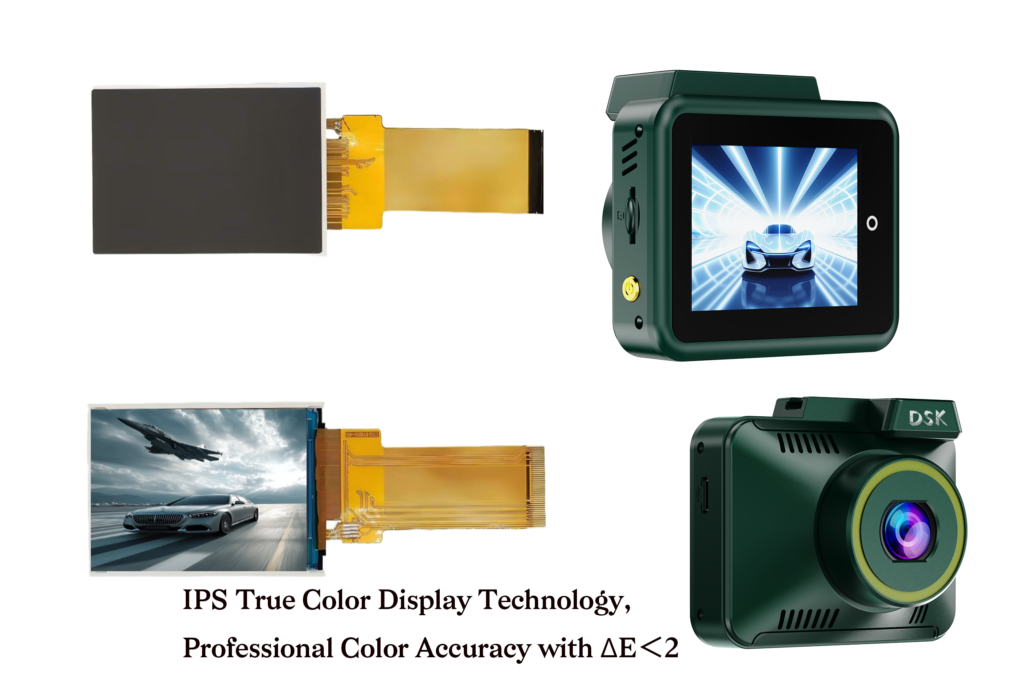
- Color Gamut & Evidence Verification: IPS panels typically cover 95%+ of the sRGB color space. In a legal or insurance context, accurate color reproduction is vital for identifying vehicle colors, traffic light states, and road signage.
- User Interface (UI) Fluidity: The stable crystal structure of IPS allows for better touch-response integration and clearer menu rendering, which is essential for the localized, multi-language UIs we develop for the Nordic and Western European markets.
4. Defining the “A-Spec” (Automotive-Grade) Middle-High End
Why does an “A-Spec” IPS screen separate a premium DANSKER product from a generic one? It comes down to AEC-Q100 standards and environmental resilience:
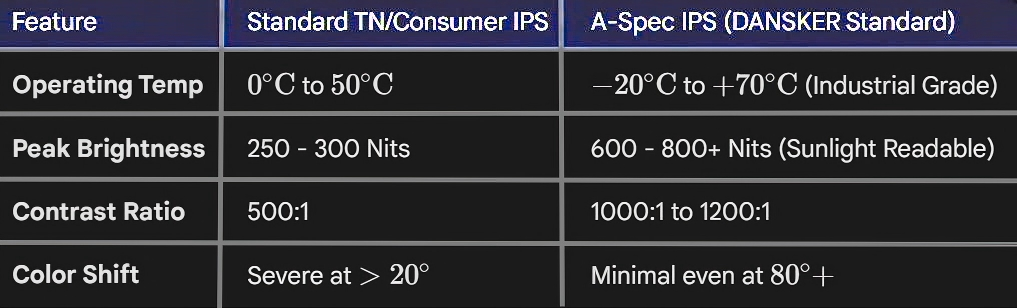
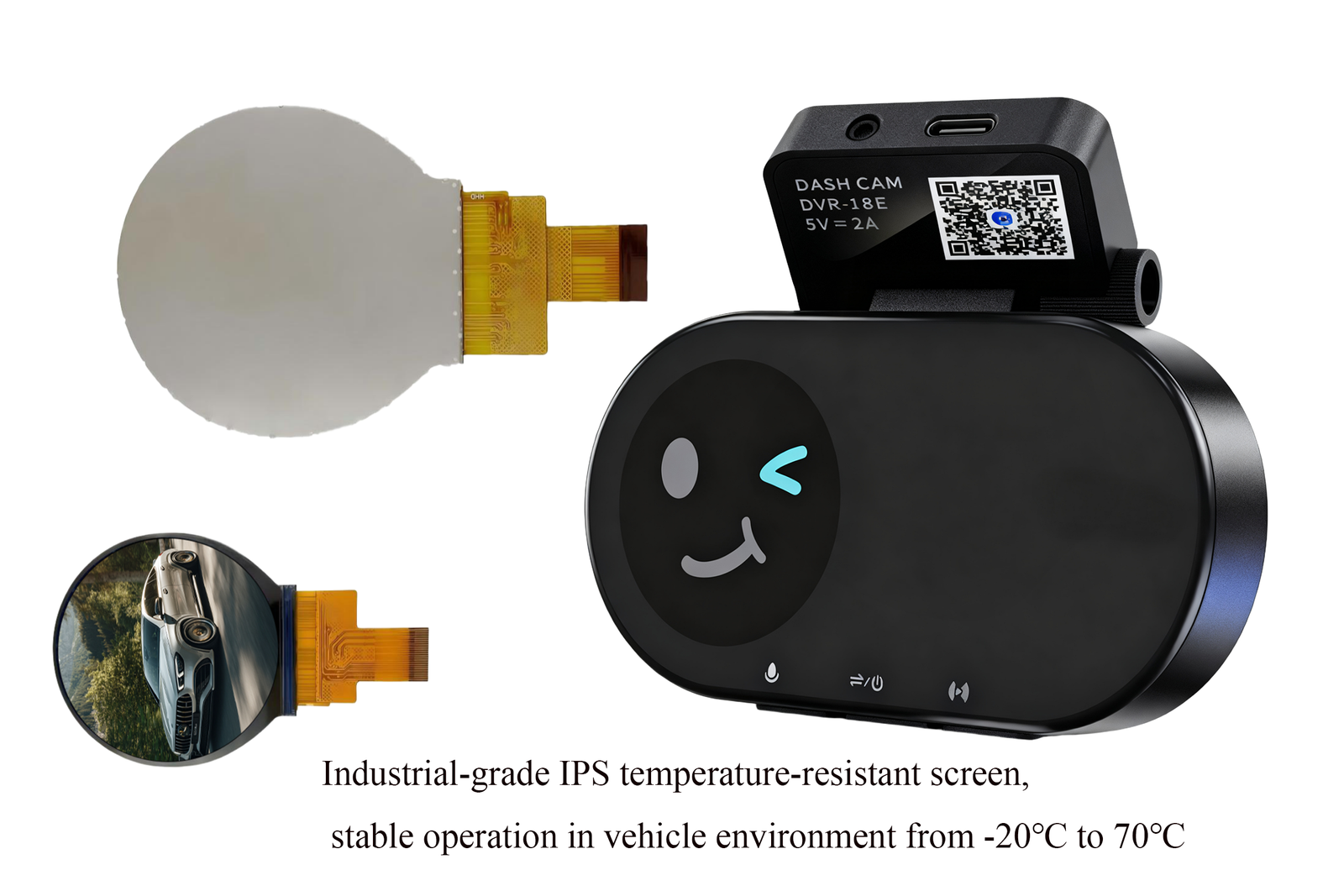
A-Spec IPS panels use specialized liquid crystals that don’t “pool” or turn black under the direct thermal load of a windshield in the Texas summer or the freezing winters of Norway. This thermal stability is why they are positioned as mid-to-high-end components.
5. IPS Screen vs. Screenless: The User Experience Advantage
While screenless dash cams are valued for their “stealth” factor, IPS-equipped models offer superior Operational Readiness:
- Immediate Calibration: You don’t need to pull out a smartphone to check if the camera is aimed correctly after a car wash or window cleaning.
- On-Site Evidence: In the event of a roadside incident, being able to play back a high-resolution video on an IPS screen with accurate color and contrast can settle a dispute with law enforcement or other drivers on the spot.
- System Status at a Glance: Drivers can instantly verify that the SD card is recording, the GPS is locked, and the microphone is active via the OSD (On-Screen Display).
The Engineer’s Perspective: Why We Don’t Compromise
As an engineer, my focus is always on the “Mean Time Between Failures” (MTBF) and the integrity of the data we provide to the user. A dash cam is, first and foremost, a safety device. Using a standard TN panel or a low-grade display might save on manufacturing costs, but it fails the driver when they need it most—under the glaring sun of a California highway or a freezing morning in Oslo.
At DANSKER, our move toward A-Spec IPS technology is a deliberate engineering choice. We prioritize the stability of the liquid crystal layer to ensure that even after hours of exposure to high thermal loads, the interface remains responsive and the playback remains crystal clear. We aren’t just building a screen; we are building a reliable witness. When you choose an IPS-equipped DANSKER device, you are choosing a product designed to withstand the environment, not just inhabit it.