By: [William/Senior Engineering Lead at DANSKER]
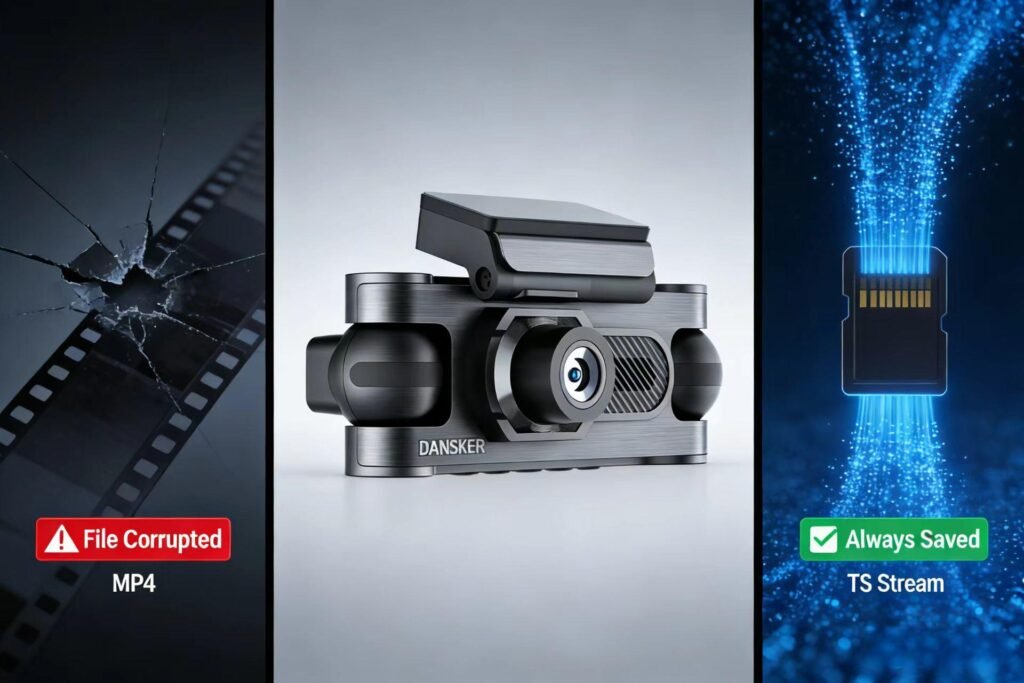
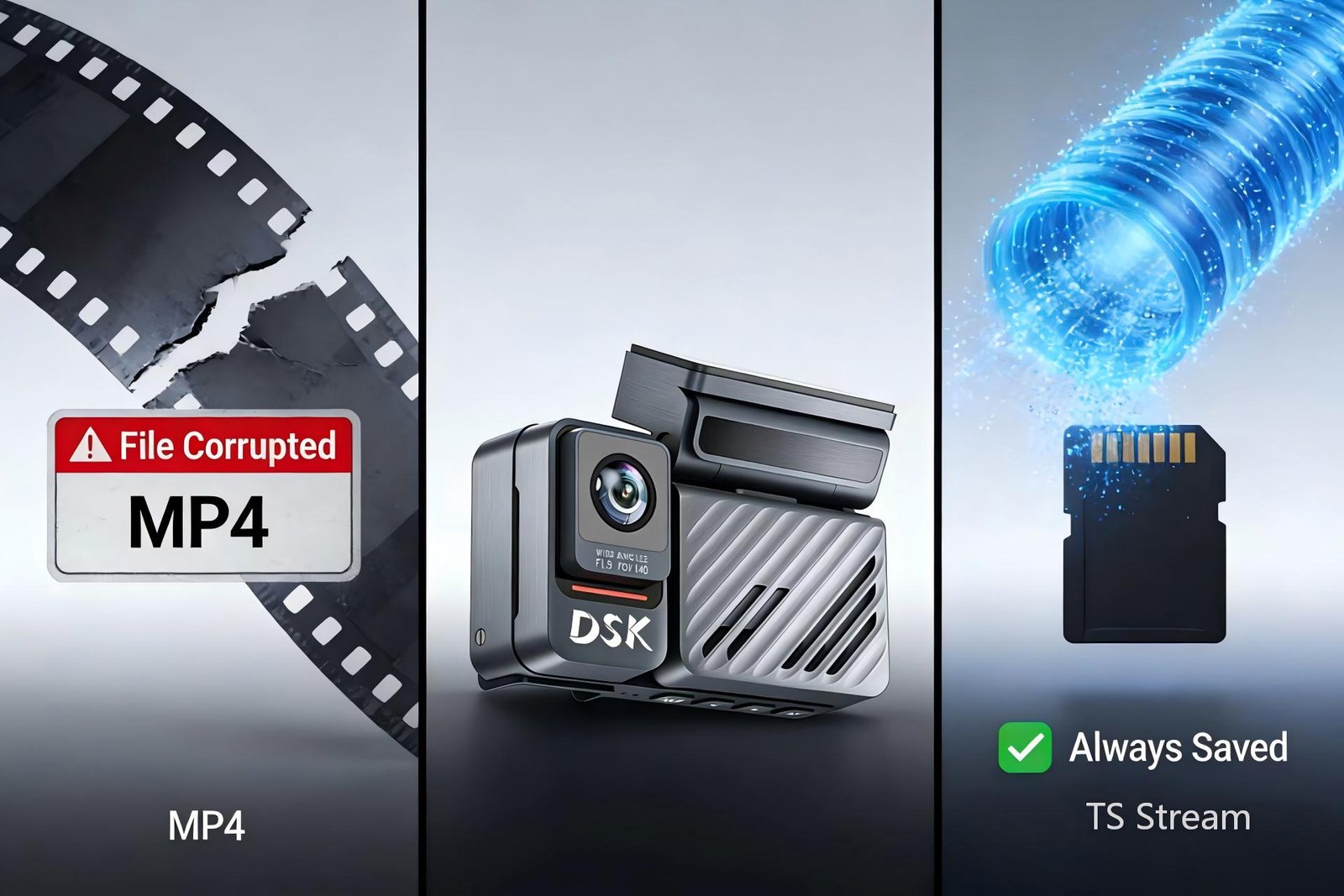
As a senior software engineer at DANSKER, focusing on the rigorous demands of the North American and European automotive markets, I am often asked: “Why does the file format matter if the video looks the same?” The answer lies not in the pixels, but in the architecture of data integrity. In markets like Germany, the UK, and the US, where dash cam footage is a critical legal and insurance asset, the transition from traditional MP4 to TS (Transport Stream) is not just a feature—it is a necessity.
Here is a professional breakdown of why TS Stream is redefining the “high-end” dash cam segment.
1. What is TS Stream? An Engineer’s Perspective
From a software engineering standpoint, MPEG-TS (Transport Stream) is a communication protocol for transmitting audio, video, and data. Unlike the MP4 (MPEG-4 Part 14) container, which is “index-heavy,” TS is “packet-oriented.”
- MP4 Architecture: Uses a
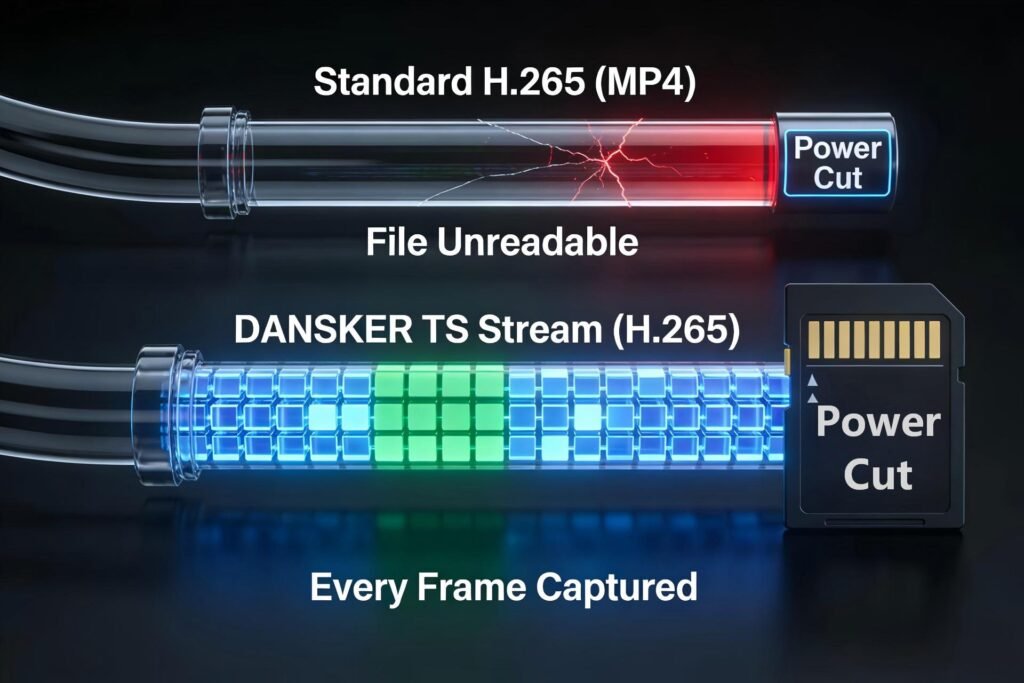
moovatom (a metadata header) that typically resides at the end of the file. To play an MP4, the player must read this header to understand the video’s structure. If the recording is interrupted before the file is “closed,” themoovatom is never written, leaving the entire file unreadable. - TS Architecture: Video is sliced into independent 188-byte packets. Each packet contains its own synchronization and timing information (PCR – Program Clock Reference).
The Software Verdict: TS is essentially “live-streaming” to your SD card. Every millisecond recorded is a millisecond saved, regardless of what happens to the power source a second later.
2. The Mid-to-High End Barrier: Why TS Costs More
You won’t find true TS Stream functionality in budget dash cams. Implementing it requires a significant leap in SoC (System on Chip) performance and firmware complexity:
- Real-time Multiplexing (Muxing): High-end chips (like those from Ambarella or Novatek’s top-tier series) must constantly wrap encoded video into TS packets while simultaneously handling 4K resolution and AI-based ADAS features. This requires high I/O throughput.
- Buffer Management: To prevent frame drops during the constant writing of small packets, the device needs a larger DDR/SRAM buffer. Low-end chips lack the memory overhead to manage this “continuous flush” without overheating or lagging.
- File System Optimization: Writing thousands of small packets requires a sophisticated Flash Translation Layer (FTL) in the firmware to prevent file system fragmentation on the SD card.
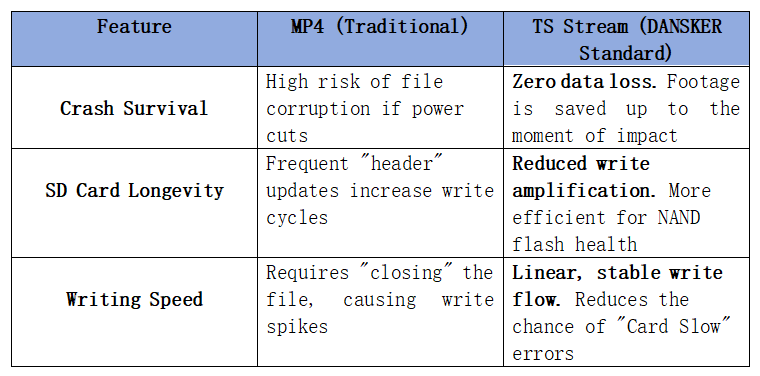
3. TS vs. MP4: The Reliability and Hardware Advantage
The technical superiority of TS provides two massive advantages in storage:
4. Strategic Value: From Private Drivers to Fleet Management
In the Western market, dash cam footage is evidence.
- For Private Drivers: In a severe collision, the power cable may be severed. With TS, the vital seconds leading up to the impact are preserved. With MP4, that critical evidence often becomes an “unsupported file format.”
- For Fleet Management (B2B): For logistics companies in the US or UK, data integrity is a compliance requirement. TS Stream ensures that even if a driver attempts to tamper with the device or if the vehicle suffers a total power failure, the telematics data and video remain intact for insurance claims.
5. Future Trends: Is TS Stream Necessary?
As we move toward 2026 and beyond, the demand for TS Stream will only grow. With the rise of Cloud-connected dash cams and 5G Telematics, TS is the natural choice because it is native to streaming.
In Europe, where GDPR and strict evidentiary rules apply, the ability to recover uncorrupted, timestamped packets is becoming a baseline requirement for legal admissibility. We expect TS to migrate from “high-end” to “standard” in the next three years as SoCs become more efficient.
Engineer’s Summary: The Dev Bench Perspective
From a firmware architecture perspective, the shift from MP4 to TS Stream represents a move from “Best-Effort Recording” to “Deterministic Data Storage.” > In the world of automotive safety, we cannot afford the “File Open/Close” vulnerability inherent in MP4 containers. By utilizing TS Stream, we implement an atomic write strategy: each packet is a complete entity. If the system experiences a sudden power loss (a common scenario in high-impact collisions), the hardware doesn’t need to “save” the file; the data is already there. For us at DANSKER, engineering for the Western market means prioritizing data atomicity and fault tolerance over mere file compatibility. TS is not just a format; it is our fail-safe.
When Should You Choose TS?
At DANSKER, we recommend prioritizing TS Stream if you fall into these categories:
- Commercial/Fleet Operators: Where “missing footage” equals a lost legal case.
- Professional Drivers (Uber/Lyft): Where continuous recording and instant save are non-negotiable.
- High-Performance Users: If you are recording in 4K or Multi-channel (Front/Rear/Cabin), TS is the only way to ensure the high bitrate doesn’t lead to file corruption.