
By [Olivia/DANSKER Team], Senior Marketing & Engineering Specialist
As a senior embedded engineer at DANSKER, I often get asked why our entry-level dash cams stick to 25fps when the world seems obsessed with higher numbers. Many users assume that 25fps is just a way to cut costs. However, in automotive electronics, every specification is a careful balance between performance, power, and environmental stability. Today, I will take you behind the scenes of our hardware logic to show you why 25fps is actually a high-efficiency engineering choice for the European and North American markets.
1. Understanding FPS from a Professional Engineering Perspective
In automotive electronics, FPS (Frames Per Second) is the temporal sampling rate of the CMOS Image Sensor (CIS). From a signal processing standpoint, it defines the “Nyquist frequency” of motion capture.
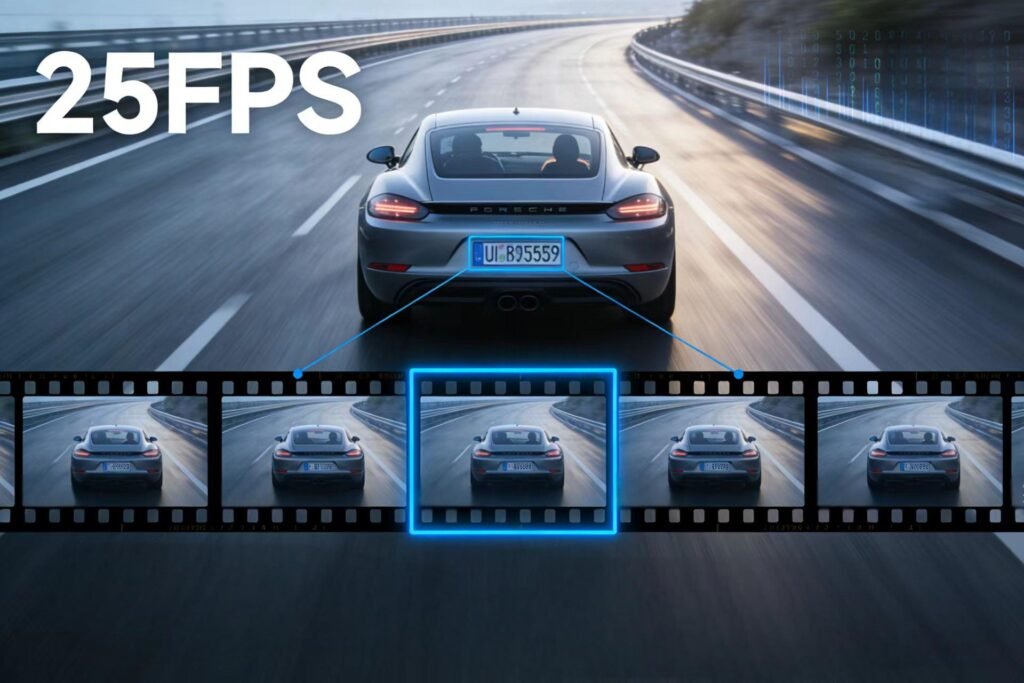
- Temporal Resolution: Each frame is a discrete data sample. At 25fps, the system captures one image every 40ms.
- Integration Time (Shutter Speed): FPS dictates the maximum exposure window. In a 25fps system, the shutter can stay open longer compared to 60fps, which is crucial for light accumulation in automotive environments.
- Data Throughput: It determines the MIPI CSI-2 bus load and the ISP (Image Signal Processor) clock frequency required to process raw Bayer data into YUV/RGB formats.
2. The PAL Standard: Why 25fps?
The 25fps rate is intrinsically linked to the PAL (Phase Alternating Line) television standard, historically used in Europe, China, and much of the world.
- Grid Frequency Alignment: The “Bottom Logic” is the AC power grid frequency. In PAL regions (Europe/UK), the grid operates at 50Hz. 25fps is exactly half of this frequency.
- Sampling Sync: By sampling at 25fps, the Sensor/SoC can easily synchronize with the 50Hz flicker of artificial lighting (LED streetlights, traffic signals).
- Hardware Legacy: Most entry-level SoCs (System-on-Chip) use hardware encoders optimized for PAL/NTSC clock trees to maintain compatibility with global analog/digital display outputs.
3. The “Sweet Spot” of Engineering: Why 25fps Rules Entry-Level
Entry-level dash cams prioritize Reliability and Cost-to-Performance (CP) Ratio.
- Light Sensitivity (Low-Light Performance): Lower FPS allows for longer exposure times (1/25s vs 1/30s). This means the sensor collects more photons per frame, significantly reducing digital noise (SNR improvement) in night driving without needing expensive, large-format sensors.
- Anti-Flicker Logic: In the UK or Germany, a 30fps camera often records “flickering” traffic lights because of the 50Hz/60Hz mismatch. 25fps stays in phase with the 50Hz grid, ensuring solid, non-blinking evidence.
- Thermal and Power Efficiency: Processing 25 frames puts significantly less load on the ISP and H.264/H.265 encoder than 30fps. This prevents thermal throttling—a critical failure point in dash cams sitting behind hot windshields.
- Storage Optimization: 25fps reduces bit-rate requirements, allowing longer loop-recording cycles on standard microSD cards, which is a key selling point for budget-conscious users.
4. Strategic Application Scenarios
The 25fps configuration is highly effective for “Evidence-First” scenarios where motion fluidity is secondary to image clarity and reliability:
- Logistics & Long-Haul Trucking: High-stability recording for 10+ hour shifts.
- Public Transport & Taxis: Reliable in-cabin and road-facing surveillance under varied city lighting.
- Civilian Daily Commutes: Sufficient for capturing license plates and accident dynamics in urban environments.
5. Market Insight: 25fps/30fps Market Share (2022-2025)
In the European and North American markets, while 4K/60fps gains “mindshare,” the “Basic/Standard” segment (primarily 25/30fps) remains the volume leader due to insurance mandates and fleet deployments.
| Year | 25fps/30fps (Entry-Mid) Share | High-Frame Rate (60fps+) Share |
| 2022 | 78% | 22% |
| 2023 | 74% | 26% |
| 2024 | 69% | 31% |
| 2025 (Est.) | 65% | 35% |
Data Note: Despite the rise of 60fps, 25/30fps units still account for ~65% of sales in 2025, driven by the massive “Basic” dash cam segment (approx. 39% of the total market) and fleet-wide adoptions.
Engineer’s Summary
From my perspective at the R&D bench, 25fps is not a limitation. It is a tool for stability. In the automotive world, the best camera is the one that never fails when an accident happens. By choosing 25fps, we give you better night vision, a cooler device, and video that matches the European power grid. It is the most practical choice for everyday safety and professional fleet management.