By [Olivia/DANSKER Team], Senior Marketing & Engineering Specialist
In the world of automotive electronics, the difference between 25FPS (Frames Per Second) and 30FPS is much more than just five extra frames. As an embedded engineer at DANSKER, I see how these technical choices impact driver safety and fleet liability. While 25FPS serves the entry-level market, professional-grade systems rely on 30FPS for critical accuracy.
1. The Core Differences: Fluidity and Motion Blur
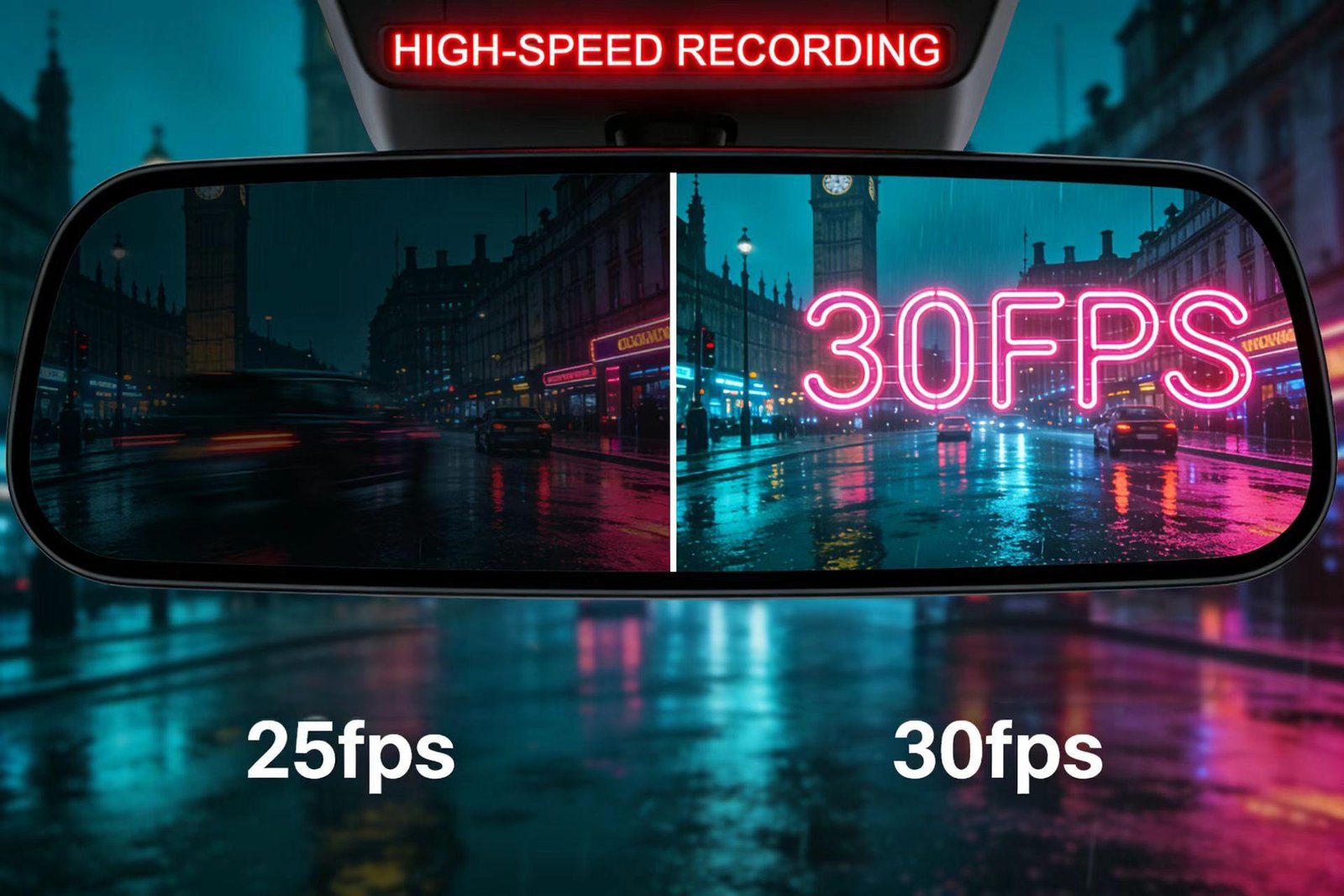
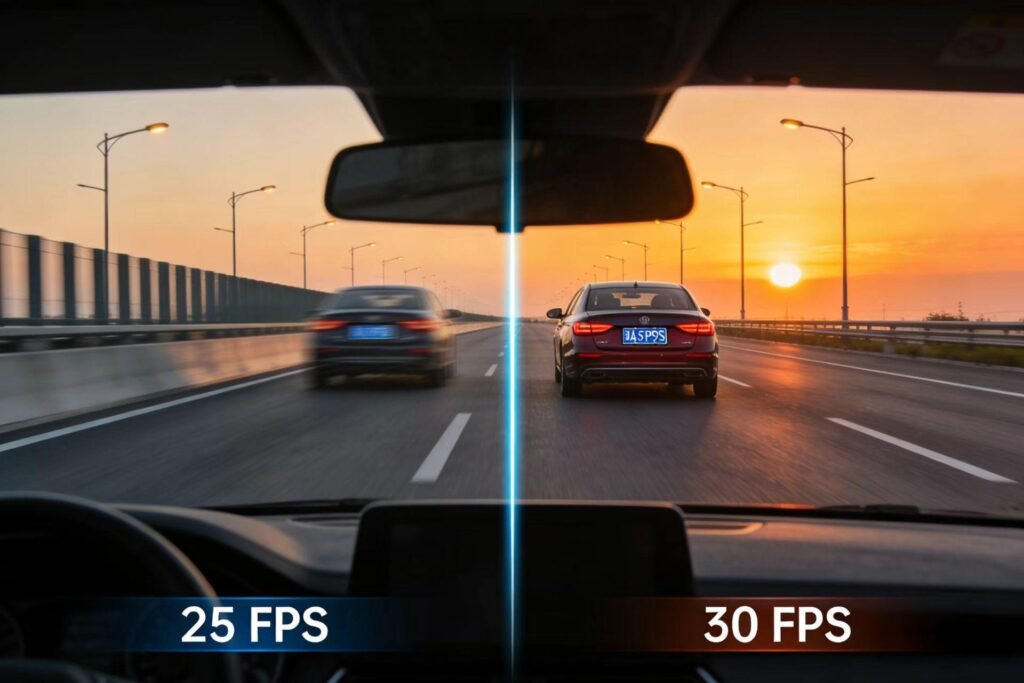
The primary difference lies in temporal resolution. A 30FPS camera captures 20% more visual data every second compared to a 25FPS model.
- Motion Blur: At high speeds on a German Autobahn or a US Interstates, 30FPS significantly reduces motion blur. This makes it easier to freeze a frame and read a license plate.
- Visual Fluidity: 30FPS aligns with the standard NTSC refresh rate. It provides a smoother playback experience that feels more natural to the human eye.
2. Hardware Architecture: Beyond the Surface
Professional 30FPS systems require a more robust BOM (Bill of Materials).
- Sensor & SoC: 30FPS demands higher throughput. We use Image Sensors with larger pixels and SoCs (System on Chips) with higher clock speeds to process the extra data.
- Thermal Management: Processing 30 frames generates more heat. Professional units use automotive-grade heat sinks and high-temp capacitors to prevent CPU throttling.
- Optics: 30FPS professional units often feature 6G (six-layer glass) lenses to match the sensor’s high-speed data capture.
3. Software and ISP Optimization
For commercial fleets, the software stack is the “brain” of the device.
- AE and HDR: Professional 30FPS firmware uses advanced Auto Exposure (AE) and High Dynamic Range (HDR). This ensures the camera transitions quickly between dark tunnels and bright sunlight.
- Bitrate Control: 30FPS requires sophisticated encoding (H.265) to manage larger file sizes without losing image quality.
- Stability: Pro-grade software includes Electronic Image Stabilization (EIS) optimized for the 30FPS cadence to counteract engine vibrations in heavy trucks.
4. Application Scenarios: Which One Fits Where?
- Entry-Level (25FPS): Best for Private Civilian Cars. It offers a budget-friendly way to record daily commutes where high-speed precision is less critical.
- Professional-Grade (30FPS): This is essential for Police Patrols, Logistics/Cold Chain Trucks, and Ambulances. These vehicles operate in high-stakes environments where every millisecond of footage counts for legal evidence.
5. Market Reality: Why 30FPS Dominates the West
In the US, Canada, and much of Europe, 30FPS is the industry standard.
- NTSC Heritage: Historically, the US and parts of the Americas used the NTSC (30FPS/60Hz) television standard.
- Flicker Reduction: Most modern LED streetlights in these regions operate at frequencies that sync better with 30FPS, reducing the “flicker” effect in night footage.
6. Cost Efficiency vs. System Overhead
The cost difference between 25FPS and 30FPS is not just about the hardware price tag. It is about the Total System Overhead.
- Storage Costs: A 30FPS unit generates 20% more data every hour. For a fleet of 500 trucks, this means 20% more cloud storage fees and more frequent SD card wear.
- BOM Savings: 25FPS allows us to use entry-level SoCs with lower clock speeds and cheaper thermal pads.
- The “Professional” Premium: While 30FPS increases the BOM cost by roughly 10%–15%, it prevents costly “unusable footage” during legal disputes. For professional users, the extra $10–$20 per unit is a cheap insurance policy compared to a rejected insurance claim.
7. Legal Compliance and Fleet Requirements
In the UK and North America, the choice of FPS is often driven by Legal Standards rather than personal preference.
- Evidence Admissibility: Many European insurance providers and US “ELD” (Electronic Logging Device) mandates prefer 30FPS. It provides smoother “Frame-by-Frame” analysis in court.
- Fleet Management (FMS): Commercial fleets (like Cold Chain or Logistics) require 30FPS because their AI-driven “Driver Monitoring Systems” (DMS) need higher frame rates to accurately detect yawning or distracted eyes.
- Civilian Simplicity: For a standard consumer, 25FPS is “good enough” for a weekend drive. But for a business, “good enough” is a liability.
8. The Future: Dual-Standard Integration (PAL/NTSC)
Is it possible to integrate both 25FPS (PAL) and 30FPS (NTSC) into one device? Yes, and it is the future.
- Global SKU: Engineers are now designing “Global Firmware.” A single device can detect its GPS location and switch the frame rate to match local power grid frequencies (50Hz vs 60Hz).
- AI Adaptability: Future dash cams will use AI to adjust frame rates dynamically. They might drop to 25FPS to save storage during parking mode and jump to 30FPS during a detected collision.
Technical Comparison: 25FPS Entry-Level vs. 30FPS Professional Dash Cams
| Feature | 25FPS Entry-Level (Consumer) | 30FPS Professional (Enterprise/Fleet) |
| Video Standard | PAL (Phase Alternating Line) | NTSC (National Television System Committee) |
| Temporal Resolution | Standard fluidity; noticeable motion blur. | 20% more frames; high-speed motion clarity. |
| BOM Cost (Hardware) | Lower: Uses entry-level SoCs/Sensors. | Higher: Requires high-speed ISP & RAM. |
| Image Sensor (CMOS) | Small pixel size; basic Dynamic Range. | Large pixel size; Advanced HDR & WDR. |
| Thermal Management | Passive cooling; standard components. | Automotive-grade: Heat sinks & high-temp caps. |
| ISP & Software | Basic AE (Auto Exposure) logic. | Advanced AI logic for DMS and ADAS. |
| Data Throughput | Lower bitrate; saves 20% storage space. | High bitrate; requires H.265 (HEVC) encoding. |
| Legal Evidence | Sufficient for low-speed city traffic. | Critical: Frame-by-frame clarity for court. |
| Fleet Compatibility | Limited; prone to frame dropping. | Native: Supports 4G/5G real-time streaming. |
| Main Scenarios | Private Cars / Daily Commute. | Logistics, Police, Ambulances, Cold Chain. |
The Engineering Verdict: 30FPS is the Foundation for AI
From a technical perspective, the shift from 25FPS to 30FPS is not just about “smoothness.” It is about Sampling Frequency. Modern fleet management relies on Computer Vision (CV). Algorithms for Lane Departure Warning (LDW) and Driver Monitoring Systems (DMS) perform significantly better with a 33.3ms frame interval (30FPS) compared to a 40ms interval (25FPS). This 6.7ms difference can be the deciding factor in whether an AI detects a collision threat in time.
Furthermore, 30FPS allows for better Clock Synchronization with NTSC-based telematics systems used across North America and much of Europe. At DANSKER, we prioritize 30FPS for our professional lines because it ensures Hardware-Level Reliability. It provides the thermal headroom and processing power required to run HDR (High Dynamic Range) and EIS (Electronic Image Stabilization) simultaneously without frame dropping.