By: [William/Senior Engineering Lead at DANSKER]
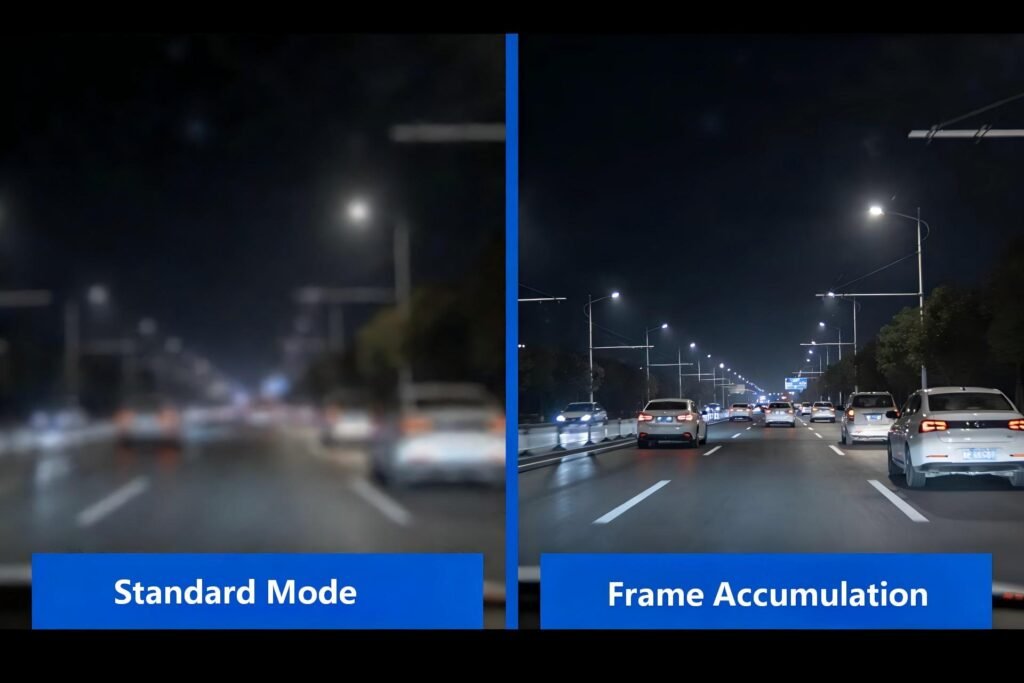
As a product developer at DANSKER, I see how road conditions in the US and Europe change at night. Low-light environments are the biggest challenge for any dash cam. Standard sensors often produce grainy images or motion blur when the sun goes down. To solve this, high-end professional cameras now use Frame Accumulation (FA). This technology does not just “brighten” a picture; it intelligently combines data from multiple frames to create a clean, high-definition result.
In this post, I will explain the engineering behind this feature. We will look at the hardware requirements, the software logic, and why this tech is becoming essential for commercial fleets across the UK and Germany.
1. What is Frame Accumulation (FA)?
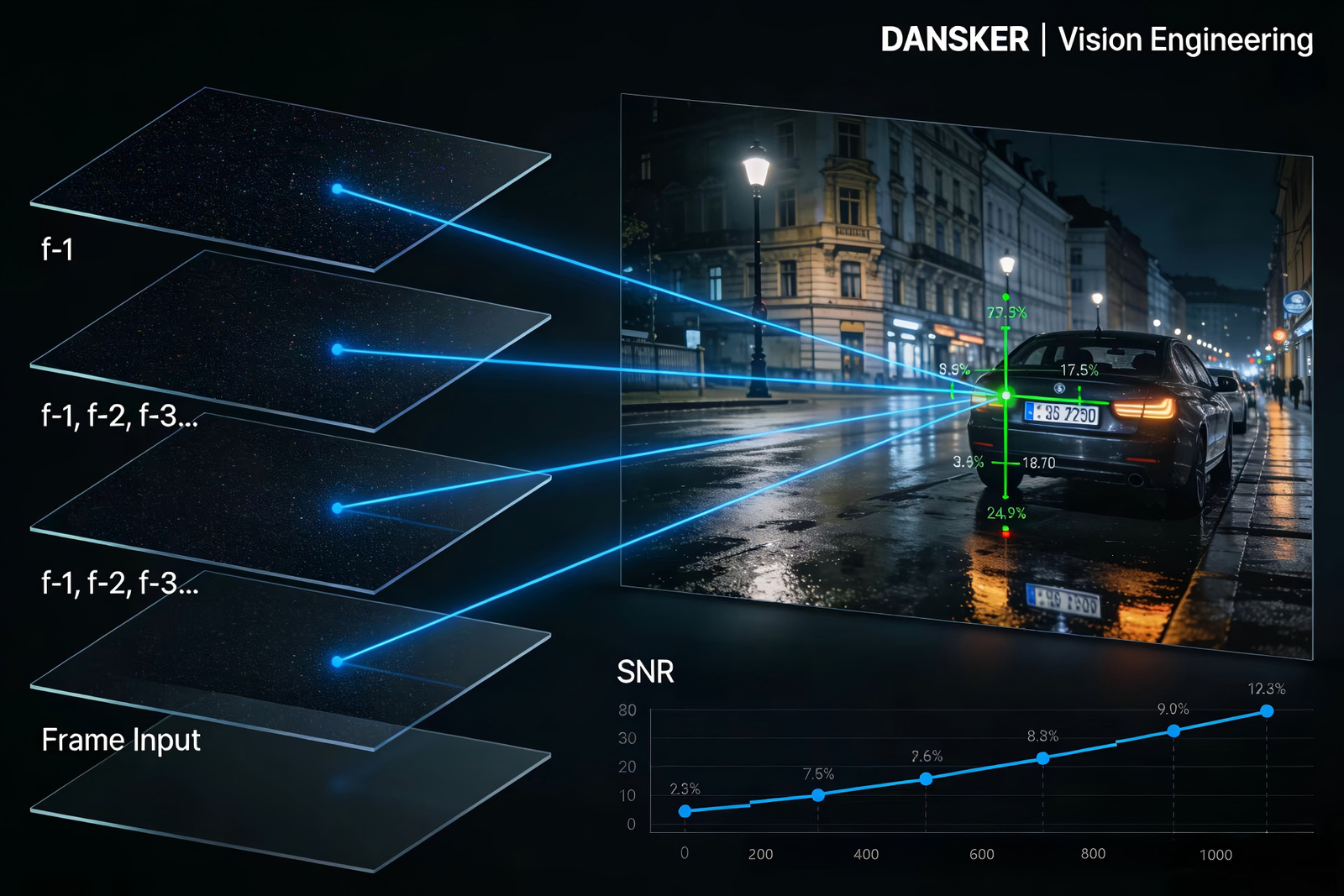
From a professional engineering perspective, Frame Accumulation is a temporal noise reduction (TNR) and sensitivity enhancement technique. Unlike a single long exposure which causes motion blur, FA captures multiple short-exposure frames in rapid succession. The system then mathematically stacks these frames to improve the Signal-to-Noise Ratio (SNR). This allows the camera to “see” in near-total darkness without losing detail to electronic grain.
2. Hardware Requirements for Implementation
To support FA, the hardware architecture must be robust:
- Image Sensor: Requires high quantum efficiency and low read noise. It must support high frame rates (e.g., 30-60fps) to provide enough “sub-frames” for accumulation.
- Gain Control: Precise control over Analog Gain and Digital Gain is vital to prevent pixel saturation before the fusion stage.
- ISP Power: The Image Signal Processor (ISP) needs high throughput to handle real-time pixel-level math.
- Hardwired Blocks: Dedicated hardware for LNR (Lens Noise Reduction), BLC (Black Level Correction), and DPC (Defect Pixel Correction) must clean the raw data before accumulation.
- Optics: A large aperture lens (f/1.6 or better) is necessary to gather enough initial photons.
3. Software and Algorithmic Strategy
Software is where the “magic” happens. We focus on these layers:
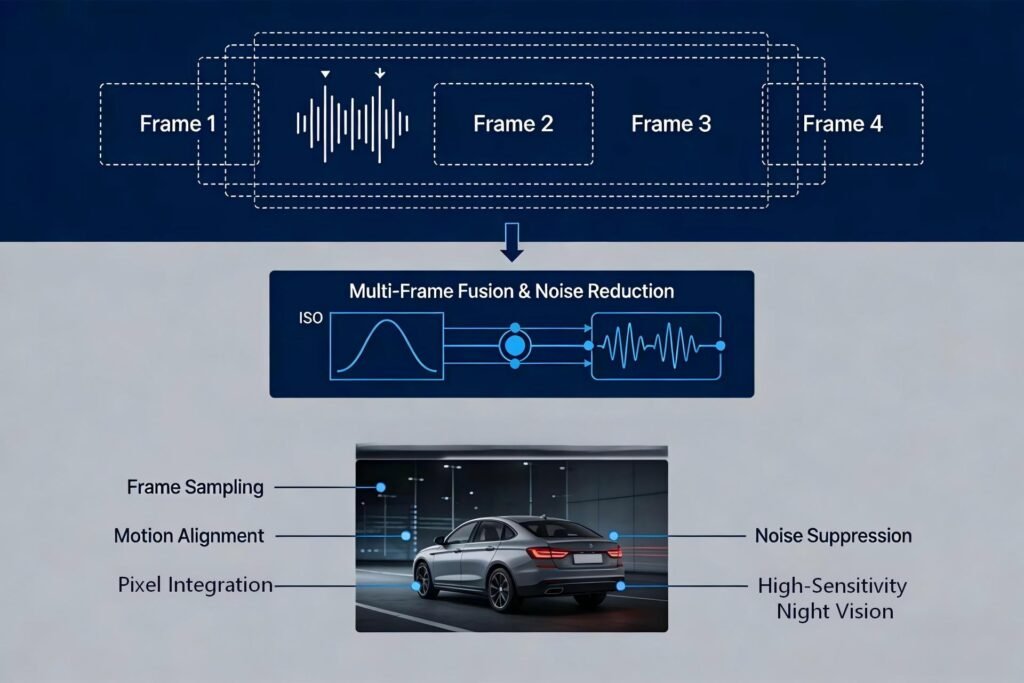
- Frame Alignment: We use Motion Compensation and Global Motion Alignment (GMA). For professional units, we implement Optical Flow or Mesh-Warp to align moving objects across frames.
- Fusion Logic: We apply weighted averaging. Pixels with motion are given less weight to prevent Ghosting Artifacts.
- 3A Integration: The AE (Auto Exposure) and AWB (Auto White Balance) must be aware of the accumulation cycle. If the AE shifts during capture, the merged image will flicker.
- Feature Matching: Algorithms like ORB or SIFT help identify static landmarks to stabilize the background during the stacking process.
4. Application Scenarios
Frame accumulation is a game-changer for specialized fleets:
- Logistics & Long-haul Trucking: Critical for identifying plates on dark highways.
- Emergency & Police: Provides clear evidence during night patrols in unlit areas.
- Engineering Vehicles: Helps document work sites with poor lighting.
- Civilian Premium: For users who demand “Night Vision” quality for parking mode security.
5. Market Data: US & European Adoption (2022-2025)
The adoption of FA technology has grown as ISP costs have decreased. Here is the estimated market share for dash cams equipped with advanced Frame Accumulation in the West:
| Year | Market Share (Professional/High-End Segment) |
| 2022 | ~8% |
| 2023 | ~12% |
| 2024 | ~18% |
| 2025 (Est.) | ~25% |
6. Engineering Reliability and Thermal Management
FA technology puts a heavy load on the processor. Running high-speed accumulation 24/7 generates significant heat. In the automotive world, reliability is everything. We must use Automotive-grade Thermal Pads and aluminum heat sinks. If the ISP gets too hot, it will “throttle” or slow down. This would lead to dropped frames. Our designs ensure the camera stays cool even during long summer drives in Southern Europe or the US.
7. BOM (Bill of Materials) and Cost Structure
Implementing FA increases the BOM cost. You cannot use “budget” components for this tech. It requires premium CMOS sensors (like the Sony STARVIS series) and faster LPDDR4 RAM to store frame buffers. The ISP must also be a high-tier chipset with dedicated NPU or DSP power. These high-quality parts usually place FA-equipped products in the $150+ professional price bracket.
Engineer’s Summary
From a development standpoint, Frame Accumulation is not a marketing gimmick. It is a complex balance of sensor physics, ISP math, and thermal engineering. At DANSKER, we prioritize image data integrity. By stacking frames, we provide drivers with the clarity they need when safety is on the line. As hardware continues to evolve, we expect this technology to become the baseline for all professional automotive recording systems.
DANSKER: Engineering clarity for every mile, even in total darkness.