By [Olivia/DANSKER Team], Senior Marketing & Engineering Specialist
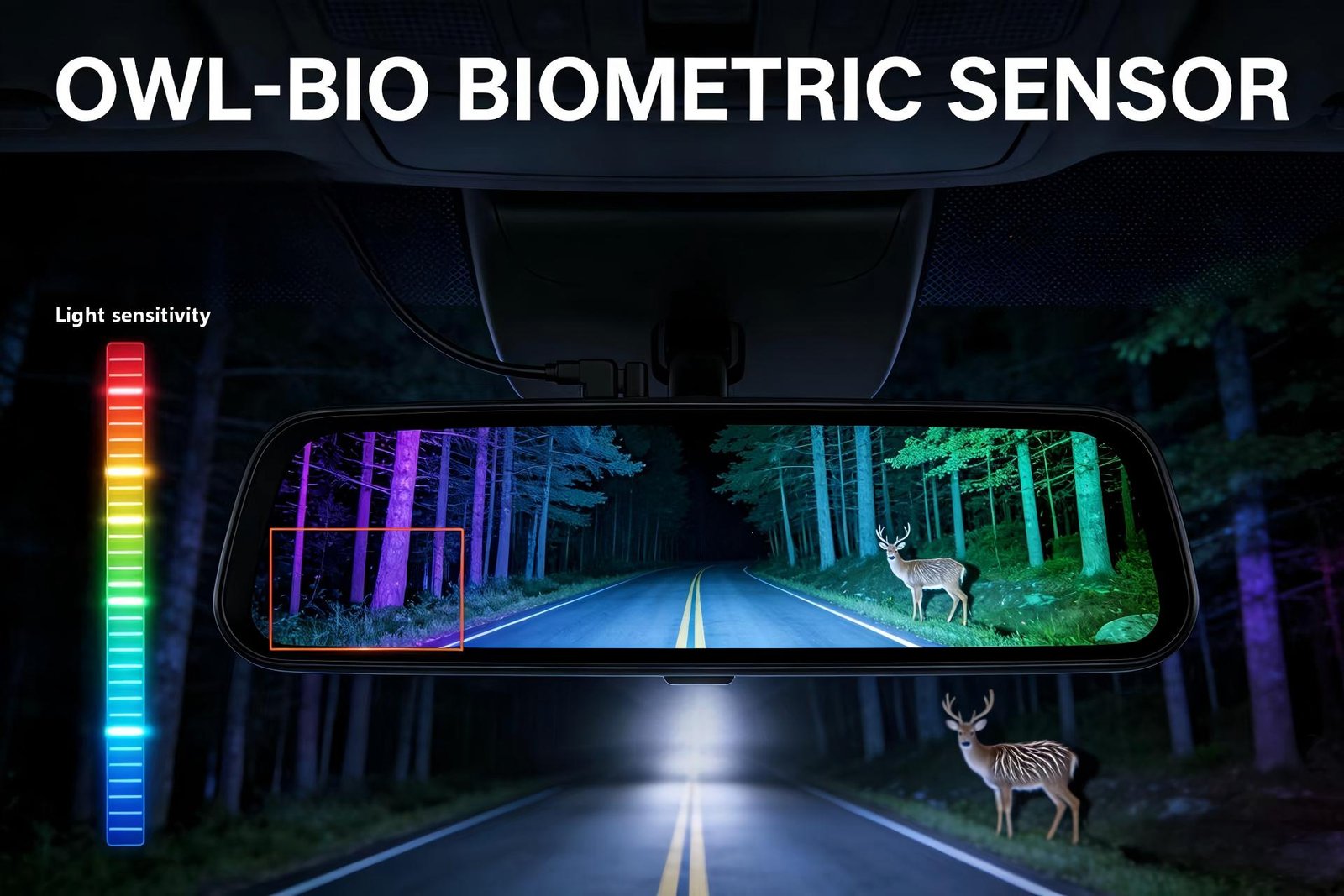
As a senior embedded engineer at DANSKER, I have spent years bridging the gap between automotive hardware constraints and high-end imaging software. In the competitive markets of North America and Europe, “decent” night vision isn’t enough anymore. Professional-grade dash cams are now moving toward Owl-Inspired Bionic Night Vision.
This technology isn’t just a marketing buzzword. It is a sophisticated engineering approach that mimics the biological advantages of a nocturnal predator to solve the “blindness” of traditional CMOS sensors in low-light environments.
1. What is Owl-Bionic Night Vision?
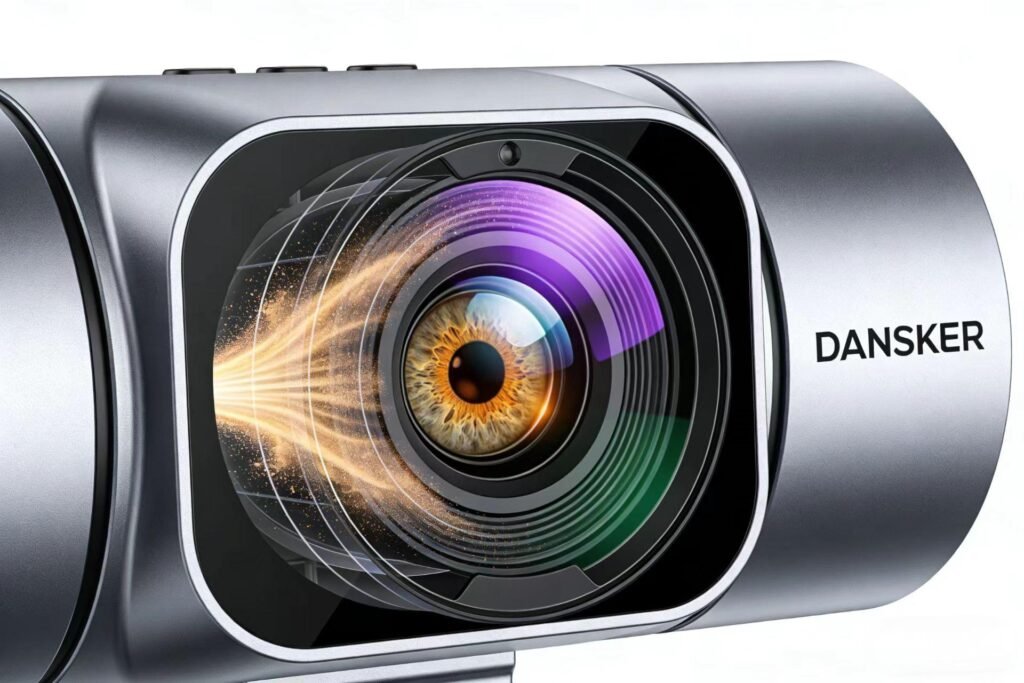
From an automotive imaging perspective, this technology mimics the owl’s eye. It combines a massive “aperture” (light intake) with a highly sensitive “retina” (sensor).
- Ultra-High Light Intake: It utilizes F1.5 or F1.8 large-aperture lenses.
- Multi-Scale Information Fusion: It extracts details from both deep shadows and faint highlights.
- Zero Infrared Pollution: Unlike traditional security cameras, it does not rely on visible red-glow IR LEDs. It captures natural ambient light to maintain true color and prevent “over-exposure” on license plates.
2. Hardware Requirements: The Foundation
To support bionic algorithms, the hardware must be top-tier:
- Large Format Sensors: We use “Big Bottom” sensors (1/1.8″ or 1/1.2″) with large pixels (>2.0u m).
- High Quantum Efficiency (QE): The sensor must convert more photons into electrons, especially in the near-infrared spectrum.
- Optical Precision: Lenses require high-transmittance glass to minimize internal reflections (ghosting).
- Thermal Management: Processing high-frame-rate raw data generates heat. Effective heat sinking is vital to prevent “thermal noise” from ruining the night image.
3. Software & Frame Accumulation
Frame accumulation is the “secret sauce.” It isn’t just stacking photos; it is complex math:
- Bionic Vision Modeling: Software mimics how an owl’s brain filters background noise.
- Motion Detection & Ghosting Suppression: When a car moves, frame stacking can cause blur. We use optical flow algorithms to align frames perfectly.
- Adaptive AE/AWB: The Auto Exposure (AE) must react in milliseconds to oncoming headlights without plunging the rest of the scene into darkness.
4. Optimal Use Cases
This technology shines where standard dash cams fail:
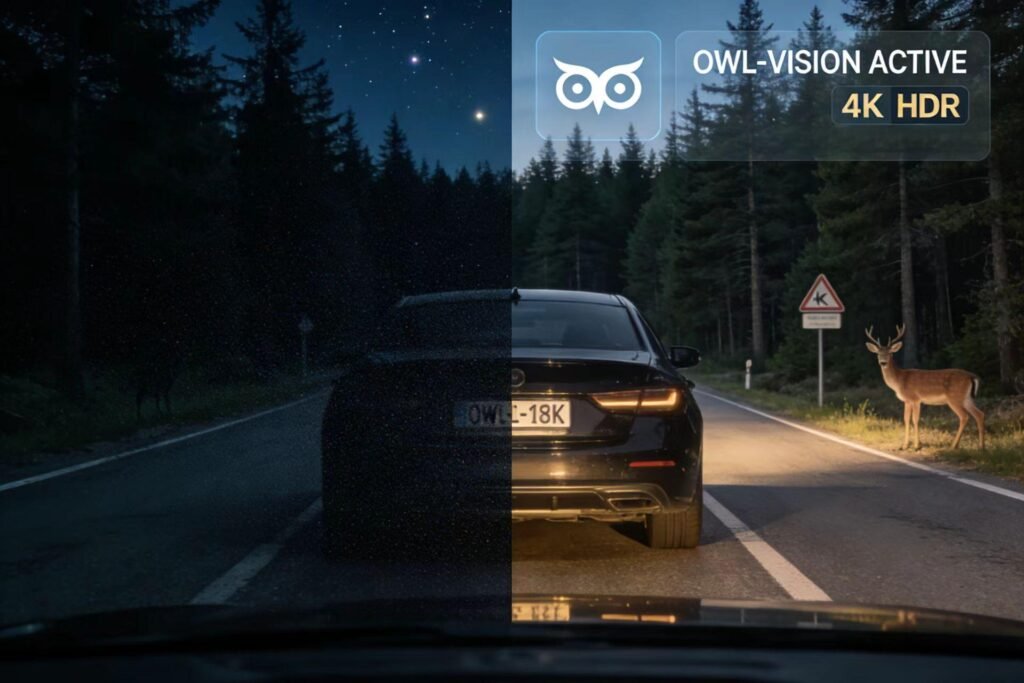
- Total Blackout Nights: Remote rural roads in Scandinavia or the UK with no streetlights.
- Deep Underground Garages: Low-contrast environments where textures usually disappear.
- High-Speed Night Driving: Capturing clear license plates at 100 km/h under moonlight.
5. Value for Fleet Management (BOM Considerations)
For fleet owners, the higher Bill of Materials (BOM) cost is an investment in risk reduction:
- Evidence Accuracy: True-color night video provides better legal evidence than grainy black-and-white IR footage.
- Driver Safety: It acts as an “electronic eye,” helping in post-incident analysis to see what the driver might have missed.
- Reduced Liability: Better clarity means a higher chance of identifying hit-and-run culprits in dark depots.
6. The Three Greatest Engineering Challenges
- SNR (Signal-to-Noise Ratio) Balance: Boosting brightness without introducing “salt and pepper” noise.
- Dynamic Range vs. Motion Blur: Keeping a high frame rate (30/60fps) while trying to accumulate enough light.
- Real-time Processing: Running heavy bionic AI models on an embedded ISP (Image Signal Processor) without overheating.
7. Engineering Reliability
At DANSKER, we ensure these systems pass automotive-grade stress tests. This includes Vibration Resistance for the large lens assemblies and Wide Temperature Operation (-20°C to +70°C). Bionic night vision is only useful if it works consistently during a heatwave or a blizzard.
Core Engineering Takeaways: Owl-Bionic Night Vision
| Core Pillar | Technical Implementation | Engineering & Business Value |
| 1. Bionic Logic | Mimics the owl’s retinal sensitivity using multi-scale information fusion algorithms to extract faint light. | Enables clear imaging in ultra-low light (<0.001 Lux), pushing past the limits of standard CMOS sensors. |
| 2. Hardware First | Utilizes F1.5 ultra-large aperture lenses and “Big Bottom” sensors (1/1.8″ or larger) to maximize Quantum Efficiency (QE). | Increases physical light intake, reducing the need for electronic gain and significantly lowering image noise. |
| 3. Smart Stacking | Implements frame accumulation with motion compensation and optical flow to align moving pixels. | Eliminates “ghosting” and motion blur, ensuring license plates are legible even at night during high-speed driving. |
| 4. True Color | Operates purely on ambient light without the need for 850nm or 940nm infrared (IR) LEDs. | Provides full-color forensic evidence and eliminates “IR glare” or over-exposure on reflective surfaces like license plates. |
| 5. Fleet ROI | Higher BOM (Bill of Materials) investment in high-SNR (Signal-to-Noise Ratio) and HDR components. | Delivers superior legal evidence for fleet managers, reducing insurance disputes and liability costs in dark environments. |
| 6. Thermal Control | Integrated structural heat dissipation for high-performance ISP and AI processing units. | Prevents “thermal noise” and “hot pixels,” ensuring the sensor maintains peak image quality during long-duration operation. |
Final Summary: The Future of Professional Vision
In the world of high-end automotive electronics, Owl-Bionic Night Vision represents a shift from “seeing” to “understanding” the dark. At DANSKER, we do not just boost the brightness; we re-engineer the entire imaging pipeline. By combining massive physical apertures, high-QE sensors, and intelligent frame accumulation, we have solved the oldest problem in dash cam history: the trade-off between noise and motion blur.
For fleet managers and professional drivers in the UK, Europe, and North America, this technology is more than just a feature. It is a critical safety tool. It provides the clarity needed for legal evidence and the reliability required for 24/7 operation. As sensors and processing power continue to evolve, bionic vision will become the standard for any vehicle that operates where the streetlights end.