
By: [William/Senior Engineering Lead at DANSKER]
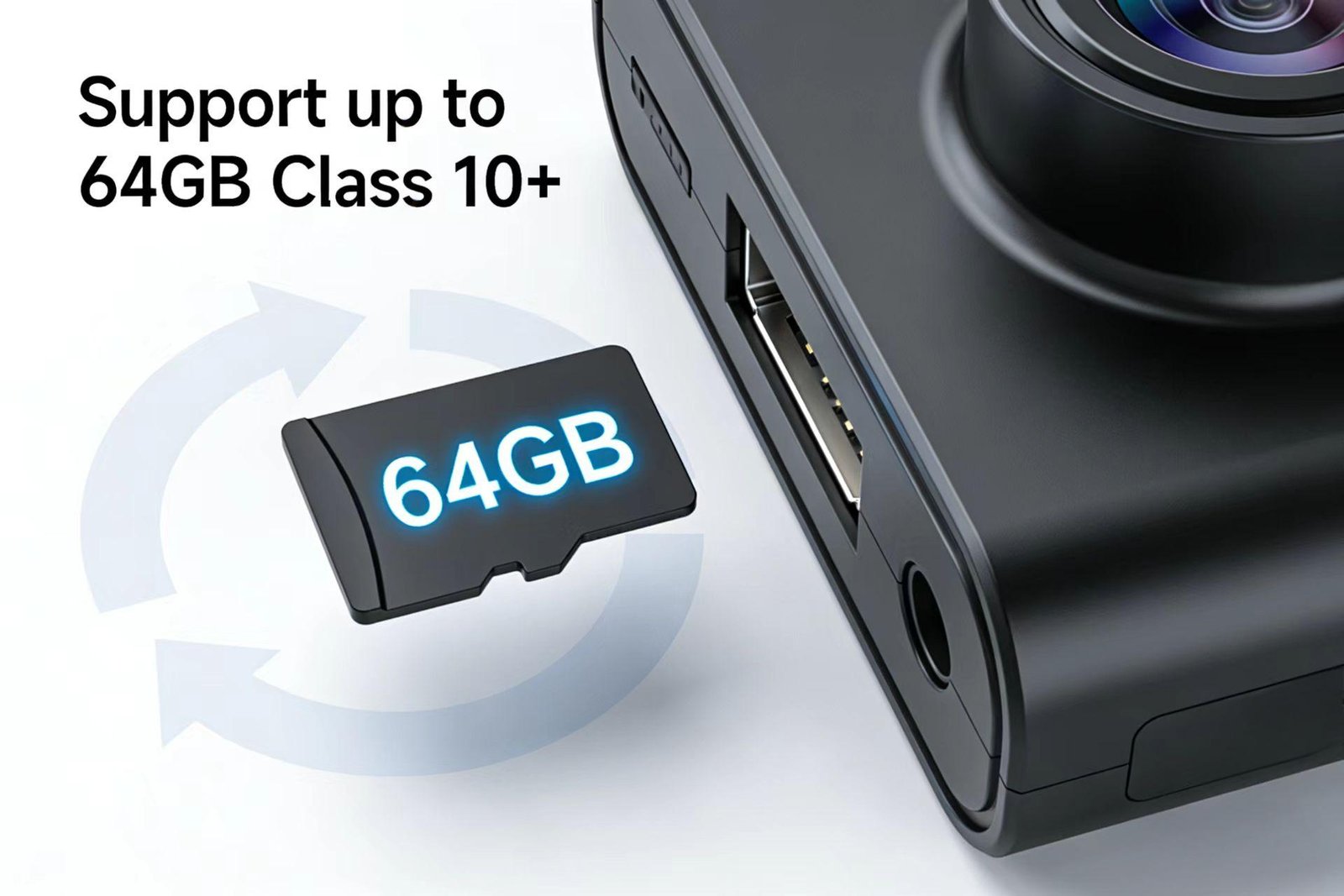
In the competitive landscape of automotive electronics, “entry-level” does not mean “low quality.” For brands like DANSKER operating across Europe and North America, designing a 64GB-limit dash cam is a deliberate engineering choice. This capacity balances cost, hardware stability, and software simplicity. As an embedded systems engineer, I see these devices not as restricted, but as optimized for specific high-duty cycles.
1. The Strategic Logic of the 64GB Limit
For entry-level models, 64GB is the “sweet spot” for several professional reasons:
- Cost Efficiency: At the BOM (Bill of Materials) level, controllers supporting larger SDXC capacities (128GB+) require higher licensing fees and more expensive silicon.
- FAT32 Compatibility: 64GB is the practical limit for stable FAT32 implementation. This file system is universal. It requires zero complex optimization, ensuring the device works instantly on Windows, macOS, and Linux without proprietary drivers.
- Write Cycle Balance: For standard 1080p loops, 64GB provides enough “runway” to prevent premature NAND flash exhaustion while keeping the device affordable.
2. Hardware Considerations: Beyond the Plastic Shell
Supporting a reliable 64GB stream requires rigorous hardware validation:
- SDIO Interface: We tune the SDIO 2.0/3.0 interface for consistent bus speeds. High-bitrate recording creates heat; we must ensure the controller doesn’t throttle during peak summer temperatures in regions like Southern Europe.
- Electrical Reliability: We use shielded TF card slots with gold-plated pins. This prevents signal interference and physical oxidation caused by vehicle vibrations and humidity.
- Thermal Management: Constant writing to a 64GB card generates localized heat. Our PCB layout separates the power management IC (PMIC) from the storage slot to prevent thermal runaway.

3. Software Architecture and Data Integrity
Software is where the “64GB limit” ensures extreme reliability:
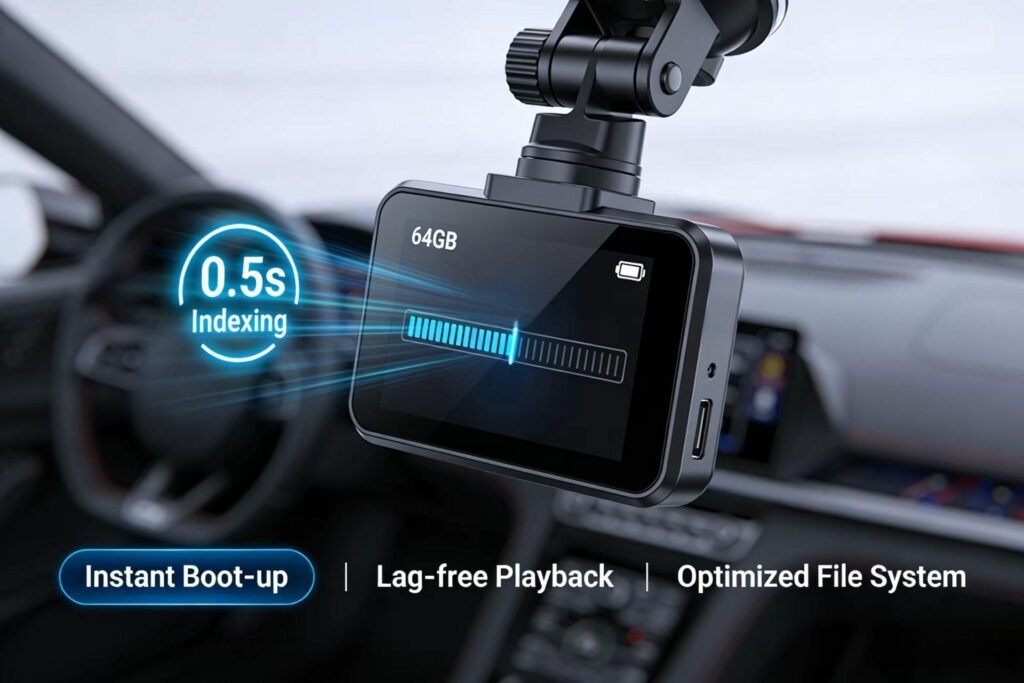
- Loop Recording Mechanism: We implement a strict “First-In, First-Out” (FIFO) logic. Small 64GB partitions allow the file system to index and overwrite data quickly without lagging.
- Power-Loss Protection: Entry-level cams often use small internal batteries or capacitors. Our software uses “Atomic Writing” to ensure that if the engine stops mid-record, the 64GB card doesn’t suffer from file system corruption.
- Wear Leveling: Even at 64GB, our firmware includes basic bad-block management. This spreads the write load across the NAND cells to extend the card’s life.
4. Optimal Use Cases for 64GB Storage
A 64GB limit is ideal for specific vehicle types where data is offloaded frequently:
- Consumer Passenger Cars: Perfect for daily commutes where the driver only needs the last 4-6 hours of footage.
- Taxi and Rideshare: Good for short-shift evidence where data is reviewed daily.
- Note: It is not recommended for long-haul trucking or logistics, where 24+ hours of continuous footage are required before overwriting.
5. Fleet Management: The Value and the Risks
From a fleet perspective, 64GB BOMs offer clear trade-offs:
- The Value: Lower upfront investment per vehicle. It allows large fleets to deploy “evidence-only” units across thousands of cars at a low cost.
- The Drawbacks (The “Cons”): The primary risk is the high overwrite frequency. In a fleet environment, a 64GB card might reach its maximum write cycles in months rather than years. This leads to higher maintenance labor costs for card replacements. Short storage windows also mean critical footage might be deleted before a fleet manager can request the download.
6. Engineering Reliability Assessment
A 64GB-limited dash cam is often more reliable than a poorly optimized 256GB unit. By limiting the capacity, we reduce the complexity of the File Allocation Table (FAT). This leads to faster boot times, fewer “Card Error” prompts, and a more stable recording heartbeat. In the world of automotive safety, “simple” usually means “it works when you need it.”
Engineer’s Summary: From an embedded system perspective, the 64GB limit is a “stability ceiling.” It allows us to use mature, low-latency firmware and cost-effective hardware without sacrificing data integrity. While it is not a “set and forget” solution for heavy industrial use, it offers the highest reliability-to-cost ratio for the mass consumer market. In automotive electronics, the most reliable product is often the one that does exactly what it was designed to do, without unnecessary complexity.