By: [Lucas/Senior R&D Engineer at DANSKER]
A single parking video should never cause a dead battery. Fleet managers across North America and Europe face this exact risk every week. Trucks sit idle over the weekend. Vans wait for hours at border crossings and ports. Drivers park overnight to guard high-value cargo.
In these cases, fleets need 48 to 72 hours of steady video security. But a poorly designed dashcam will drain the starter battery. Then the vehicle will not start on Monday morning.

At DANSKER, we design automotive hardware and embedded firmware to solve this problem. Here are six core engineering points that keep your fleet recording and your engines starting.
1. Wide-Voltage 12V and 24V Power Adaptation
Commercial fleets use different electrical systems. Passenger vans run on 12V systems. Heavy-duty trucks run on 24V systems. A reliable dashcam must handle both platforms automatically.
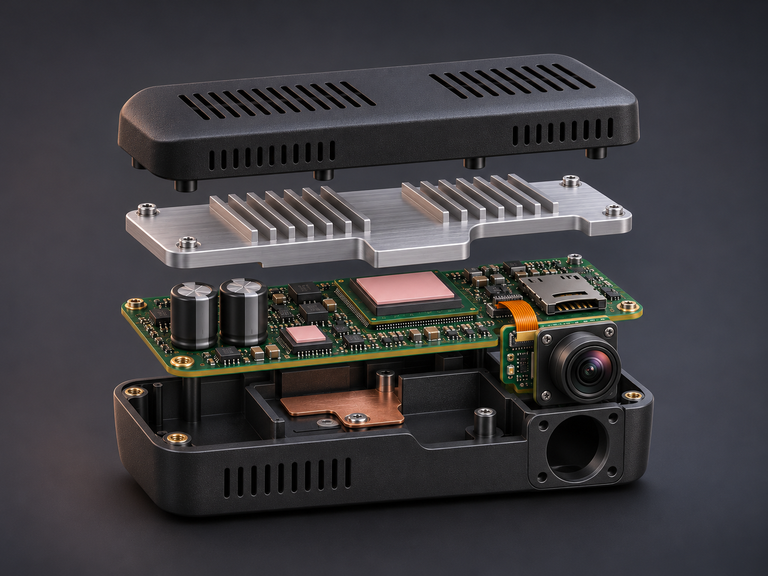
- High-Efficiency Conversion: Our hardwire kits use DC-DC buck converters. These circuits step down 12V or 24V input to a stable 5V output with minimal heat loss.
- Smart Ignition Detection: The hardware reads the vehicle’s
B+(constant power) andACC(ignition) lines. When the driver turns off the key, theACCvoltage drops to zero. Then the dashcam knows the vehicle is parked. - Automotive Surge Protection: Truck electrical systems produce harsh voltage spikes during cold cranking and alternator load dumps. We build our power circuits to meet ISO 7637-2 standards. This protection keeps the camera stable under heavy electrical loads.
2. Accounting for Cold Weather, Battery Aging, and Starting Power
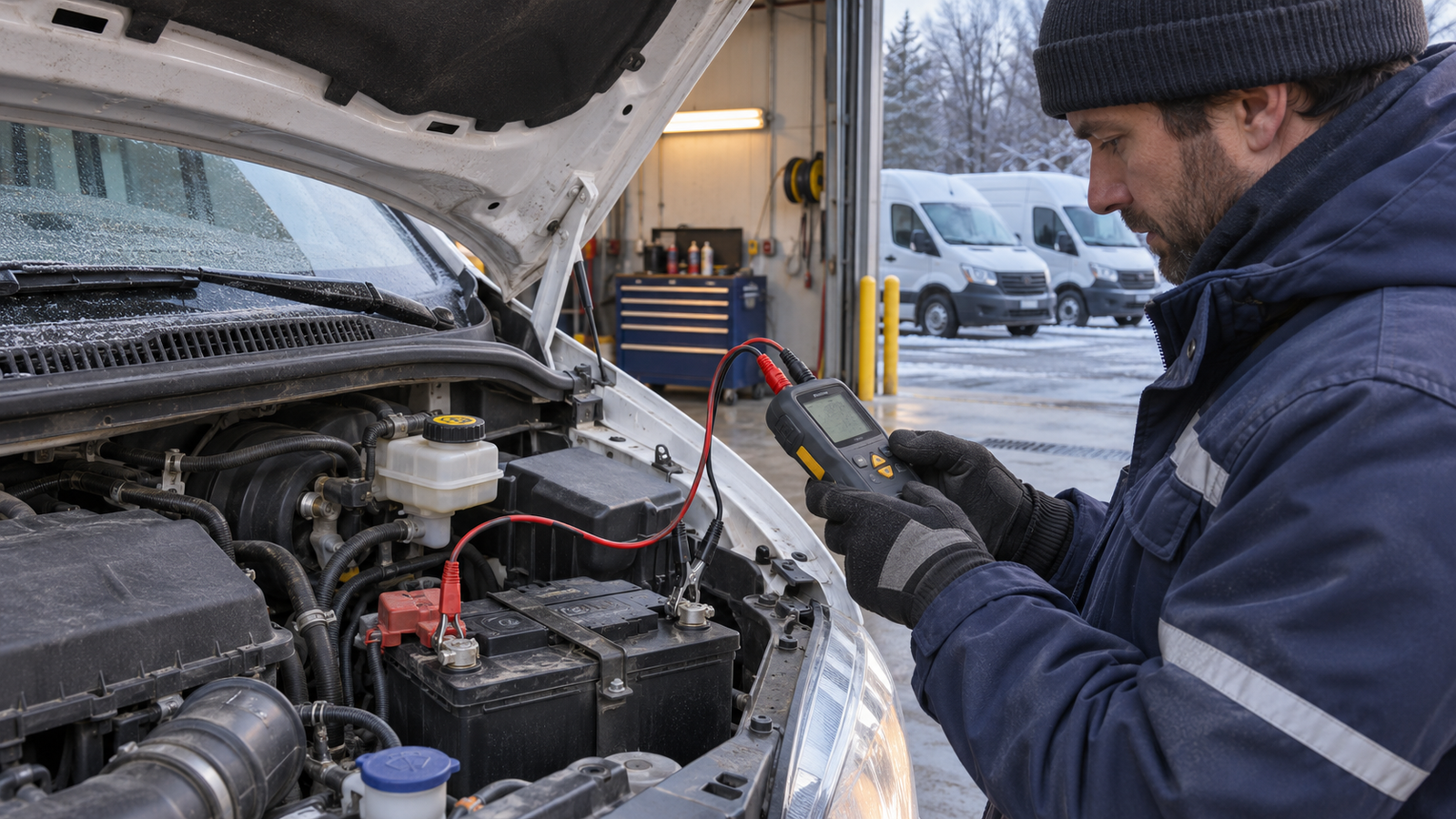
A vehicle battery does not behave the same way all year. In Canada, Germany, and Northern Europe, winter temperatures drop far below freezing. Cold weather slows down the chemical reaction inside a lead-acid battery. At -18°C (0°F), a standard battery can lose up to 50% of its available power. At the same time, thick engine oil makes the starter motor draw much more current.
Battery aging makes this problem worse. An older battery has higher internal resistance and lower capacity. It holds less charge than a new one.
Because of this, a dashcam cannot use a simple power budget. The system must always leave enough State of Charge (SoC) to meet the engine’s Cold Cranking Amps (CCA) demand. If the camera ignores winter weather and battery age, the truck will fail to start.
3. Smart Parking Mode Switching for 48–72 Hours
Standard continuous recording uses too much power. A typical dual-channel dashcam draws 300mA to 500mA while recording. Over 72 hours, that draw takes 21Ah to 36Ah from the battery. That is enough to drain a passenger vehicle battery completely.
To reach 48 to 72 hours safely, our embedded software uses three power tiers:
| Power Tier | How It Works | Power Benefit |
| Low-Bitrate / Time-Lapse | The camera drops to 1–2 frames per second and turns off the screen, Wi-Fi, and GPS. | Cuts power draw by 40% to 50%. |
| Low-Power Sleep Mode | The main processor shuts down completely. Only a low-power microcontroller (MCU) stays awake. | Quiescent current drops below 5mA. |
| Scheduled Switching | The camera runs Time-Lapse for the first 12 hours, then drops into Sleep Mode for the rest of the weekend. | Balances active port security with long-term battery life. |
4. Fast Event Wake-Up Without Missing Evidence
Sleep Mode saves a lot of power. But it creates a new challenge. The camera must wake up fast enough to catch a hit-and-run or a cargo break-in.
We solve this with dedicated hardware triggers:
- 3-Axis G-Sensor: This low-power sensor watches for impacts or vehicle movement.
- Millimeter-Wave Radar: On higher-end units, radar watches for people moving near the cargo doors.
When a sensor detects a threat, it sends an interrupt signal to the MCU. Our firmware runs on a lightweight Real-Time Operating System (RTOS). The camera boots up and starts recording in under one second. This fast wake-up saves battery power during quiet hours, and it still captures clear video evidence when an incident happens.
5. Dynamic Low-Voltage Protection (LVP) and Hysteresis
Low-Voltage Protection (LVP) is the final safety net for your starter battery. The hardwire kit monitors the vehicle’s battery voltage in real time. When the voltage drops to a preset limit, the kit cuts power to the dashcam.
A fixed 11.8V cutoff is too low for an aging battery in winter. So DANSKER hardwire kits offer selectable thresholds:
| Vehicle System | Standard Cutoff (Summer / New Battery) | Safe Cutoff (Winter / Aged Battery) |
| 12V System | 11.8V – 12.0V | 12.2V – 12.4V |
| 24V System | 23.6V – 24.0V | 24.4V – 24.8V |
We also program voltage hysteresis into the LVP logic. When the kit cuts power, the battery voltage naturally bounces back up slightly. Without hysteresis, the camera would turn back on, drain the battery again, and repeat the loop. Our firmware waits for a steady voltage drop before shutting down, and it stays off until the driver starts the engine.
6. Evaluating Fleet Costs: Monitoring Time, Battery Wear, and Downtime
Fleet managers need clear numbers to control costs. Deep-discharging a standard starter battery shortens its lifespan. Replacing a heavy-duty commercial battery costs hundreds of dollars. Calling a roadside jump-start truck costs even more. A delayed cargo delivery can cost thousands in penalties.
With predictable power management, fleets can calculate their exact risk. You can set a 12.4V (or 24.8V) cutoff and a 48-hour timer to guarantee zero dead batteries. You know the camera will stop before it harms the battery’s cycle life.
Fleet Recommendation for Extreme Cold: If your fleet needs non-stop 72-hour continuous recording in freezing weather, we recommend an auxiliary LiFePO4 dashcam battery pack. This external pack charges while the truck drives, and it powers the dashcam while parked. It isolates the vehicle’s starter battery completely, so you get full video security with zero risk of downtime.
Engineering Summary
Reliable 48-to-72-hour parking security is not just a simple software feature. It is a complete automotive power management system.
Hardware circuits must handle 12V and 24V trucks while blocking harsh voltage spikes. Embedded firmware must drop quiescent current below 5mA and wake up in under one second. Voltage protection must use hysteresis and adapt to cold weather and battery age.
At DANSKER, we bring these hardware and software rules together. Fleets get clear video evidence for every incident, and drivers get a reliable engine start every morning.